This week the #puzzle is: How Fast Can You Surf? #trigonometry #maximum #differentiation
A surfer is riding along a crest of a sinusoidal wave given by the function y = 2·sin(x−t), where y is the height above sea level in meters, x is horizontal position in meters, and t is time in seconds. Based on this, the surfer knows that her speed—and the speed of the wave—is 1 meter per second.
But hold on—it appears that another wave is approaching from the opposite direction. This wave has half the amplitude but twice the speed: y = sin(x+2t).
The two waves, the forward and the backward, ”interfere,” meaning they combine. In other words, the height of the water at position x and time t is given by y = 2·sin(x−t) + sin(x+2t). Nevertheless, the surfer stays atop a crest of the combined wave.
As the wave moves along, what are the surfer’s slowest and fastest [horizontal] speeds, in meters per second?
And for extra credit:
The surfer rides the crest of the combined wave, y = 2·sin(x−t) + sin(x+2t), for a very long time.
What is her average [horizontal] speed, in meters per second?
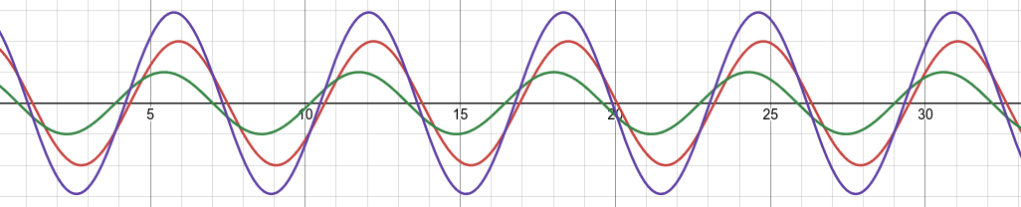
Method 1: Code it up in Desmos, just to see what’s happening. Huh! The combined wave (purple) has a funny start and stop pattern, where horizontal movement seems to stop entirely, while the wave grows in size.
Method 2: Math. Everybody seems to agree, when = speed of wave (or in out case, speed of crest), = wave length and = wave frequency:
This can’t quite fit our situation, because the speed obviously varies, while the wave length and the wave frequency stay constant.
Let’s just look at a single moment.
When does this function have a max or min?
And this max/min is:
Yeah, actually a max. So at time 0, the crest (or one crest) is at .
Let’s try this with a more general time instead.
Chain rule:
Looking for a max/min:
Identities:
I try out this function in Desmos. It actually follows the minimum, but the math is the same.
So far so good! A visual inspection shows these values for the speed of the crest.
Doing a test where I look at how much the crest moves over a short amount of time, , 0 is confirmed. And the max value seems to be 4!
Method 3: Write a program. This simply supplies Desmos with data to show the path of the crest and a curve for the speed of the crest. As it uses the same math, it spits out the same results.
Result: .
And for extra credit:
This is suspiciously easy.
Average speed = total distance / total time. From reading Desmos again, measuring between 2 maxima:
Method 2: Every time fish 1 goes by at speed 1, fish 2 goes by at speed 2 twice. The average of 1, 2 and 2 is 5/3 or 1.67.
Result: 1.67.
And for extra credit:
Method 1:
Result 1................:    1.2533140
Result 1................:    1.2533792
Result 1................:    1.2532510
Result 1................:    1.2533647
Result 1................:    1.2532415
======================================
Number of loops.... 5 * :    100980391
Target deviation........:    0.0001000
Deviation so far........:
................result 1:    0.0000632
======================================
Final result 1..........:    1.2533101
                         +/- 0.0000632
I ask every episode: Why do I love trek? Most episodes demonstrate some of the reasons.
Number / Name
Why I liked it
401 / 4:1 “Kobayashi Maru”
Trying to save everybody. Bad thing? Accept the non-perfect solution?
402 / 4:2 “Anomaly”
Visual of zero gravity. Remember to say “Well done”. Admit your trauma.
403 / 4:3 “Choose to Live”
A “soul” getting a new body.
404 / 4:4 “All Is Possible”
Therapy. Leader + teacher. Topic: Working together. Negotiation, mediation. When a career change is the right thing.
405 / 4:5 “The Examples”
In mortal danger, everybody should be rescued. The therapist might need therapy too. Survivor’s guilt. The right to choose suicide.
406 / 4:6 “Stormy Weather”
Helping a new AI deal with feelings.
407 / 4:7 “…But to Connect”
Trying to figure out the exact nature of an AI. Trust. Communication.
408 / 4:8 “All In”
A poker game.
409 / 4:9 “Rubicon”
Handling that personal ties to “the enemy” = disqualification. “Resting” the mind before a difficult mission.
410 / 4:10 “The Galactic Barrier”
Discussing parenting with your child.
411 / 4:11 “Rosetta”
Decryption! Communication! Balanced response, not just criticism. A headler in need of healing.
412 / 4:12 “Species Ten-C”
Learning a new language. Math!
413 / 4:13 “Coming Home”
Reasons matter.
It makes sense to me, that a species might not look like a human, and that a translator might be needed. Unfortunately this broke “show, don’t tell” big time, and every aspect of the threat felt very abstract. (And “the enemy blew up my planet” is a cliche by now, yes?)
This week the #puzzle is: Can You Frame the Triangle? #trigonometry #triangle #circumscribe #montecarlo #coding #minimum #average
Congratulations—you just won your school’s tabletop football championship! You flicked your lucky paper football to victory countless times, and would now like to frame it for posterity.
The football is an equilateral triangle with a side length of 1 inch. What is the side length of the smallest square frame that will contain the football?
And for extra credit:
To add a little excitement to the framing process, your new plan is to spin the triangular football by a random angle, and then frame it with a square that is not rotated. That is, the square consists of two perfectly horizontal sides and two perfectly vertical sides.
On average, what can you expect the side length of the smallest resulting square frame to be?
Checking… Yeah, this is a triangle, where all 3 sides have the same length.
My sense is, that this square will have side length 1 inch. But let me just check. Oh, that’s not right. Messing around with Desmos gives me something like 0.966. This is achieved, when 1 side of the triangle has exactly a 45 deg angle on the horizontal and vertical axes. This was actually fun. To go from an angle to a triangle, to a circumscribed rectangle, to a circumscribed square. Visit Desmos to see an animation!
So that’s method 1. Method 2 is monte carlo (where it’s kind of overkill to have a variance check, I’m looking for a minimum). Result confirmed.
0.966 inches.
And for extra credit:
The easiest is to let the monte carlo register a lot of squares and take the average. (It was already registering a lot of them and taking the minimum.)
======================================
Number of loops.... 5 * :        32010
Target deviation........:    0.0001000
Deviation so far........:
................result 1:    0.0000029
................result 2:    0.0000886
======================================
Final result 1..........:    0.9659279
                         +/- 0.0000029
Final result 2..........:    0.9886172
                         +/- 0.0000886
0.989 inches. This makes sense, as being between the minimum and 1.
This week the #puzzle is: Can You Swap the Cups? #average #ExpectedValue #montecarlo #coding
My friend has three cups, labeled “A,” “B,” and “C” in a row. She randomly picks two different cups and swaps their positions. Then she does this again and again, picking a random pair each time, until all three cups are back in their original order. For example, here is one such sequence of swaps:
– A, B, C (original) – C, B, A (first and third were swapped) – B, C, A (first and second were swapped) – B, A, C (second and third were swapped) – A, B, C (first and second were swapped)
In this example, the cups returned to their original order after four swaps.
On average, how many swaps would you expect until the cups return to their original order?
And for extra credit:
In total, there are six possible orders of the cups. Without any swaps, one of those orders (A, B, C) has already been achieved.
On average, how many swaps would you expect until the remaining five orders (and thus, all six) are also achieved?
I didn’t read the instructions correctly. I thought the 1st quiz had 4 questions, not 3.
I did notice other answers using strategies involving “if the 1st correct answer was A, there’s a slightly better chance the 3rd answer is A”, but I didn’t understand why this could be until the official answer was out.
Method 1: Ye olde monte carlo. This time I play around with variance and deviation calculations, so that the program will keep going, until I get the number of decimals, I want.
======================================
Number of loops.... 3 * :    102970102
Target deviation........:    0.0010000
Deviations so far, res 1:    0.0003204
======================================
Final result 1..........:    5.9999515 +/-  0.0003204
Result: 6.00. Maybe simply 6?
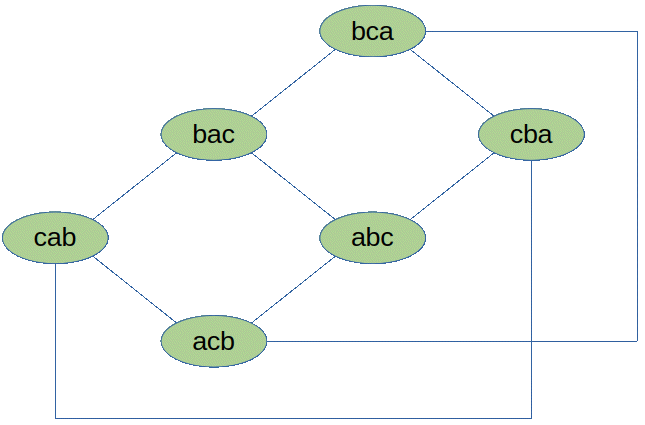
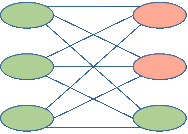
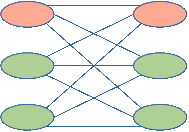
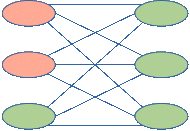
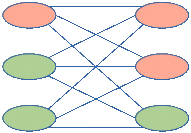
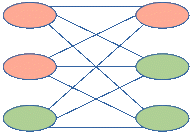
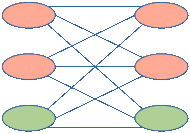
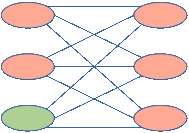
Method 2: Look closely at what’s going on. This is a diagram of all states and all changes between states.
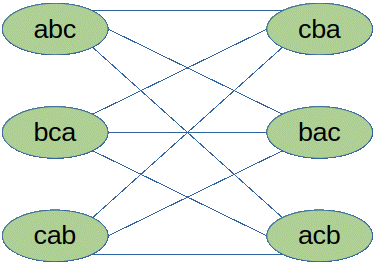
And that’s a little… Wait, that can actually be shown in a better way.
“abc” is the beginning state. Each line represents 1 swap. How many steps does it take to get from a state back to the beginning state?
If we’re already in the beginning state, 0 steps.
Here I’ve called “a state on the left that isn’t the beginning state” “left”. 1/3 of the time, take 1 step and get back to the beginning state. 2/3 of the time, take 1 step and reach a left state. And actually, let’s call all the states on the right “right”.
In a left state, I have to take 1 step to get to a right state. Let’s solve this.
There’s always a 1st step, away from the beginning state. And then it will take 5 further steps/swaps to get back. That’s 6. Result confirmed.
And for extra credit:
Same program, I just use the data slightly differently.
======================================
Number of loops.........:    102970102
Target deviation........:    0.0010000
Deviations so far, res 2:    0.0005949
======================================
Final result 2..........:   12.2144230 +/-  0.0005949
Result: 12.21 – 12.22.
Method 2. Let me see. First some new notation.
How many steps left on average, when there’s x already visited states on “my” side (WLOG the left side) of the diagram and y on the other?
If both sides are already full, there are 0 steps left.
This is the same situation as the fiddler. Being in one of the lower states on the left side and aiming for (WLOG) the top state of the left.
This was the intermediate situation above, taking 1 step away from the coveted state.
Let’s just summarize.
0
5
n/a
6
n/a
n/a
n/a
n/a
n/a
Some of these situations are impossible. Typically, I can’t have visited 2-3 states on one side of the diagram and 0 on the other. Also, x can’t be 0, because I am in a state, that is therefore visited.
Right!
Let’s solve this.
And:
And:
Let’s summarize again.
0
5
8
n/a
6
8
n/a
9
n/a
n/a
n/a
n/a
Solving.
And:
And summarizing:
0
5
8
n/a
6
8
n/a
9
n/a
n/a
n/a
n/a
Almost there!
Solving:
0
5
8
n/a
6
8
n/a
9
n/a
n/a
n/a
n/a
Whew! Only one more.
Solving:
This was the number, we were looking for. And it confirms the previous result.
Ehm. Yes. I think part of the solution is to look at a diagram of how the states change.
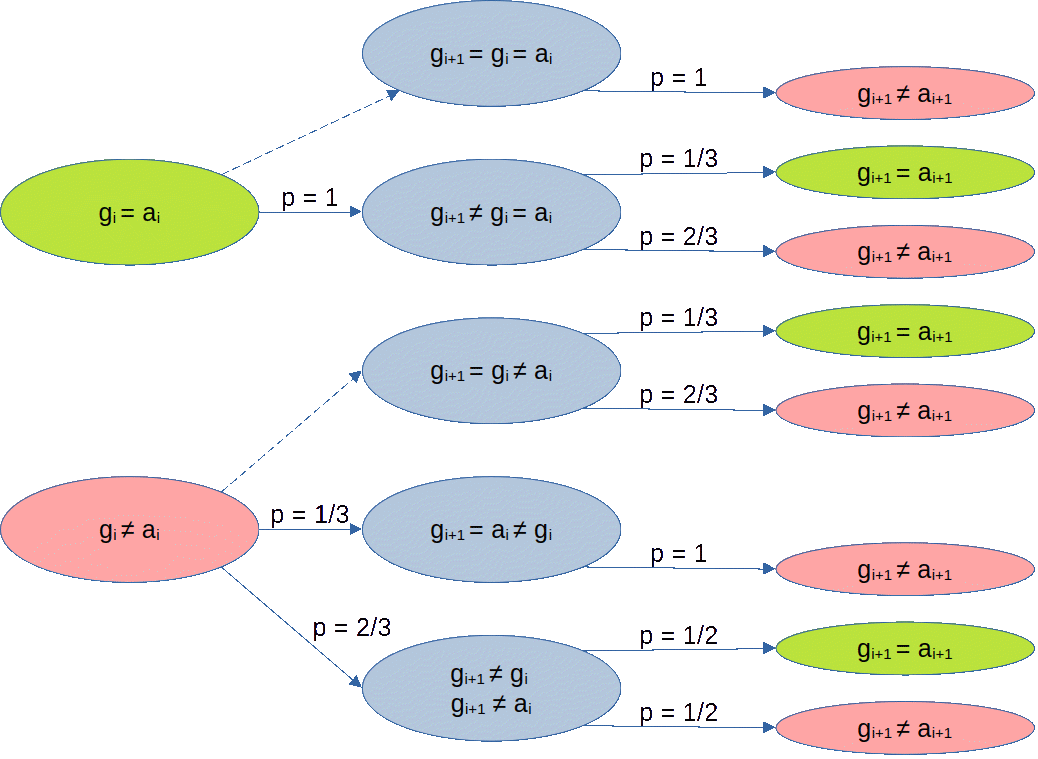
At any given point in the quiz, gi is a guess and ai is the correct answer to the question qi. I can choose the dashed strategy, which is to guess the same again, or I can guess something else.
At q1, Charlie knows a1 and therefore must guess g1 = a1, that is the best strategy. So now Charlie’s in the green bubble on the left, and he knows it. Therefore the best strategy for q2 is not the dashed “choose the same again” strategy. With p = 1/3 he happens to guess the right answer and ends up in a new green bubble. With p = 2/3 he doesn’t and ends up in a red bubble. He doesn’t know which one happened, so for the next step of the strategy, his choices are “guess the same again” or “don’t guess the same again”.
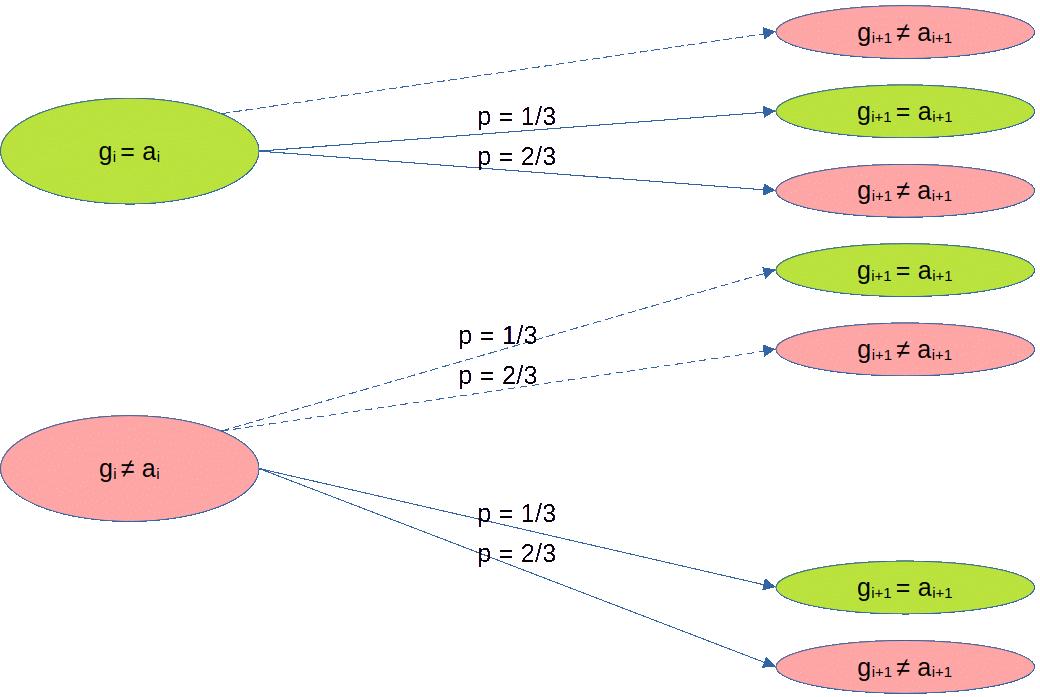
Hang on. Let’s just simplify that diagram.
Nice symmetry, if you don’t use the dashed lines, regardless of whether Charlie guessed right or wrong, there’s p = 1/3 of guessing correctly the next time.
Charlie’s strategy should begin with “g1 = a1, g2 ≠ g1“. But then what?
Turns out the best strategy is to never choose the same twice in a row. And with this strategy, Charlie can expect 2 correct answers. If I have done all my calculations correctly… And even modelled the problem correctly.
Okay, let me try method 2. Monte Carlo. And this one gives… Something like 1.84. I have no idea why. And I do trust my Monte Carlo more. So that will be my official answer.
Result: 1.84.
And for extra credit:
This is strictly a guess on my part. But I think the best strategy is to cheat on question 4 and then construct the rest of the guesses from that. This gives 1 correct answer in the middle and an expectation of 0.84 correct answer above and below. 2.68 correct answers in all.
This week the #puzzle is: Can You Spell Like a Queen Bee? #probability #counting #period #pattern #repetition
… If you find all the words in a given day and therefore accrue the maximum number of points, you earn the “Queen Bee” ranking. Meanwhile, accruing smaller point totals earns you other rankings. In particular, the point cutoff for “Genius” is 70 percent of the maximum number of points, rounded to the nearest whole number. While the cutoff for “Genius” is clearly displayed in the puzzle, the “Queen Bee” point total is not readily shown.
Of course, this maximum total can be approximated by dividing the “Genius” cutoff by 0.7. Even so, the total may be ambiguous, since multiple “Queen Bee” values can result in the same “Genius” cutoff.
Suppose a given round of Spelling Bee has some very large, randomly chosen point total. What is the probability that this total can be precisely determined (i.e., without any ambiguity) from its point cutoff for “Genius”?
And for extra credit:
Let’s put the rank of “Genius” aside. Here are some other ranks you can attain in Spelling Bee:
– Amazing (if you get 50 percent of the maximum, rounded to the nearest whole number) – Great (40 percent) – Nice (25 percent) – Solid (15 percent) – Good (8 percent) – Moving Up (5 percent) – Good Start (2 percent)
Suppose a given round of Spelling Bee has some very large, randomly chosen point total. What is the probability that this total can be precisely determined from these cutoffs combined (i.e., from “Good Start” through “Amazing,” inclusive)?
Method 1: Go through a lot of large queen bee values, and check whether a queen bee value either 1 higher or 1 lower would give the same genius cutoff. I do this with a program.
Result: 0.4.
A wonderfully exact number!
Method 2: Examine what’s actually happening.
Queen bee
10000
10001
10002
10003
10004
10005
QB * 0.7
7000.0
7000.7
7001.4
7002.1
7002.8
7003.5
Genius
7000
7001
7001
7002
7003
7004
Queen bee
10006
10007
10008
10009
10010
10011
QB * 0.7
7004.2
7004.9
7005.6
7006.3
7007
7007.7
Genius
7004
7005
7006
7006
7007
7008
Every time the queen bee value is divisible by 10, the genius cutoff won’t be rounded at all.
Every 10 queen bee values result in the same roundings.
Adding 1 to the queen bee value = adding 0.7 to the unrounded genius cutoff.
From 10000-10009 there are 10 queen bee values, but only 7 genius cutoffs, 7000-7006. In 3 cases rounding a number means hitting the same genius cutoff as the queen bee value below (7001.4, 7004.2, 7006.3). This creates 3 pairs of ambiguous cutoffs, or 6 ambiguous cutoffs.
How often does all this result in an ambiguous genius cutoff? 6/10 times.
So how often do we not have ambiguity? 4/10 times.
I wonder whether probability and statistics have something like programming’s one off error? But instead it’s “the probability is 1 – p, not p”.
And for extra credit:
Method 1: Basically the same as method 1.
Result: 0.7.
Method 2:
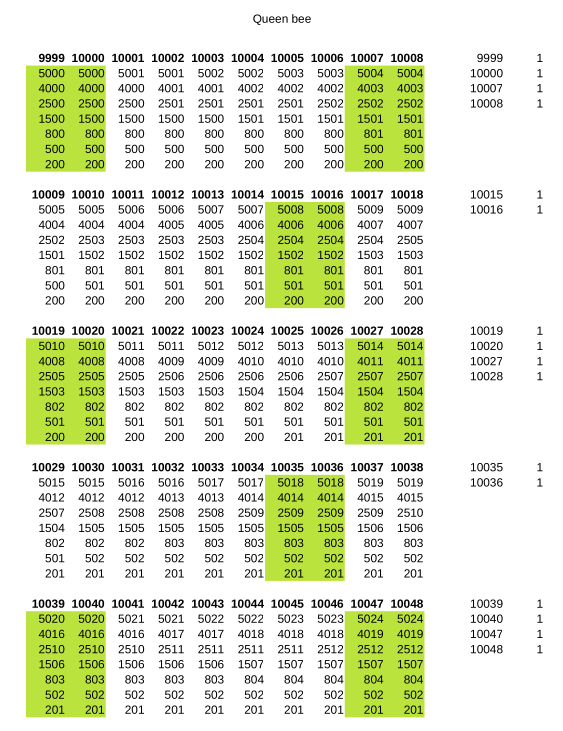
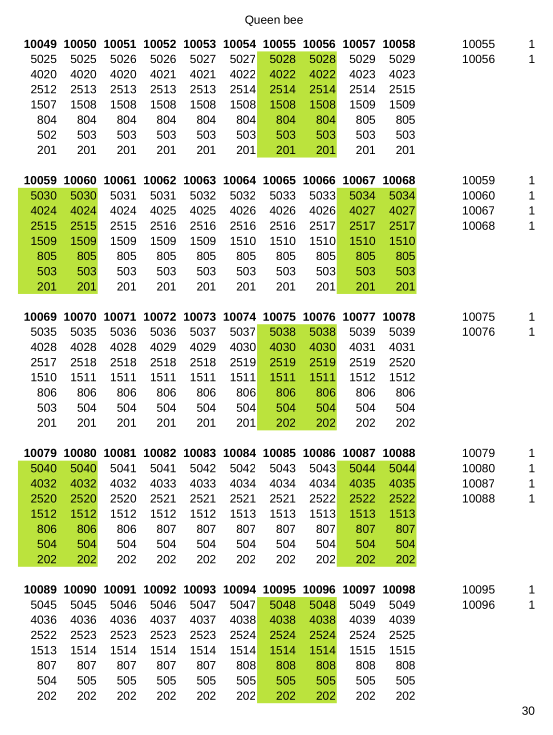
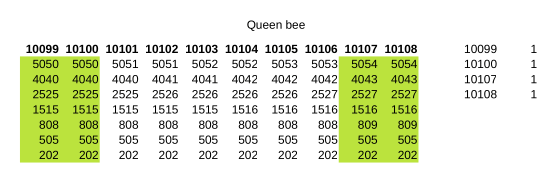
Because one of the multipliers is 0.02 and another 0.05, this pattern will probably repeat every 100 possible queen bee values. Let’s look at it.
At a glance, the pattern repeats every 20. Ambiguous? 6/20. Unambiguous? 14/20. Result confirmed.