This week the #puzzle is: Can You Design a Quadrangular Logo? #area #average #ArithmeticSequence
| Inspired by Delta Airlines, you and a graphic designer colleague are crafting a new logo for Fiddler Airlines. Your colleague starts with an equilateral triangle with a side length of 1 unit. Next, you pick a random point inside the triangle, giving you four points: the three corners of the triangle and this fourth point inside. There are several (simple) quadrilaterals that can be drawn whose four vertices are these four points. Your colleague picks one of these quadrilaterals at random, with each having an equal probability. This quadrilateral will be the new logo. |
| On average, what can you expect the area of the quadrilateral to be? |
And for extra credit:
| While picking random points inside the equilateral triangle with side length 1, you and your colleague notice that some points are “special.” When one of these special points is connected with the triangle’s three vertices, it creates three smaller triangles whose areas form an arithmetic sequence. |
| After further investigation, you realize these special points all belong to a locus, the total length of which is L. What is this length L? |

Can You Design a Quadrangular Logo? 
Solution, possibly incorrect:
Mumble, mumble, equilateral = all 3 sides have the same length. Mumble, mumble, simple = no crossings or holes. So I guess this means I always get my quadrilateral by replacing 1 side of the triangle with a trip to the new internal point. I’m not sure it’s possible to create a non simple polygon this way. Let me mess around with this a bit. (Including some messing around on Desmos.)
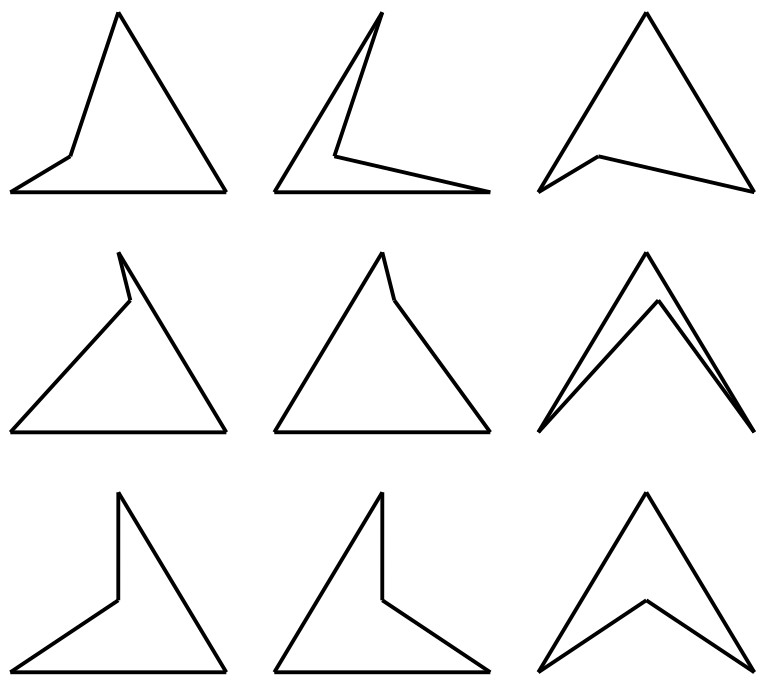
So each row here has the same internal point, and then each quadrilateral represents a choice of which side of the triangle to replace.
Method 1: I guess I’m ready for some monte carlo now. Using a fun method for finding an internal point randomly. I can use 2 sides of the triangle as vectors, and an internal point will be 1 point + some part of each vector, where the 2 parts / fractions have a sum of 1 or less.
Number of loops.... 5 * :      3162523
Target deviation........:    0.0001000
Deviation so far........:
................result 1:    0.0000757
======================================
Final result F, 1.......:    0.2886861
                         +/- 0.0000757
Method 2: Meanwhile I’ve figured out how to do this another way.
The area of the triangle is:
This area is also the sum of the areas of the smaller 3 triangles inside, using the internal point:
When I’m choosing a quadrilateral, I’m also choosing 2 of the small triangles. So the resulting area will be a sum of the corresponding areas. I’m choosing between these areas:
Just looking at the case with this particular random internal point, what is the average area:
Assuming a random process chose the same internal point 3 times and then chose each possible quadrilateral 1 time each, the average area for just these 3 choices would be about 0.2887. And it doesn’t matter where the internal point is, this always holds.
Result confirmed! Area is 0.2887.
And for extra credit:
Mumble, mumble, arithmetic sequence = the distance between 2 neighboring elements in the sequence is constant. So we’re talking about a sequence like this:
Method 1: While my monte carlo is looking at random quadrilaterals, I will also peak at the areas and save good internal points. Then I will print out those points and transfer them to Desmos, to see what we’re talking about.
I’ve already guessed the point in the middle of the triangle will be a part of the goodness, as all 3 areas would be the same, k = 0.
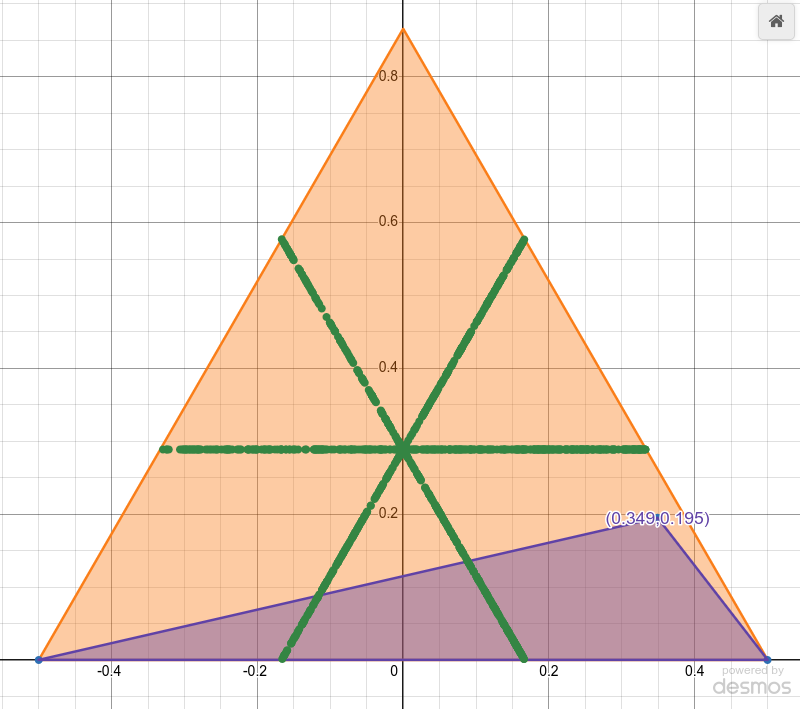
Oh! The good points are on 3 lines going through the middle. The horizontal line goes from x = – 1/3 to x = 1/3 and has length 2/3. The 3 lines combined have length 2.
Method 2: After this enormous hint, let’s see if this can be proven in another way.
The 3 corners of the triangle are at:
The middle of the triangle is at:
Looking at the horizontal line, assume some other x.
The formula for the area of the big triangle:
The area of a subtriangle is obtained by replacing a point with the internal point.
Let me just repeat that:
WLOG, let’s assume:
And we already know:
Then it becomes:
And move them around a little.
See, this would fit with the arithmetic sequence, if .
Result: L = 2.
 , I’ve been reminded of it lately. So, let’s study