Anmeldelse af “The V*mpire” (gratis), af PH Lee. Novelle. 2024. Nebula-nomineret.
Skitse: Det er 2012 og på tumblr, og du er 14, og det giver bare mening at sige, at du er en pige. Er det okay at lade som om? Hvad er det der med trans? Og hvorfor er det forskelsbehandling ikke bare at invitere alle vampyrer ind i sit hjem?
Er det science fiction? Nix. Fantasy/horror.
Temaer: Øj, en ordentlig omgang “jamen, hvad er det okay at sige?”. Fordi det er ikke kun “de gode”, der retter dig. Og er det ikke altid okay at kalde, æhm, problematiske personer ved det navn? Være intolerant overfor de intolerante.
Psykisk og fysisk vold. Nok til at teksten starter med en advarsel.
Er det godt? Åh, den rammer noget. Sådan, lidt for meget. Av. 👽👽⭐
Skitse: Et rumskib fyldt med fanger ankommer til planeten Tartarus og Orfeus-fabrikken.
Er det science fiction? Nemlig.
Temaer: Det er kun hvert 10. år, sådan et rumskib er der. Min fornemmelse er, at vi taler om uhyrlige forbrydelser og utænkelig straf, men det fremgår ikke eksplicit. En del af mekanismen er, at fabrikken giver evigt liv.
Teksten er ganske kort. Det virker som et godt valg.
Anmeldelse af “Evan: A Remainder” (gratis), af Jordan Kurella. Novelle. 2024. Nebula-nomineret.
Skitse: Da Evan sagde højt, at han faktisk er en mand, førte det til en skilsmisse og et nyt liv i en grim lejlighed. Han bliver optaget af en blodplet på gulvet, der bare ikke vil gå af, og af at spytte tænder (?) ud.
Er det science fiction? Det kan man vist ikke påstå. Horror, nutid.
Temaer: Noget med transformation. Noget med at acceptere hvem man er og har været.
Noget med knogler.
Noget med kærlighed.
Formen har hop i tid.
Er det godt? Jeg ved ikke, om det her er nyskabende. Det er i hvert fald ikke lige mig. 👽👽☠️
Let p represent the probability the Celtics win any given game in the [best-of-seven] series. You should assume that p is constant (which means there’s no home-court advantage) and that games are independent.
For certain values of p, the likeliest outcome is indeed that the Celtics will win the series in exactly five games. While this probability is always less than 50 percent, this outcome is more likely than the Celtics winning or losing in some other specific number of games. In particular, this range can be specified as a < p < b.
Determine the values of a and b.
And for extra credit:
Let p4 represent the probability that the Celtics sweep the Knicks in four games. And let p7 represent the probability that the series goes to seven games (with either team winning).
Suppose p is randomly and uniformly selected from the interval (a, b), meaning we take it as a given that the most likely outcome is that the Knicks will lose the series in five games. How likely is it that p4 is greater than p7? In other words, how often will it be the case that probably losing in five games means a sweep is more likely than a seven-game series?
Highlight to reveal (possibly incorrect) solution:
It’s easy to calculate p(4) (that Celtics wins in 4 games). It’s [ p4 ].
For p(5), we need 3 wins and 1 loss, and then 1 final win. The loss can be anywhere in the 4 first games. So this is p3 * (1-p)1 * c(4, 1) * p = [ p4 * (1-p)1 * 4 ].
For p(6), we need 3 wins and 2 losses, and then 1 final win. The losses can be anywhere in the 5 first games. So this is p3 * (1-p)2 * c(5, 2) * p = [ p4 * (1-p)2 * 10 ].
For p(7): p3 * (1-p)3 * c(6, 3) * p = [ p4 * (1-p)3 * 20 ].
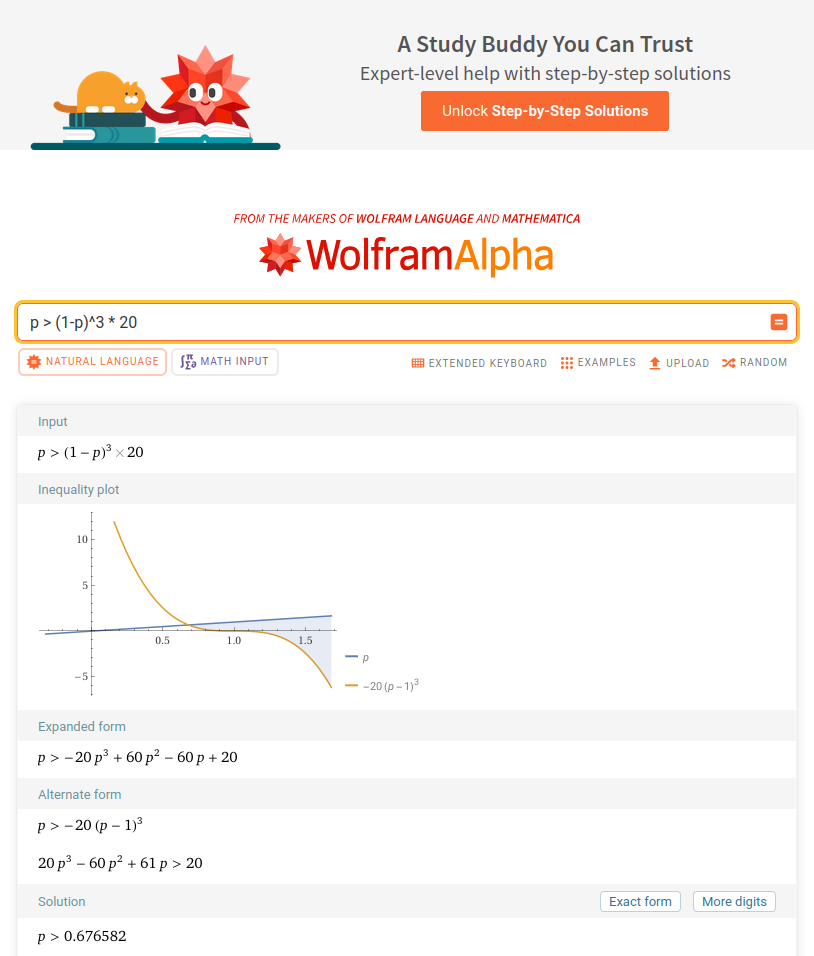
A quick visit to WolframAlpha reveals, that p > 0.6766.
As p is chosen randomly, 0.6 < p < 0.75, and the inequality holds when 0.6766 < p, the number we’re looking for is (0.75 – 0.6766) / (0.75 – 0.6) = 0.4893. My 1st program somewhat confirms this. Program 2 also lands in this general vicinity.
Jeg har læst “0wnz0red”/”Din kr0p er v0res”, #CoryDoctorow. Quick fix. Spoilers.
Nogen har udviklet et stykke software, der via passende kabler kan styre alt muligt i en krop: niveau af serotonin, stofskifte, smertetærskel osv. Med lidt kreativitet kan man også opfinde en kur mod en given sygdom. Og hvad så?
En af hovedpersonerne forestiller sig, at man kan putte en masse af det her software i en virus, der på længere sigt vil smitte alle. Nogle fordele vil indtræffe med det samme, andre kræver en lille computer ved siden af, så man selv kan skrue op og ned for tingene. Igen på længere sigt vil den blive billig, så alle kan få en. Voila! Fysisk og psykisk sundhed til alle, og i forbifarten også en slat penge til vores helt.
Vi ser noget af det virke ret godt hos nogle få personer. Det er ikke klart, hvordan effekten i sidste ende vil være på samfundet, men jeg gætter på positiv.
Anmeldelse af “Din kr0p er v0res”, af #CoryDoctorow. Novelle. 2024. Så fremmed et sted.
Skitse: Siden Liam døde, der har Murray ikke rigtig kunnet passe sit job som programmør. Han bliver stille og roligt flyttet over på noget mindre farligt, nemlig at skrive dokumentation. Livet begynder at virke lidt igen. Men så dukker Liam pludselig op, ikke spor død.
Er det science fiction? Absolut.
Temaer: Det er jo et smaddergodt spørgsmål, hvad der er med Liam, og svaret handler bl.a. om programmering.
Så sniger et nyt spørgsmål sig ind. Når man har et fantastisk stykke software, hvad skal man så gøre med det? Holde det for sig selv og sine nærmeste venner i militæret og/eller efterretningstjenesten og/eller politiet? Sætte det frit til salg? Forære det væk? Måske en kombination?
Anmeldelse af “Supermanden og udflytteren”, af #CoryDoctorow. Novelle. 2024. Så fremmed et sted.
Skitse: Supermands hemmelige identitet er den canadiske, jødiske Hershie. Han synes selv, at han bør støtte demonstrationer imod krig, specielt nu hvor Udflytterne har inviteret Jorden ind i den Galaktiske Føderation, hvor krig ligesom ikke længere er noget, man bruger. Men hans mor synes, det lugter af ballade.
Er det science fiction? Åh ja.
Temaer: Hershie har ikke længere samme kurs som regeringen, og det giver alle mulige problemer, inkl. økonomiske. Såsom: Skal han betale skat? (Første gang, jeg læste den her historie, bed jeg virkelig mærke i det spørgsmål.)
Anmeldelse af “Hjemme igen, hjemme igen”, af Cory Doctorow. Novelle. 2024. Så fremmed et sted.
Skitse: Som 10-årig bor Chet i Stærekassen, sammen med alle de andre, som uransagelige rumvæsner har vurderet til at have pip. Der er skole, samtaler med en udenjordisk vejleder og besøg hos en fyr, der bl.a. har et stort akvarium med koraller og fisk.
Er det science fiction? Ja.
Temaer: Chets forældre må altså have pip, mindst en af dem, men de ved ikke hvilken, og det er ikke godt for den mentale sundhed at havne i den her kategori. Ham med akvariet er heller ikke helt jordbunden. Håbet er, at Chet har en bedre fremtid. Der er i øvrigt system i galskaben. Efter en generation vil stærekasserne blive nedlagt igen, fordi der ikke længere er behov for dem.
Sideløbende følger vi den noget ældre Chet, der har været ude i universet, men nu er kommet hjem igen. Hans bedre fremtid indeholdt selv at blive vejleder.
Fyren med akvariet tror, at han er Tesla. Det kommer du ikke til at glemme et sekund under læsningen! 👎🏻
Synspunktet skifter mellem 1. og 3. person. Tja. Skiftene er ret bratte.
Anmeldelse af “Skyggen af moderskibet”, af Cory Doctorow. Novelle. 2024. Så fremmed et sted.
Skitse: En ny kult jager lykken og bygger huse af hærdet skum. Da rumvæserne ankommer, er det kultens leder, der bliver inviteret op på moderskibet og taget med på en lille udflugt. Hvad siger man så, som lederens efterladte søn Maxes?
Er det science fiction? Jeppe-depper.
Temaer: Ikke uventet er livet kaotisk, både for alle Jordens beboere generelt og Maxes helt specifikt. Skrivestilen afspejler det: Store hop i tid, store forandringer.
I was recently a guest at Disney World, which has a new system called “Lightning Lane” for reserving rides in advance—for a fee, of course.
By purchasing “Lightning Lane Multi Pass,” you can reserve three of the many rides in a park, with each ride occurring at a different hourlong time slot. For simplicity, suppose the park you’re visiting (let’s say it’s Magic Kingdom) has 12 such time slots, from 9 a.m. to 9 p.m. So if you have the 3 p.m. time slot for a ride, then you can skip the “standby lane” and board the much shorter “Lightning Lane” at any point between 3 and 4 p.m. Assume you can complete at most one ride within each hourlong time slot.
Once you have completed the first ride on your Multi Pass, you can reserve a fourth ride at any time slot after your third ride. This way, you always have at most three reservations. Similarly, after you have completed your second ride, you can reserve a fifth ride at any time slot after your fourth, and so on, up until you are assigned a ride at the 8 p.m. (to 9 p.m.) time slot. That will be your final ride of the day.
Magic Kingdom happens to be very busy at the moment, and so each ride is randomly assigned a valid time slot when you request it. The first three rides of the day are equally likely to be in any of the 12 time slots, whereas subsequent rides are equally likely to occur in any slot after your currently latest scheduled ride.
On average, how many rides can you expect to “Lightning Lane” your way through today at Magic Kingdom?
And for extra credit:
If you’re a Disney aficionado, then you know that week’s Fiddler is in fact an oversimplification of how Lightning Lane actually works. Let’s make things a little more realistic.
This time around, after you complete the first ride on your Multi Pass, you can reserve a fourth ride at any time slot after your first ride (rather than after your third ride). Similarly, after you have completed your second ride, you can reserve a fifth ride at any time slot after your second, and so on, until there are no available time slots remaining.
As before, the first three rides of the day are equally likely to be in any of the 12 time slots, whereas subsequent rides are equally likely to occur in any remaining available slots for the day.
On average, how many rides can you expect to “Lightning Lane” your way through today at Magic Kingdom?
Highlight to reveal (possibly incorrect) solution:
I actually solved this 3 different ways. The first time around I also got 3 different results. So I kept going until the results lined up.
The spreadsheet is the more mathy. I’m looking at the expected numbers directly. What can we expect if 3 rides are already booked, and after having done the 1st ride, I’m looking to book 1 more?
If the last booked ride is in the 12th hour (E(12)), 0 more rides are expected.
If the last booked ride is in the 11th hour (E(11), 1 more ride + E(12) are expected. This is 1.
If the last booked ride is in the 10th hour (E(10)), 1 more ride + either E(11) or E(12) are expected. E(11) and E(12) are equally likely, as they consist in the next ride chose being in either the 11th or 12th hour. So E(10) = 1 + (E(11) + E(12))/2 = 1 + (1 + 0)/2 = 1 + 1/2 = 1 1/2.
If the last booked ride is in the 9th hour (E(9)), by a similar logic, 1 + (E(10) + E(11) + E(12))/3 rides are expected. This is 1 5/6.
This goes on until E(3).
To calculate the expected number of rides in total, I also need the probabilities for each situation. Given I have booked 3 rides, how many ways can I do this, ending up with the latest being in the nth hour?
If the last booked ride is in the 12th hour, the other 2 rides are chosen randomly among the first 11, 11 choose 2 = 11*10/2 = 55 = P(12)/sum. (Sum: the sum of all these ways.)
If the last booked ride is in the 11th hour, the other 2 rides are chosen randomly among the first 10, 10 choose 2 = 10*9/2 = 45 = P(11)/sum.
All the way until…
If the last booked ride is in the 3rd hour, the other 2 rides are chosen randomly 😉 among the first 2, 2 choose 2 = 2*1/2 = 1 = P(3)/sum.
Adding up all these ways, there are sum = 220 in all.
Now I just take each product, E(n) * P(n), calculate the sum, and hey presto! The result is 1.2699. Oh, and then I have to add the 3 rides already booked, so the result is actually 4.2699.
My first program does a Monte Carlo. My second program goes through all the options, calculating the numbers of rides and averaging out. These 2 programs confirm the result.
And for extra credit:
For this one I define E(a, b) as the expected number of rides added, given that at time a (in the ath hour) there are b booked rides after this time.
E(12, 0) = 0 – I am at the 12th hour, of course there are no rides left after this one, of course I can’t add any rides.
E(11, 0) = 1 + E(12, 0) = 1 – I am at the 11th hour, the 12th slot is empty, I can therefore add that ride and progress to the 12th hour.
E(11, 1) = 0 + E(12, 0) = 0 – I am at the 11th hour, the 12th slot is already booked, I can add no rides and simply progress to the 12th hour.
E(10, 0) = 1 + (E(11, 0) + E(12, 0))/2 = 1 + (1 + 0)/2 = 1 + 1/2 = 1 1/2 – I am at the 10th hour, the 2 slots after this one are empty, either the 11th or 12th will be booked, with equal probability, and I can move forward to that slot.
E(10 , 1) = 1 + E(11, 1) = 1 + 0 = 1 – I am at the 10th hour, 1 of the 2 next slots is already booked, so now the empty is also booked, I can move forward to the 11th hour.
E(10, 2) = E(11, 1) = 0 – I am at the 10th hour, both slots after this one are already booked, I simply move 1 hour forward.
E(9, 0) = 1 + (E(10, 0) + E(11, 0) + E(12, 0))/3 = 1 + (1 1/2 + 1 + 0)/3 = 1 + (5/2)/3 = 1 + 5/6 = 1 5/6 – I am at the 9th hour, the next 3 slots are open, with equal probability one of them is chosen, and I move forward to that hour. (These calculations, where b = 0 are duplicates of calculations from the fiddler, E(9).)
E(9, 1) = 1 + (E(10, 1) + E(10, 1) + E(11, 1))/3 = 1 + (1 + 1 + 0)/3 = 1 + 2/3 = 1 2/3 – With equal probability (*) the last 3 slots are b__, _b_ or __b. (b for booked.) After booking one of them, the situation is, with equal probability (*) bb_, b_b or _bb. 2 of these represent E(10, 1), and 1 of these represent E(11, 1).
E(9, 2) = 1 + E(10 , 2) = 1 + 0 = 1 – There’s an empty slot in front of me, I fill it and move on to the next hour.
E(8, 0) = 25/12 = 2 1/12.
E(8, 1) = 1 + (E(9, 1) * 3 + E(10, 1) * 2 + E(11, 1))/6 = 1 + (1 2/3 * 3 + 1 * 2 + 0)/6 = 1 + 7/6 = 2 1/6 – The new states are bb__, b_b_, b__b, _bb_, _b_b and __bb.
E(8, 2) = 1 + (E(9, 2) * 3 + E(10, 2))/4 = 1 + (1 * 3 + 0)/4 = 1 3/4 – The new states are bbb_, bb_b, b_bb and _bbb.
E(7, 0) = 2 17/60
E(7, 1) = 1 + (E(8, 1) * 4 + E(9, 1) * 3 + E(10, 1) * 2 + E(11, 1))/10 = 1 + (2 1/6 * 4 + 1 2/3 * 3 + 1 * 2 + 0)/10 = 1 + 1 17/30 = 2 17/30 – The new states are bb___, b_b__, b__b_, b___b, _bb__, _b_b_, _b__b, __bb_, __b_b and ___bb. (I smell a formula. Let c = 12-a. This represents the number of slots left. Part of the sum is going from E(a, 1) to E(a+1, 1) * (c-1) + E(a+2, 1) * (c-2) + … + E(a+(c-1), 1) * 1. And dividing by the sum of the integers from 1 to c-1, also called the triangle number.)
E(7, 2) = 1 + (E(8, 2) * 6 + E(9, 2) * 3 + E(10, 2))/10 = 1 + (1 3/4 * 6 + 1 * 3 + 0)/10 = 1 + 1.35 = 2.35. (Again, there’s structure. Let d = 12-a-1. The sum goes from E(a, 2) to E(a+1, 2) * tri(d-1) + E(a+2, 2) * tri(d-2) + … + E(a+(d-1), 2) * tri(1). And then dividing by the sum of the triangle numbers.)
I continue this exercise in the spreadsheet.
(*) I assume.
The next step, after having calculated all of these, going all the way to E(1, 2), is again to compute the expected number, P*E. This gives, that the expected number of rides added, after the first 3 rides already added and the first of these at a, is 3.8096. Adding the 3 first rides, we get 6.8096.
 (gratis), af PH Lee. Novelle. 2024. Nebula-nomineret.







 Stuff from ommadawn.dk (Lise Andreasen)