William Gibson’s Neuromancer: Does the Edge Still Bleed? Eileen Gunn.
“Fiction, even science fiction, is not about the future: I think everybody knows that.”

William Gibson’s Neuromancer: Does the Edge Still Bleed? Eileen Gunn.
“Fiction, even science fiction, is not about the future: I think everybody knows that.”

Interesting article. Why is it wrong to say science fiction gets its predictions wrong? Are they predictions? Some interesting quotes.
Science Fiction Is About Predicting the Future, Sep 21st, 2011 by Steve Davidson.

A very interesting article looks at the phenomenon of sf “getting its predictions wrong”. And why it keeps coming up.
Nader Elhefnawy: “Of Science Fiction and Forecasting”. New York Review of Science Fiction, 351.
“Introduction”, Brian W. Aldiss, Introducing SF.
…the business of sf is to imagine, not to predict – otherwise it would be written in the future tense rather than the past tense.

“Introduction”, Damon Knight, One Hundred Years of Science Fiction, book two.
I have said elsewhere that science fiction and prophecy are two different things. Science fiction deals with what may be, not what will be. It is true that we can now afford to smile at those who once dismissed SF as ‘Buck Rogers stuff’, while our astronauts orbit the earth, our space probes photograph the moon, Mars, and Venus; while computers take over banking, commerce and industry, and electron microscopes unlock the secrets of the genetic code. But to value science fiction merely because of its predictive quality is as absurd as to reject it, as some unimaginative readers do, because it is ‘not true’. Science fiction stories allow us to enter worlds that exist nowhere else. We prize them for that, not for the irrelevant coincidence that may later make them seem prophetic. The War of the Worlds is no less a great story because the Martians have not landed; neither is Out of the Silent Planet diminished if there are no sorns.
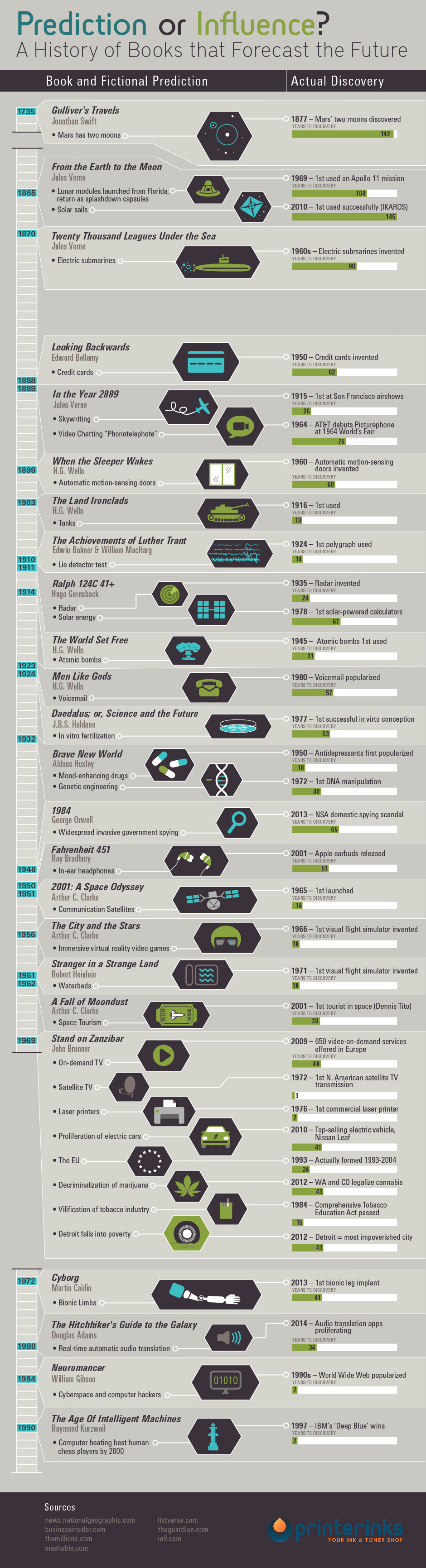
(Click for full graphic of the opposite point of view.)
Science Fiction and Prophecy: Talking to Arthur C. Clarke, Tod Mesirow interviews Arthur C. Clarke
TM: Is it fair to call some science fiction writers prophets in a way?
ACC: Yes, but accidental prophets, because very few attempt to predict the future as they expect it will be. They may in some cases, and I’ve done this myself, write about — try to write about — futures as they hope they will be, but I don’t know of anyone that’s ever said this is the way the future will be.
TM: I guess the definition of a real prophet, right?
ACC: Well, I don’t think there is such a thing as, as a real prophet. You can never predict the future. We know why now, of course, chaos theory, which I got very interested in, shows you can never predict the future.
TM: So the success of science fiction writers is, because they predict everything that might happen, eventually —
ACC: Well, the success of a science fiction writer is if he can write a good read.
Elon’s Basilisk: why exploitative, egomaniacal rich dudes think AI will destroy humanity, Cory Doctorow:
As I’ve written before, science fiction isn’t very good at predicting the future, but it’s great at predicting the present: tell us what futuristic phenomena you fear and hope for and we’ll know what fears about yourself and your relations with the people around you are lurking, possibly unacknowledged, in your psyche.
A Comparison of Dystopian Nightmares and Utopian Dreams: Two Paths in Science Fiction Literature That Both Lead to Humanity’s Loss of Empathy, Thomas M. Disch:
Better than any SF [or, science fiction,] writer of his time, Dick understood that science fiction is not about predicting the future but examining the present.
Prediction, SF Encyclopedia, David Langford and Peter Nicholls.
The most widespread false belief about sf among the general public is that it is a literature of prediction. Very few sf writers have ever claimed this to be the case, although Hugo Gernsback did see one function of his sf magazines as to paint an accurate picture of the future. Very few of the stories he published lived up to his editorializing. When John W Campbell Jr took over the editorship of Astounding he demanded an increasing scientific plausibility from his writers, but a plausible-sounding “perhaps” is a long way from prediction.
“Huxley’s Bad Trip”, An introduction to the Folio Society edition of Aldous Huxley’s Brave New World, 2013, Ursula K. Le Guin.
“The cautionary novel does what many people assume all science fiction does: it predicts the future. However much they may exaggerate dramatically or satirically, predictive writers extrapolate immediately from fact. And, believing that they know what’s going to happen in the future, for good or for evil, they want the reader to believe it too. A great deal of science fiction, however, has nothing to do with the future, but is a playful or serious thought experiment, such as H. G. Wells’s War of the Worlds or Ray Bradbury’s Martian Chronicles. Thought experimenters use fiction to recombine aspects of reality into forms not meant to be taken literally, only to open the mind to possibility. They don’t deal with belief at all.
This distinction enforced itself on me when I realised that Huxley himself appears to have believed quite literally in his prediction.”