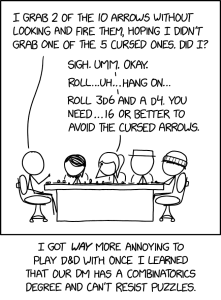
The question is, very simply: Is this comic mathematically correct?
Highlight to reveal (possibly incorrect) solution:
10 arrows in all. 5 of them poisoned. I choose 2. What is the probability 0 of them are poisened? For the first arrow I have to choose, among the 10, one of the 5 good ones. For the second arrow I choose one of the 4 among the 9. I could have chosen the same 2 arrows in the opposite order, so to avoid double counting, divide by 2. My probability is 5/10 * 4/9 * 1/2 = 1/9, appr. 0.1111.
Simply looking at 3d6, it’s easy to find a table with the probabilities, like this one. Let me replicate some of that table and add a little extra information.
3d6 sum
p
d4
p
12
27/216
n/a
0
13
21/126
4
1/4
14
15/216
3+
2/4
15
10/216
2+
3/4
16
6/216
1+
1
17
3/216
1+
1
18
1/216
1+
1
Going through the columns: Given a sum of 3d6, what is the probability of this sum, what should the d4 roll to hit a sum of 16+, and what’s the probability of that? To get the complete probability, multiply columns 2 and 4, and add these products together. (21/4 + 15*2/4 + 10*3/4 + 6 + 3 + 1) / 216 = 30.25/216, appr. 0.1400.
Anmeldelse af “Kaffe !”, af Dennis Rosenaa. Novelle. 2024. Novum 152.
Skitse: Politifolk samles ved en kaffebar. En helt bestemt kaffebar. Med en helt bestemt barista.
Er det science fiction? Ja. Baristaen er ikke jordbo.
Temaer: Der er et helt ritual. Dato, klokkeslæt, antallet af politifolk. Der forventes respekt!
Desværre et vist antal bortløbne tegn. Til gengæld rigeligt med mellemrum.
Er det godt? Der var en lille overraskelse til sidst, men jeg kunne godt have tænkt mig noget mere. Den er til gengæld sjov og af en passende længde. 👽👽💀
Anmeldelse af “I syv sind”, af Peter Nørgaard. Novelle. 2024. Novum 152.
Skitse: Hovedpersonen ser fjernsyn, et talkshow, der gør sit bedste for at være meget eksklusivt og på forkant og alt det der. Seerne stemmer på mulige deltagere i showet.
Er det science fiction? Ja. Talkshow-genren og dens deltagere fremskrevet.
Temaer: Vi hører om forskellige mennesker og andet godtfolk (robotter, chatbots, kunstige intelligenser osv.), der kæmper med at finde den rigtige identitet. (Bliver der gjort grin med det her med at finde det rigtige navn, køn osv., der passer med ens personlighed?)
Uha. Korrekturlæseren i mig har det ikke godt med tegnsætningen. Og mange replikker, æh, smager også underligt.
Er det godt? Mja. Kunne vist godt have været kortere. Og jeg gættede slutningen. 👽👽💀
Anmeldelse af “Drømme”, af Jasmin Hansen. Novelle. 2024. Proxima 109.
Skitse: Felicia vinder måske en pris i aften, årets influencer. Bagest i lokalet sidder klonerne og kigger.
Er det science fiction? Ja. Kloner kloner dagen lang.
Temaer: Tja. Kloner. Og at man kan have en flok kloner af sig selv, der også i virkeligheden er ens slaver. I det her tilfælde i et miljø, hvor det gælder om at være perfekt på sociale medier og sådan noget.
Der er lidt med opsætningen, og nogle ret konsekvente stavefejl. Have/havde. Famle/falme.
Er det godt? Den primære slutning, der havde jeg 3 gæt, og ramte rigtigt. Den sekundære slutning var uventet. Novellen kunne forkortes? På den anden side er jeg ikke god til at vurdere angst og den slags. 👽👽💀
Anmeldelse af “Nej, Alphonse”, af Jesper Goll. Novelle. 2024. Proxima 109.
Skitse: Alphonse har en luftballon, der kan opvarmes med gas. Når han gør sig umulig ved hoffet i Paris, så rejser Madeleine med vestpå. Når ballonen går i stykker, så reparerer hun den, og sukker kun lidt.
Er det science fiction? Ja. Sådan på Niels Klim-måden. Videnskaben er lidt løs i det. Alternate history-agtigt.
Temaer: Alphonse har forelsket sig i, at man kan flyve vestpå, forbi kysten, ud at se hvad der er. Gæt hvem der er skeptisk.
En håndfuld fejl i opsætning og vist et par stavefejl.
This essay sort of wanders through concepts like prophecy, futurism, extrapolation, whether sf is about the future or the present, and even whether sf is literature. It’s hard to pick a quote, so here’s the whole thing. (No copyright infringement intended.)
You are waiting in line to be sorted into one of the four houses of Logwarts (a posh wizarding boarding school in the Scottish highlands) by an anthropomorphic sorting hat. The hat is a bit of a snob about the whole matter, and refuses to sort two students in a row into the same house. If a student requests a certain house, but the previously sorted student was already sorted into that same house, then the hat chooses randomly from among the three remaining houses. Otherwise, the hat grants the student’s request.
You are standing 10th in line, and you make plans to request Graphindor house for yourself. As for the other students in line, you can assume that they have random preferences from among the four houses.
The first student steps up, and has a brief, quiet conversation with the hat. After a few moments, the hat proclaims, “Graphindor!”
At this point, what is the probability that you will be sorted into Graphindor?
When a student isn’t sorted into Graphindor, they might end up in Hafflepuff instead. For symmetry reasons, the 3 non Graphindor houses behave the same way, ending up with the same probabilities, so I’m just going to track Graphindor and Hafflepuff.
Student #1 got G.
Student #2 may want G (p=1/4) or something else, like H (p=1/4). If G was requested, H might be granted (p=1/3). The total probability for H is therefore 1/4 + (1/4)*(1/3) = 1/3. The probability for getting G is 0.
This holds in general. A random student wanting something random will end up in a random house, p=1/3, where the previously granted house has p=0.
Student #3 may want H (p=1/4) or something else. The probability this student ends up in G is p(H) from the previous step, or rather p(H) * 3/3. The probability this student ends up in H is (p(G)+…)/3. Therefore p(G) = 1/3 = 3/9 and p(H) = 2/9.
This holds in general. If at a certain step, p(G) = a/c and p(H) = b/c, in the next step, p(G) = 3b/3c and p(H) = (a+2b)/3c.
Step
p(G)
p(H)
1
1
0
2
0
1/3
3
3/9
2/9
4
6/27
7/27
5
21/81
20/81
6
60/243
61/243
7
183/729
182/729
8
546/2187
547/2187
9
1641/6561
1640/6561
The general formula for step odd n+1 is p(G) = [3n/4, rounded down]/3n and p(H) = [3n/4, rounded up]/3n. For even n+1, reverse rounding up and down. Values verified via spreadsheet.
In step 10, I can get G, if G wasn’t granted in the previous step. The probability of this is (6561-1641)/6561 = 4920/6561 = 0.749886… or approximately 1/4.
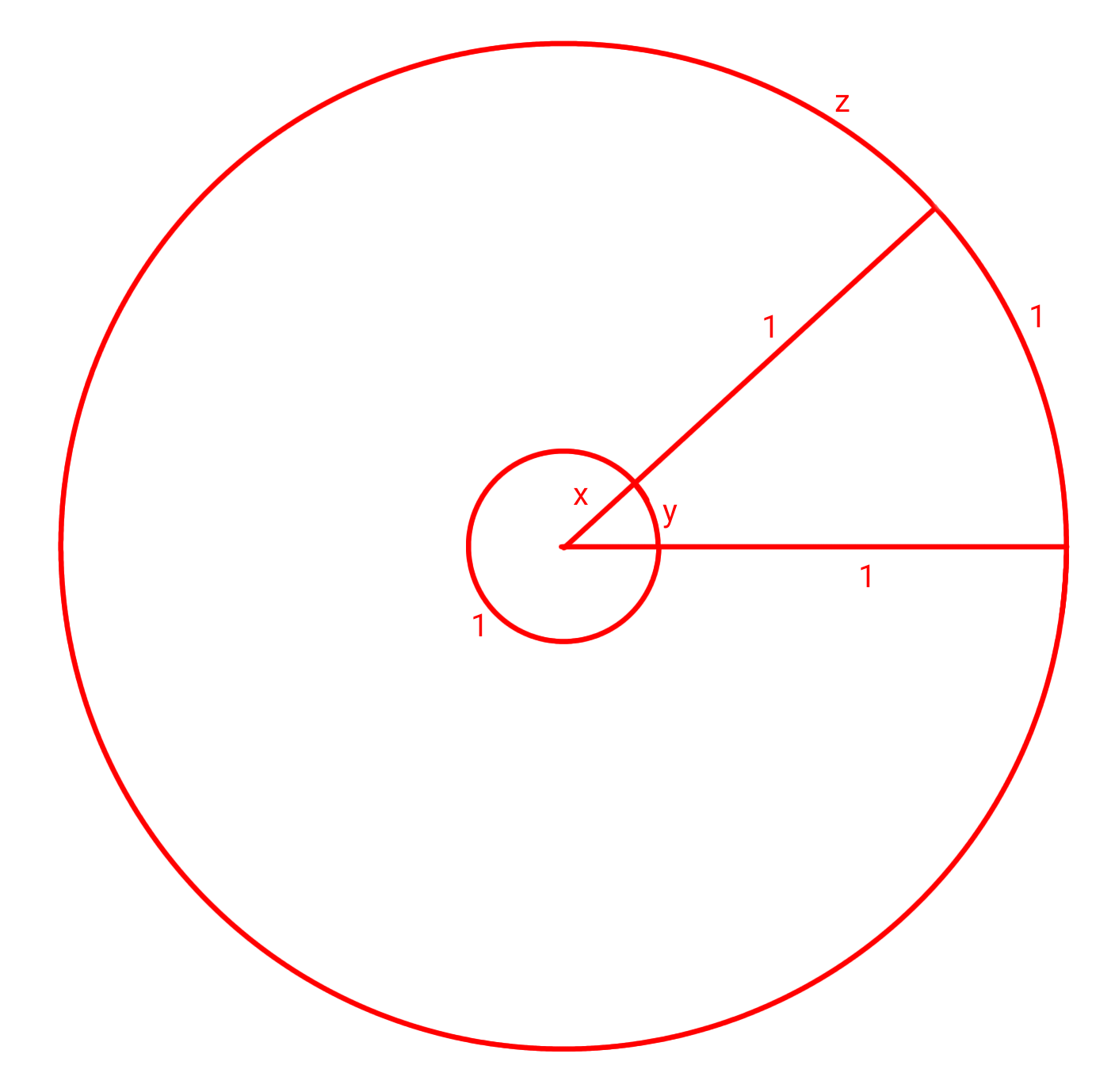
Sure enough, the shape (or one very much like it) has four “sides” of equal length, with four right angles. However, two of these sides are curved (in particular, they are arcs of circles), and two of the right angles are exterior, meaning the interior angles measure 270 degrees (rather than the usual 90 degrees).
Let’s call shapes like this one “pseudo-squares.” A pseudo-square has the following properties:
It is a simple, closed curve.
It has four sides, all the same length.
Each side is either a straight line segment or the arc of a circle.
The four sides are joined at four corners, with each corner having an internal angle of 90 degrees or 270 degrees.
The pseudo-square pictured above has two straight sides, which run radially between arcs of two concentric circles.
Assuming this is a unit pseudo-square (i.e., each side has length 1), what is its area?
I’ve built a larger diagram with 2 circles and 3 variables.
The radius of the small circle is x.
The circumference of the small circle is 1 + y.
The radius of the large circle is 1 + x.
The circumference of the large circle is 1 + z.
The 2 straight lines in the original drawing lie on top of radii of the large circle.
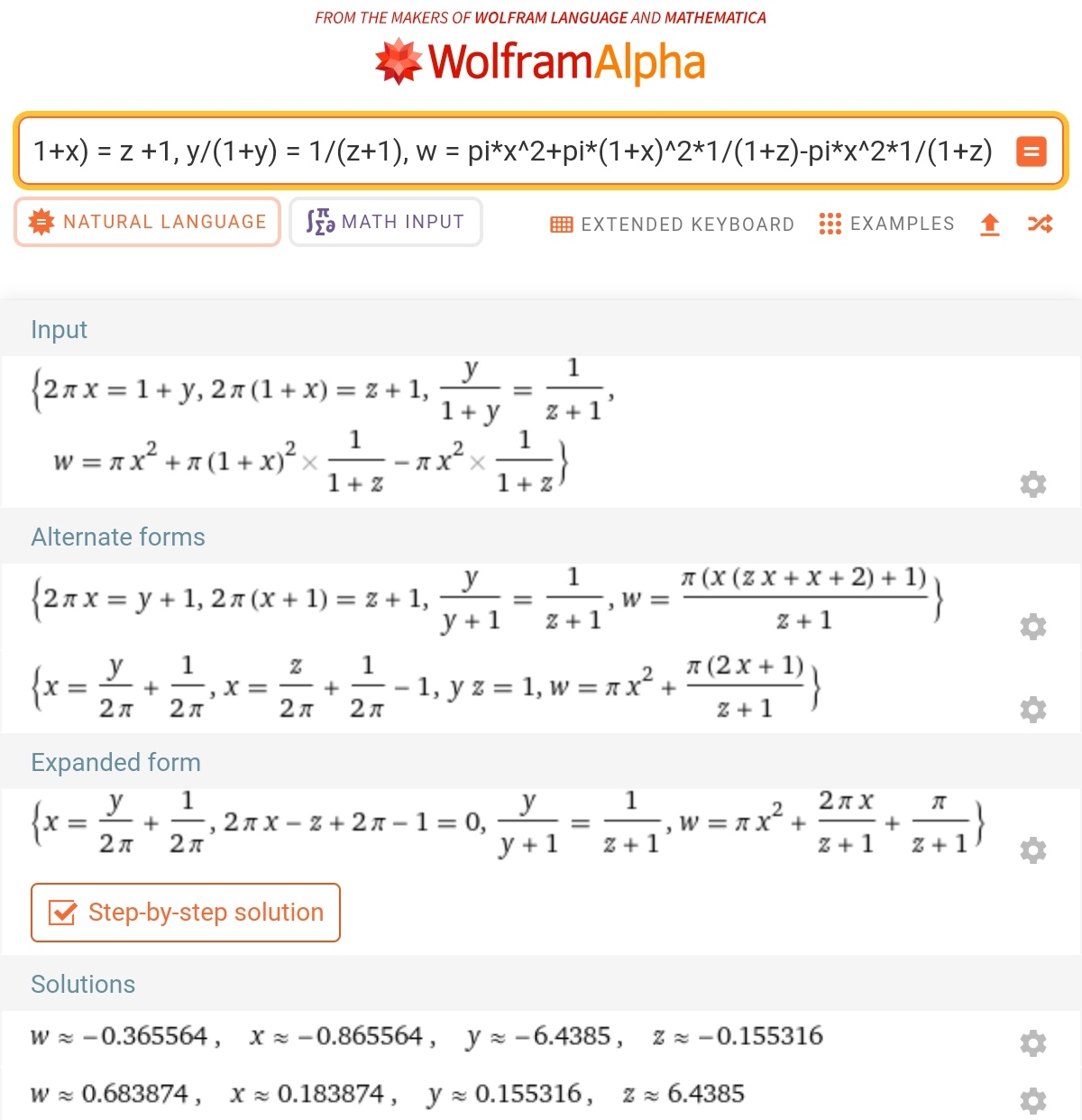
Circumference of small circle: 2πx = 1 + y.
Circumference of large circle: 2π(1+x) = 1 + z.
Ratio between circumference and smaller arc: y / (1+y) = 1 / (1+z).
This is a system of 3 equations with 3 unknowns. Calculations tell me, that x = (1-π+√(1+π2))/2π (about 0.184), y = √(1+π2) – π (about 0.155), z = π + √(1+π2) (about 6.439).
The requested area is small circle + large circle sector – small circle sector. (Avoiding double counting.)
Small circle area: πx2.
Large circle sector: π(1+x)2 * 1/(1+z).
Small circle sector: πx2 * 1/(1+z).
Further calculations find this area is about 0.684.








 Stuff from ommadawn.dk (Lise Andreasen)