This week the #puzzle is: Seeking Alpha #counting #average #probabilities
| In the figure below, four points are arranged in a square. The top two points can each be labeled with one of eight letters: A, B, C, D, E, F, G, and H. The bottom two points can each be labeled with one of three three letters: J, K, and L. (Hence the numbers “8” and “3” in the figure.) |
 |
| You are labeling exactly two of the points with letters. The other two points will remain blank. |
| Once you’ve labeled two points, you must choose one of the colored connectors (yellow, red, green, or blue) between the two points you labeled—note carefully where each color connector is in the diagram. But there are some more rules: |
| – If the two letters are the same, you cannot use a yellow connector. – You can only use the blue connector when the bottom points have the same letter. |
| Finally, two diagrams are equivalent if they are reflections of each other. For example, the following two diagrams are equivalent: |
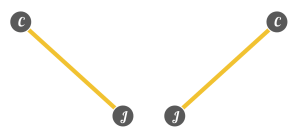 |
| All told, how many distinct (non-equivalent) diagrams can you make? |
And for extra credit:
| Next, it’s time for a little game. Let’s continue with the list of distinct diagrams you just found for this week’s Fiddler, being sure to choose exactly one representative from each pair of reflected diagrams. And further suppose every diagram in your list actually contains four letters: In addition to the two “visible” letters in the diagram, the remaining two points each have a “secret” letter—8 possible letters (A through H) for a point on top and 3 possible letters (J through L) for a point on the bottom—that are fixed for a given diagram. The top and bottom letters are chosen with replacement, so that a letter can occur more than once. |
| So here’s the game: In each round, you are randomly generating a new diagram. This time, the top two points are each randomly labeled with one of nine letters: A, B, C, D, E, F, G, H, and I. The bottom two points are each randomly labeled with one of four letters: J, K, L, and M. Letters are chosen independently and with replacement. Once these letters are assigned, you randomly pick two points whose letters are “secret.” |
| Between the remaining two “visible” letters, you randomly pick from among the four connectors between them shown in the diagram below: |
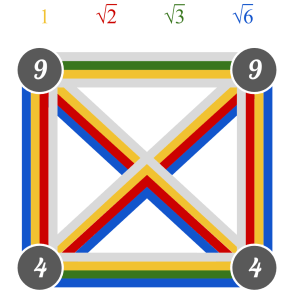 |
| While there are indeed four connectors between any two points, there are five connector types. Here are the point values associated with each type: |
| – A gray connector is worth 0 points – A yellow connector is worth 1 point. – A red connector is worth √2 points. – A green connector is worth √3 points. – A blue connector is worth √6 points if it connects identical letters—otherwise, it’s worth 0 points. |
| Now, you earn points when your randomly generated diagram perfectly matches one of the distinct diagrams from your list, including: the four letters, which letters are visible, their orientation (no reflections allowed this time!), and the color of the connector between the visible letters. If there is indeed a diagram that’s a perfect match, you get the number of points corresponding to its connector. Otherwise, you get no points. |
| On average, how many rounds of this game can you expect to play for each point that you earn? |
| | |

Solution, possibly incorrect:
The only method I can think of is to count all the options. Before I start, I label the points.
- Top left: a
- Top right: b
- Bottom left: c
- Bottom right: d
I also label the letters.
- A letter is the 1st letter, if the label for the point beneath the letter comes before the letter for the other point with a letter.
- 1st letter: l1
- 2nd letter: l2
Now let’s start counting.
- Points with letters: a, b
- l1 = l2, connector is G
- 8 options
- (8 options for l1, 1 option for l2, 1 option for connector)
- l1 ≠ l2, connector is Y or G
- 8 * 7 * 2 / 2 = 56 options
- (8 options for l1, 7 options for l2, 2 options for connector, remove equivalents (AB is equivalent to BA)
- l1 = l2, connector is G
- Points with letters: a, c
- l1 ≠ l2, connector is Y or R
- 8 * 3 * 2 = 48 options
- l1 ≠ l2, connector is Y or R
- Points with letters: a, d
- l1 ≠ l2, connector is Y or R
- 8 * 3 * 2 = 48 options
- l1 ≠ l2, connector is Y or R
- Points with letters: b, c (equivalent to a, d)
- Points with letters: b, d (equivalent to a, c)
- Points with letters: c, d
- l1 = l2, connector is G or B
- 3 * 2 = 6 options
- l1 ≠ l2, connector is Y or G
- 3 * 2 * 2 / 2 = 6 options
- l1 = l2, connector is G or B
In all, there are 8 + 56 + 48 + 48 + 6 + 6 = 172 options.
Method 2, I build a program to create all the options and count them. Same result.
And for extra credit:
Let me see, if I can count my way out of this one too.
This time the letters are simply la, lb, lc and ld. The 2 points chosen/visible are p1 and p2. The connector chosen is C.
A diagram is completely described by (la, lb, lc, ld, p1, p2, C).
When does a diagram fit perfectly with 1 from my list? The 1st yellow p is the probability the letters might actually hit something from my list of diagrams. The next is that the hidden letters fit with what I chose. The next is that the connector fits. And then I multiply those 3.
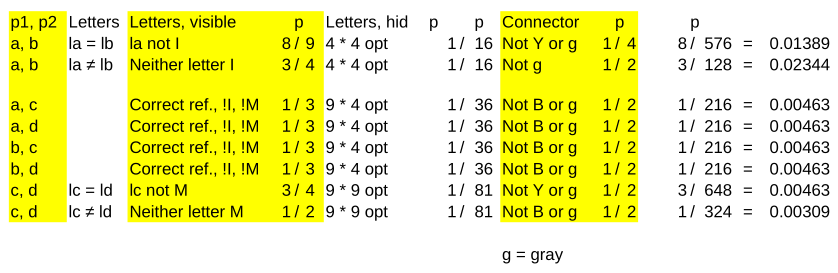
How often does the correct connector occur? The 1st p is the probability from above transferred down here. I multiply the probability with the average point value from the connectors. Then I combine into the 6 cases of point choices. And then I take the average. Finally I calculate the reverse.
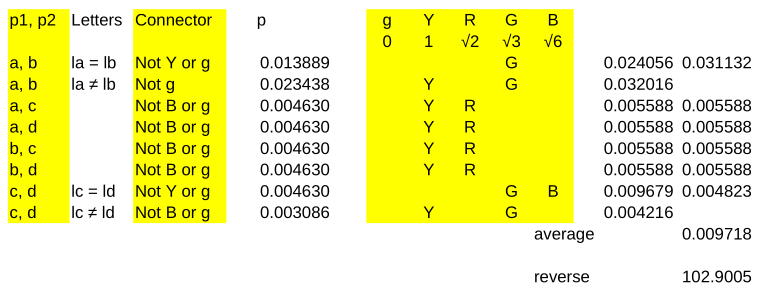
Okay, let me see. The average of all of this is 0.009718. This reversed is 102.9005. This means, for every 102.9005 games, I get 1 point. So I guess that’s my answer. I have to play 102.9005 rounds of this game to get 1 point.
Method 2, add monte carlo to my program. Build a list of diagrams. Then create random diagrams and check whether they are in the list.
Number of loops.... 5 * :      3162523
Target deviation........:    0.0001000
Deviation so far........:
................result 1:    0.0000725
======================================
Final result E, 1.......:    0.0112332
                         +/- 0.0000725

Result F 1: average number of games / point, 89.021472
So this gives me about 89, and method 1 gave me about 103. There’s enough of a difference, that I must have made a mistake somewhere.
Method 3. Hm. Instead of generating random diagrams, let me count all of them. WLOG, let’s assume all the diagrams in the good list are the ac and ad reflections.
- abCAAXY
- This is a diagram, where the visible points are a and b, the connector is C, the visible letters are A and A (a letter from the A-I group) and the hidden letters are X and Y (letters from the group(s), the hidden letters belong to)
- This can be done with 4 different connectors, 9 different letters A, 4 different letters X and 4 different letters Y.
- 4 * 9 * 4 * 4 = 576 options.
- Of these, 8 are in the list of good diagrams.
- abCABXY
- The visible letters are A and B, 2 of the letters from the A-I group.
- 4 * 9 * 8 * 4 * 4 = 4608 options.
- Of these, 56 are in the list of good diagrams.
- acCAJXY
- The visible letters are A and J, a letter from the A-I group and a letter from the J-M group.
- 4 * 9 * 4 * 9 * 4 = 5184 options.
- Of these, 48 are in the list of good diagrams.
- adCAJXY
- 5184 options.
- 48 are good.
- bcCAJXY
- 5184 options.
- 0 are good.
- bdCAJXY
- 5184 options.
- 0 are good.
- cdCJJXY
- 4 * 4 * 9 * 9 = 1296 options.
- 6 are good.
- cdCJKXY
- 4 * 4 * 3 * 9 * 9 = 3888 options.
- 6 are good.
So far, there are 576 + 4608 + 4 * 5184 + 1296 + 3888 = 31104 options, and 172 of them are good. But we also need to count the points.
- abCAAXY
- 8 are good. All will have a G connector.
- abCABXY
- 56 are good. Half will have a Y connector, half a G.
- acCAJXY
- 48 are good. Half will have a Y connector, half a R.
- adCAJXY
- 48 are good. Half will have a Y connector, half a R.
- cdCJJXY
- 6 are good. Half will have a G connector, half a B.
- cdCJKXY
- 6 are good. Half will have a Y connector, half a G.
Connectors of each type:
- Y: 28 + 24 + 24 + 3 = 79
- R: 24 + 24 = 48
- G: 8 + 28 + 3 + 3 = 42
- B: 3
This gives a sum of points of 79 * 1 + 48 * √2 + 42 * √3 + 3 * √6 = 226.97685414.
So. With 31104 options, I score 226.97685414 points.
31104 / 226.97685414 = 137.03599919. I have to play about 137.04 games to get 1 point.
Hm. I think part of my problem with method 1 was, that I didn’t get the probabilities quite right. Like, the split into the 2 ab choices give 2 probabilities, and I think I just averaged them. But they represent groups of different sizes.
I have no idea what went wrong with method 2. But method 3 was much easier to calculate, so method 2 probably had a mistake in a complicated function.
Oh. I think I made a booboo. It’s important to count options. But I should still have added, that the ab-group and the cd-group are equally likely, even though they don’t have the same size. So. Oops. No time this week to get the correct result.

