This week the #puzzle is: How Fast Can You Surf? #trigonometry #maximum #differentiation
| A surfer is riding along a crest of a sinusoidal wave given by the function y = 2·sin(x−t), where y is the height above sea level in meters, x is horizontal position in meters, and t is time in seconds. Based on this, the surfer knows that her speed—and the speed of the wave—is 1 meter per second. |
| But hold on—it appears that another wave is approaching from the opposite direction. This wave has half the amplitude but twice the speed: y = sin(x+2t). |
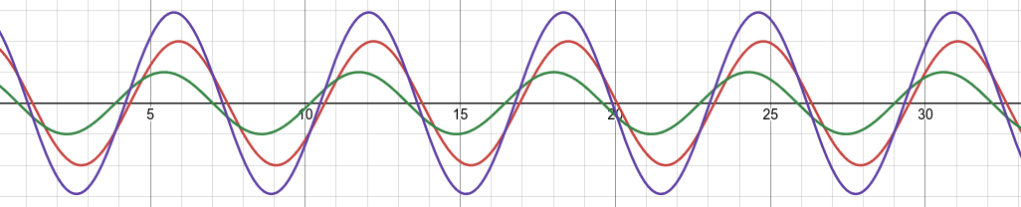
| The two waves, the forward and the backward, ”interfere,” meaning they combine. In other words, the height of the water at position x and time t is given by y = 2·sin(x−t) + sin(x+2t). Nevertheless, the surfer stays atop a crest of the combined wave. |
| As the wave moves along, what are the surfer’s slowest and fastest [horizontal] speeds, in meters per second? |
And for extra credit:
| The surfer rides the crest of the combined wave, y = 2·sin(x−t) + sin(x+2t), for a very long time. |
| What is her average [horizontal] speed, in meters per second? |

Solution, possibly incorrect:
Method 1: Code it up in Desmos, just to see what’s happening. Huh! The combined wave (purple) has a funny start and stop pattern, where horizontal movement seems to stop entirely, while the wave grows in size.
Method 2: Math. Everybody seems to agree, when = speed of wave (or in out case, speed of crest), = wave length and = wave frequency:
This can’t quite fit our situation, because the speed obviously varies, while the wave length and the wave frequency stay constant.
Let’s just look at a single moment.
When does this function have a max or min?
And this max/min is:
Yeah, actually a max. So at time 0, the crest (or one crest) is at .
Let’s try this with a more general time instead.
Chain rule:
Looking for a max/min:
Identities:
I try out this function in Desmos. It actually follows the minimum, but the math is the same.
So far so good! A visual inspection shows these values for the speed of the crest.
Doing a test where I look at how much the crest moves over a short amount of time, , 0 is confirmed. And the max value seems to be 4!
Method 3: Write a program. This simply supplies Desmos with data to show the path of the crest and a curve for the speed of the crest. As it uses the same math, it spits out the same results.
Result: .
And for extra credit:
This is suspiciously easy.
Average speed = total distance / total time. From reading Desmos again, measuring between 2 maxima:
Result: 1.

