This week the #puzzle is: Can You Spell Like a Queen Bee? #probability #counting #period #pattern #repetition
| … If you find all the words in a given day and therefore accrue the maximum number of points, you earn the “Queen Bee” ranking. Meanwhile, accruing smaller point totals earns you other rankings. In particular, the point cutoff for “Genius” is 70 percent of the maximum number of points, rounded to the nearest whole number. While the cutoff for “Genius” is clearly displayed in the puzzle, the “Queen Bee” point total is not readily shown. |
| Of course, this maximum total can be approximated by dividing the “Genius” cutoff by 0.7. Even so, the total may be ambiguous, since multiple “Queen Bee” values can result in the same “Genius” cutoff. |
| Suppose a given round of Spelling Bee has some very large, randomly chosen point total. What is the probability that this total can be precisely determined (i.e., without any ambiguity) from its point cutoff for “Genius”? |
And for extra credit:
| Let’s put the rank of “Genius” aside. Here are some other ranks you can attain in Spelling Bee: |
| – Amazing (if you get 50 percent of the maximum, rounded to the nearest whole number) – Great (40 percent) – Nice (25 percent) – Solid (15 percent) – Good (8 percent) – Moving Up (5 percent) – Good Start (2 percent) |
| Suppose a given round of Spelling Bee has some very large, randomly chosen point total. What is the probability that this total can be precisely determined from these cutoffs combined (i.e., from “Good Start” through “Amazing,” inclusive)? |
Can You Spell Like a Queen Bee? 
Solution, possibly incorrect:
Method 1: Go through a lot of large queen bee values, and check whether a queen bee value either 1 higher or 1 lower would give the same genius cutoff. I do this with a program.
Result: 0.4.
A wonderfully exact number!
Method 2: Examine what’s actually happening.
| Queen bee | 10000 | 10001 | 10002 | 10003 | 10004 | 10005 |
| QB * 0.7 | 7000.0 | 7000.7 | 7001.4 | 7002.1 | 7002.8 | 7003.5 |
| Genius | 7000 | 7001 | 7001 | 7002 | 7003 | 7004 |
| Queen bee | 10006 | 10007 | 10008 | 10009 | 10010 | 10011 |
| QB * 0.7 | 7004.2 | 7004.9 | 7005.6 | 7006.3 | 7007 | 7007.7 |
| Genius | 7004 | 7005 | 7006 | 7006 | 7007 | 7008 |
- Every time the queen bee value is divisible by 10, the genius cutoff won’t be rounded at all.
- Every 10 queen bee values result in the same roundings.
- Adding 1 to the queen bee value = adding 0.7 to the unrounded genius cutoff.
- From 10000-10009 there are 10 queen bee values, but only 7 genius cutoffs, 7000-7006. In 3 cases rounding a number means hitting the same genius cutoff as the queen bee value below (7001.4, 7004.2, 7006.3). This creates 3 pairs of ambiguous cutoffs, or 6 ambiguous cutoffs.
- How often does all this result in an ambiguous genius cutoff? 6/10 times.
- So how often do we not have ambiguity? 4/10 times.
I wonder whether probability and statistics have something like programming’s one off error? But instead it’s “the probability is 1 – p, not p”.
And for extra credit:
Method 1: Basically the same as method 1.
Result: 0.7.
Method 2:
Because one of the multipliers is 0.02 and another 0.05, this pattern will probably repeat every 100 possible queen bee values. Let’s look at it.
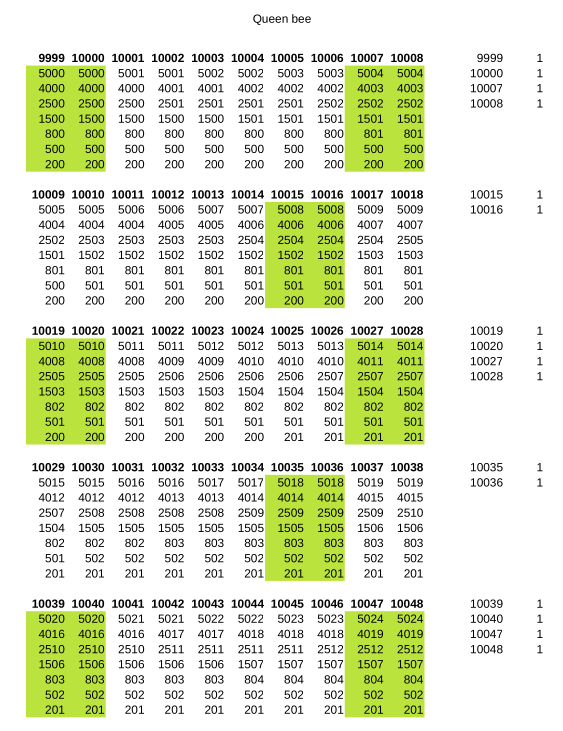
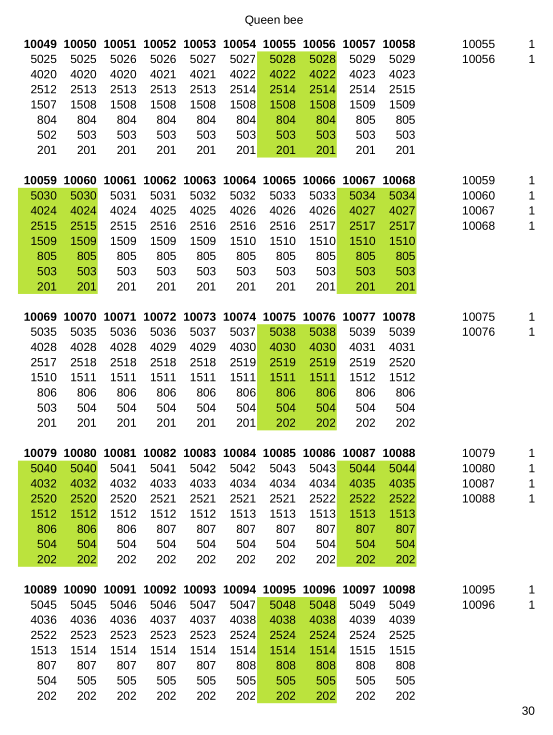
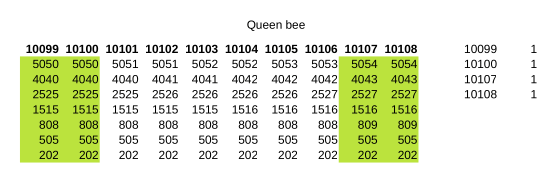
At a glance, the pattern repeats every 20. Ambiguous? 6/20. Unambiguous? 14/20. Result confirmed.

