This week the #puzzle is: How Far Can You Roll? #arclength #estimate #coding #montecarlo #average
| For her photography show, Frederica Fiddleria attaches a light to a point on the circumference of a circular wheel with a radius of 1 meter. She points a camera at the wheel and, during a single long exposure, rolls the wheel for one revolution along the ground. |
| When she develops the film, she is curious about the path the light took as the wheel rolled. What is the length of this path? |
And for extra credit:
| For her next show, Frederica wants to mix things up. Instead of placing the light on the circumference of the wheel, she will pick a random point inside the circle. (Before you ask, let me clarify what “random” means here: Any two regions with the same area are equally likely to contain the point.) |
| As before, she will roll the wheel for one revolution along the ground and capture the motion with a single long exposure on her camera. On average, what can she expect the length of the path to be? |

Intermission
Last week I didn’t really try to solve the fiddler. It involved learning rules to games, solving a chess puzzle, and picking up on subtle verbal cues. None of them are my strong suits.
Solution, possibly incorrect:
Okay, so this will be a little stream of consciousnessy. Apparently the curve, we’re looking for is a cycloid. And the length of the curve is an arc length. For a cycloid, the arc length is (see source above). With , the arc length will be .
Result: 8 meters. (Method 1.)
Oh. And I assume the distance between camera and light is large enough, that I don’t have to account for whatever it’s called, when the motive is distorted. Perspective? Parallax?
In general the length of a path (the arc length) is:
Just to test how this works, let’s look at a circle.
And combining all this:
This fits what we expect. So I guess I know how to use this formula.
For the cycloid, the formulas are:
Or how WolframAlpha would put it:
integral square root((1-cos(t))^2+sin(t)^2) from 0 to 2pi
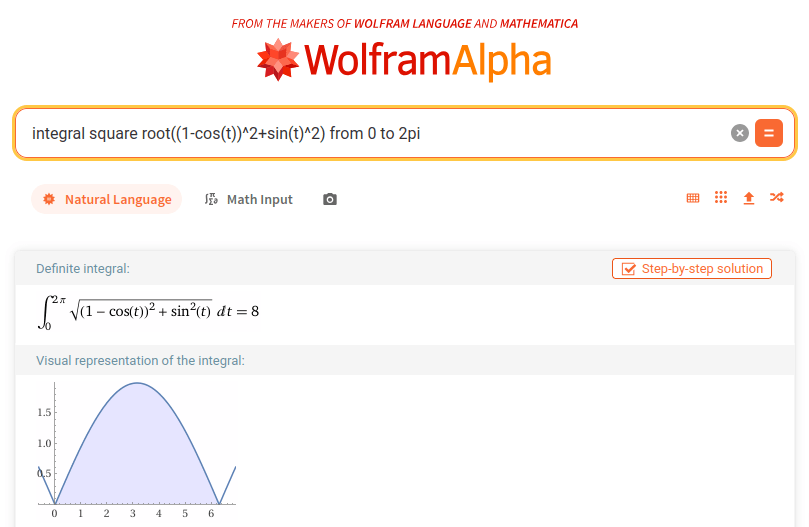
Everything seems to work okay. I guess that was method 2. Moving on.
And for extra credit:
Trochoid  Arc length of a trochoid Program
This time the curve is a trochoid. A cycloid as a special case of that. And it’s my lucky day! The arc length of that one is already calculated Out There. A new parameter is b (again), the distance between the point on the circle and the center of the circle.
Where E is an elliptical integral. Let me see… Ah yes.
Hm. There’s something wrong. E can’t have both 1 and 2 parameters.
There’s another definition of L:
I think I’m supposed to read it like this actually:
And then combining:
No. Scratch method 1. Let me go back to the definitions for the point.
Then I code a monte carlo approach, where the arc length is estimated by assuming I can just look at some points along the curve and calculate at all the little straight distances between these. Just to make sure my approach works, I also code the fiddler and sort of get the same result. Then I run the program a few times.
Result 2: 7.109200
Result 2: 7.112045
Result 2: 7.111690
Result 2: 7.111431
I am confident I can say the rounded answer is 7.11. Method 2 worked out. And I guess also gave a method 3 for the fiddler.
 Stuff from ommadawn.dk (Lise Andreasen)
You would enjoy this pretty picture which provides the same answer!
https://www.desmos.com/calculator/h50kgcqb5q
LikeLike
Yes! Nice.
LikeLike