This week the #puzzle is: Can You Sneak Past the Rings? #probabilities #montecarlo #coding #plot
| A long vertical cylinder has three narrow open rings, each of which wraps around seven-eighths of the cylinder (leaving a one-eighth “gap”). The rings are evenly spaced vertically, but are otherwise randomly rotated about the cylinder’s central axis. For some orientations of the rings, there exists at least one vertical line down the cylinder’s surface that passes through each ring’s gap, as illustrated below. |
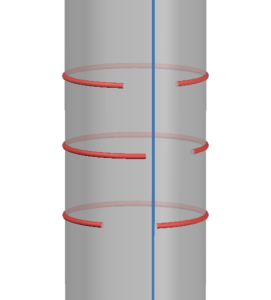 |
| What is the probability that at least one such vertical line exists? |
And for extra credit:
| Instead of requiring a vertical line down the cylinder’s surface, now any helix down the surface is allowed. An example of such a helix passing through all three gaps is shown below. |
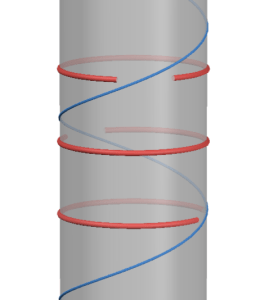 |
| What is the probability that there exists at least one such helix that can pass through each ring’s gap? |

Solution, possibly incorrect:
Method 1: Monte Carlo. It’s a bit fiddly, because when exactly do the 3 gaps overlap? I settle on:
- Put the 1st gap at 0 – 1/8, WLOG.
- If possible, create the overlap between the 2 1st gaps.
- Then look for an overlap between that overlap and the 3rd gap.
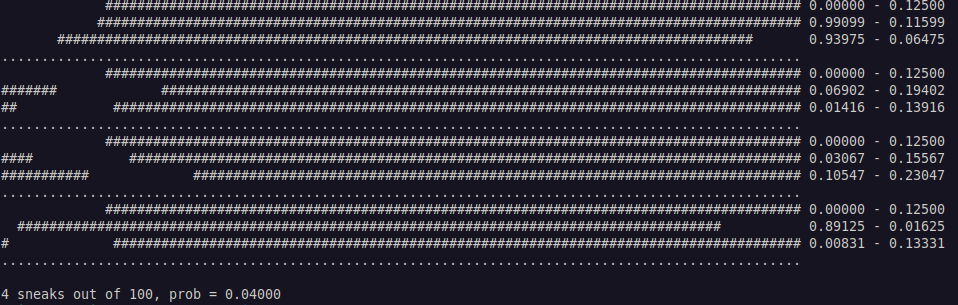
467910 sneaks out of 10000000, prob = 0.04679
468490 sneaks out of 10000000, prob = 0.04685
468187 sneaks out of 10000000, prob = 0.04682
Once I had all those conditions in place, I could actually do method 2, plot it in Desmos.
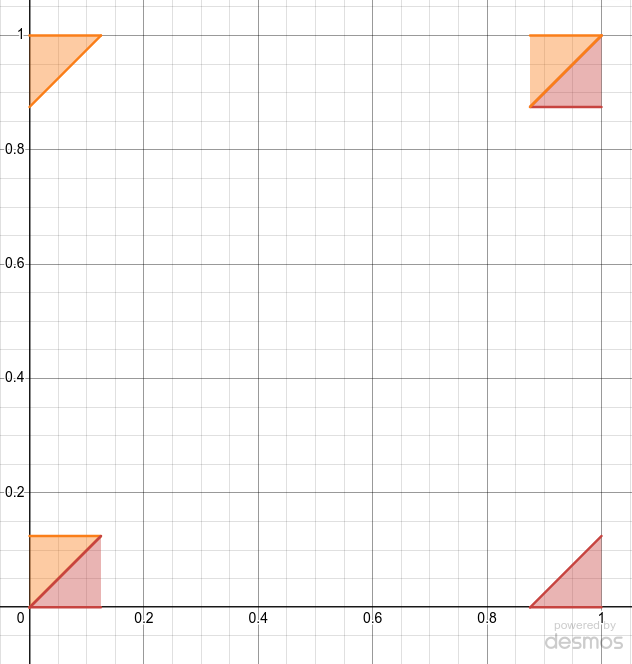
It was fun to figure out how to plot it. How the cases combine. I look at the cases for the double overlap in the columns and the cases for the triple overlap in the rows.
| Gap 1: a-b, 0 – 1/8 Gap 2: c-d, c = x, Gap 3: e-f, e = y, In general, overlap goes | Overlap: c-b, x – 1/8 | Overlap: a-d, 0 – [x – 1 + 1/8] |
| Impossible | ||
| Impossible |
Anyway. The result is 6 triangles. Each triangle has an area of . The area of all the triangles is . This agrees with method 1.
Result: 0.046875.
And for extra credit:
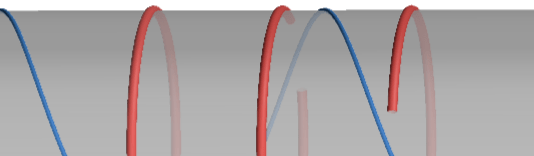
I recreated the situation in Desmos and played around a little. Among other things, I construct the (orange) interval e has to fall in, in order to make a helix possible.
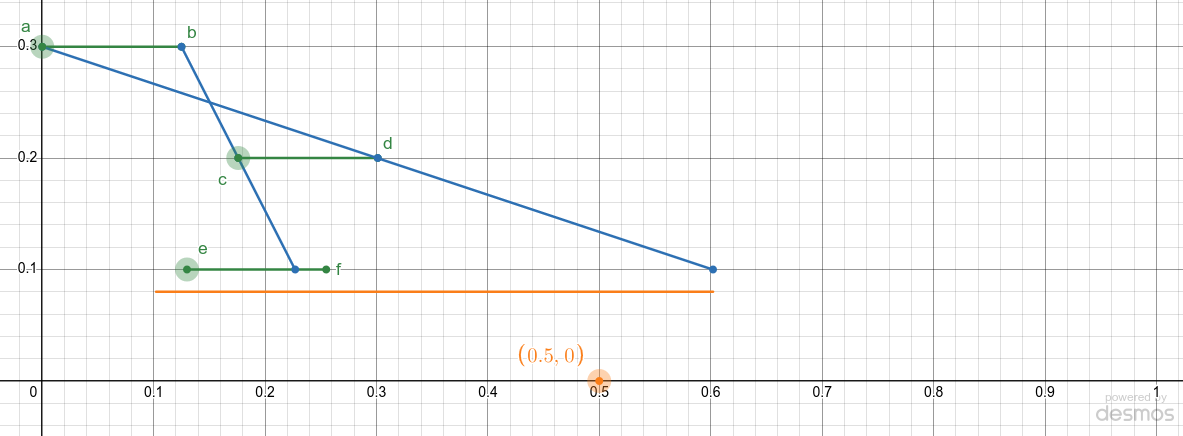
Interestingly, this interval always has length 0.5, corresponding to a probability of 0.5.
- My x axis shows how far along the circumference of the cylinder I am. As with the fiddler, the first gap is frozen 0 – 1/8.
- The helix has to go through a and d, or b and c, or somewhere in between. This corresponds to different slopes of the helix.
- I construct a point on the line going through b and c and crossing the 3rd ring. This point will have .
- This leads to .
- I also construct a point on the line going through a and d and crossing the 3rd ring. This point will have .
- This leads to .
- The interval for e to fall within is therefore .
- The length of this interval is
So the result is 0.5. I am surprised, that the answer is so simple.

