#ThisWeeksFiddler, 20260220

This week the #puzzle is: Can the Archers Coordinate? #probabilities

Two logicians are trying to earn a fabulous prize as a team. There are three targets, and, to win the prize, each logician must fire a single arrow and hit the same target as the other. Two of the targets are closer but are otherwise indistinguishable; the logicians know they each have a 98 percent chance of hitting either of these targets. The third target is farther away; the logicians know they each have a 70 percent chance of hitting that target.
The logicians can’t cooperate or consult in advance, and they have no knowledge of which target their counterpart is aiming for or whether they are successful.
What is the probability they will win the prize?

And for extra credit:

As before, there are still three targets, but their respective probabilities of being struck have changed. That said, two of the targets remain indistinguishable from each other and have the same probability of being struck. Moreover, all three probabilities are rational.
After doing some mental arithmetic, the logicians realize that it doesn’t matter which target they aim for—their probability of winning the prize is the same no matter what.
What is their probability of winning the prize?

Can the Archers Coordinate?

Possibly incorrect solution:

If the logicians could’ve consulted beforehand, they could have chosen 1 of 2 strategies. The 1st one involves aiming for one of the easy targets, the 2nd involves aiming for the hard target. Let’s look at the probability a strategy succeeds.

p(s1)=0.980.50.98=0.4802p(s_{1}) = 0.98 \cdot 0.5 \cdot 0.98=0.4802

p(s2)=0.70.7=0.49p(s_{2})=0.7 \cdot 0.7=0.49

The 1st strategy includes, that the 2nd logician won’t know, which easy target the 1st logician aimed at, so there’s a 50% chance of aiming for the same one.

Both logicians will realize, that the 2nd strategy is superior. They both employ this strategy. The probability they will win the prize is 0.49 = 49%.

And for extra credit:

This time the probabilities depend on unknown numbers for the underlying probabilities. Based on integer choices for all the unknown numbers (so that the resulting probabilities are rational), this must hold:

peasy=mnp_{easy}=\frac{m}{n}

phard=oqp_{hard}=\frac{o}{q}

It doesn’t matter which target is chosen, the probabilities will be the same. This means.

p(s1)=p(s2)p(s_{1})=p(s_{2})

0.5(mn)2=(oq)20.5 {(\frac{m}{n})^{2}}={(\frac{o}{q})^{2}}

0.5m2q2=o2n20.5 {m²}{q²}={o²}{n²}

0.5mq=on\sqrt{0.5}mq=on

As the square root isn’t an integer, this must mean the rest of the equation is 0.

m=o=0m=o=0

Therefore the probability of hitting anything is 0.

My only problem is, this doesn’t seem to require any mental arithmetic?

Another solution could be, that actually all 3 targets are indistinguishable. But again, this wouldn’t require any mental arithmetic. Still, in that case the probability would be, for some integers:

p(s)=13m2n2,mn1p(s)=\frac{1}{3}\frac{m^{2}}{n^{2}} , \frac{m}{n} \leq 1

The chance they choose the same target, and the chance of hitting it.

Result: m^2/3n^2, m and n integers, at least 0, at most 1/3.

#ThisWeeksFiddler, 20260213

This week the #puzzle is: Can You Get the Rover Home? #trigonometry #spherical #3d #animation #desmos3d

A rover is dropped down on a spherical planet with a radius of 1000 miles. The rover has been programmed with a very specific set of motions:
– First, it moves straight forward a fixed distance s, and stops.
– Without moving forward, it turns left 60 degrees. (Importantly, the rover turns 60 degrees, not 120 degrees.)
– Next, the rover moves straight forward in this new direction another distance s, and stops.
– Without moving forward, it again turns left 60 degrees.
– Finally, the rover moves straight forward in this new direction another distance s, and stops.
To be picked up, the rover must complete its journey in the same place it was dropped down. What is the minimum value of s, with s > 0, for which this works?
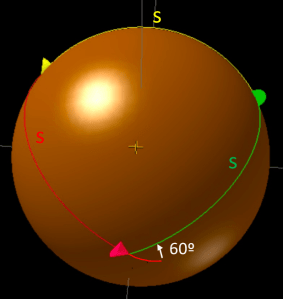
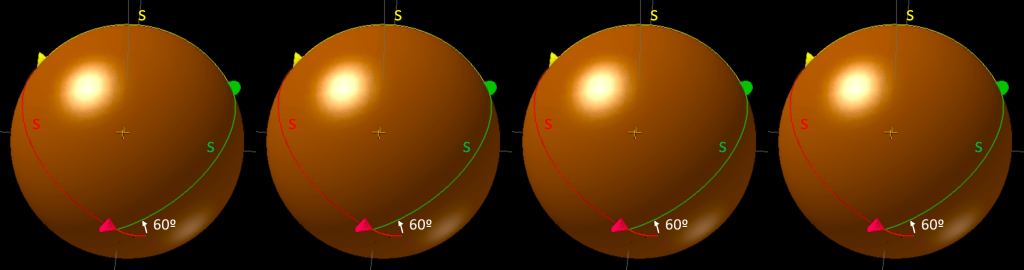
To help you out, here’s an illustration, courtesy of Pierre, of what such a path might look like:

And for extra credit:

There are other values of s for which the rover will end its journey where it was dropped down. How many such positive values of s (including the answer you just found in the Fiddler) are less than 100,000 miles?

Can You Get the Rover Home?

Possibly incorrect solution:

Method 1: Turns out there’s a Spherical law of cosines! Who knew! This law says:

cos(c)=cos(a)cos(b)+sin(a)sin(b)cos(C)cos(c)=cos(a)cos(b)+sin(a)sin(b)cos(C)

In our case:

a=b=c=s1000a=b=c=\frac{s}{1000}

C=120°C=120 \degree

So we’re just looking for s.

cos(s1000)=cos(s1000)cos(s1000)+sin(s1000)sin(s1000)(12)cos(\frac{s}{1000})=cos(\frac{s}{1000})cos(\frac{s}{1000})+sin(\frac{s}{1000})sin(\frac{s}{1000})(-\frac{1}{2})

Solutions:

s1n=2(πntan1(2))1000s_{1n}=2(\pi n – tan^{-1}(\sqrt{2}))1000

s2n=2πn1000s_{2n}=2 \pi n 1000

s3n=2(πn+tan1(2))1000s_{3n}=2(\pi n + tan^{-1}(\sqrt{2}))1000

In our case the most interesting solution is this one:

s30=2(π0+tan1(2))10001911s_{30}=2(\pi 0 + tan^{-1}(\sqrt{2}))1000 \approx1911

Method 2: I looked at the sphere is Desmos . Looks good.

Result: 1911 miles.

Animations

I have made animations of the 3 situations! I am insanely proud of them!

Desmos 6 , Desmos 7 , Desmos 8 .

And for extra credit:

Method 1: The solutions are clustered around:

2πn10002 \pi n 1000

The next 3 solutions are:

4373,6238,81944373, 6238, 8194

The 3rd solution of these is a replica of the fiddler solution, it just goes all the way around the planet before taking the 1911 miles.

The 2nd solution is going all the way around the planet to the starting point. The trivial one.

The 1st solution emulates the fiddler. Imagine a fiddler solution. Start at one of the corners. Then instead of going to the next corner, go in the opposite direction, away from the triangle, going around the planet and arriving at the next corner. Etc.

There will be a set of solutions for n = 15:

92337,94247,9615892337, 94247, 96158

And a partial set for n = 16:

9862098620

And then the values grow larger than 100000.

So there’s 1 + 15 * 3 + 1 solutions.

Method 2: I also looked at these solutions in Desmos.

Result: 47 solutions.

Spock inspires scientists

#SFinspiresScientists

From Natalie Portman, Oscar Winner, Was Also a Precocious Scientist :

“Leonard Nimoy, who played the most famous TV scientist of all time, Mr. Spock, came from an arts and theater background and in real life is nothing like his character. Yet he told me that because Mr. Spock and “Star Trek” have inspired so many young viewers to become scientists, researchers who meet him are always desperate to give him lab tours and explain the projects they’re pursuing in peer-to-peer terms. Mr. Nimoy nods sagely and intones to each one, “Well, it certainly looks like you’re headed in the right direction.””

#ThisWeeksFiddler, 20260206

This week the #puzzle is: How Long Is the All-Star Streak? #math #probabilities #InfiniteSums #coding #MonteCarlo

The Fiddler Basketball Association’s All-Star Game consists of two teams: “East” and “West.” Every year these two teams play a game, each with a 50 percent chance of winning that’s independent of the outcomes of previous years.
Many, many years into the future, you look at the most recent results of the All-Star Game. On average, what is the longest current winning streak that one of the teams is on? (Here, having won only the most recent game still counts as a “streak” of one game.)

And for extra credit:

To spice up the All-Star Game, the commissioner of the FBA has decided that there will now be three teams competing in All-Star Games: “Stars,” “Stripes,” and “International.” Each year, two of the three teams play each other. If one year has Stars vs. Stripes, the next year has Stripes vs. International, the year after that has International vs. Stars, and then the cycle repeats with Stars vs. Stripes.
Many, many years after this new format has been adopted, you look at the most recent results of the All-Star game. On average, what is the longest current winning streak that one of the teams is on? (As before, having won one game counts as a “streak.” Also, note that the team with the longest winning streak might not be one of the two teams that played in the most recent All-Star Game.)

How Long Is the All-Star Streak?

Highlight to reveal (possibly incorrect) solution:

Math StackExchange Program

And for extra credit:

Spreadsheet

#ThisWeeksFiddler, 20260130

This week the #puzzle is: Can You Hop in a Spiral? #geometry #trigonometry #angle #arctan #minimize #markovchain #coding

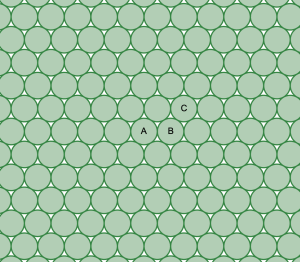
Frankie the frog is hopping on a large, packed grid of lily pads, shown below. The pads are circular and each is a distance 1 from its nearest neighbors. (More concretely: Each pad has a diameter of 1 and they are arranged in a hexagonal lattice.) Frankie starts at (0, 0), the center of the pad labeled A. Then she hops due east to pad B at (1, 0), and from there she hops to pad C at (1.5, √(3)/2).
She wants to continue hopping in a counterclockwise, spiral-like pattern. Each of her jumps is to the center of a neighboring pad, a net distance of 1. But there are two rules her spiral must follow:
– Each next pad must be in a more counterclockwise direction (relative to spiral’s origin at pad A) than the previous pad.
– Each pad must be farther from A than the previous pad.
After a number of hops spiraling around, Frankie realizes she is, once again, due east from A. What is the closest to A she could possibly be? That is, what is the minimum possible distance between the center of the pad she’s currently on from the center of pad A?

And for extra credit:

Frankie has stored all of her food on lily pad A. However, her food has a tendency to “fly” away. Every second, the food that’s on every lily pad splits up into six equal portions that instantaneously relocate to the six neighboring pads.
At zero seconds, all the food is on lily pad A. After one second, there’s no food on pad A, and 1/6 of the food is on each of the surrounding six pads. After two seconds, 1/6 of the food is again on pad A, while the rest of the food is elsewhere.
After how many seconds N (with N > 2) will pad A have less than 1 percent of its original amount?

Can You Hop in a Spiral?

Highlight to reveal (possibly incorrect) solution:

Desmos 1 Program Desmos 2

  • Sketch: Rotate the situation around A. L3 is now on x = 0. Do similar calculations. Etc.

And for extra credit:

Spreadsheet