Let’s celebrate ancient Egypt. With a match 3 game!
Further, let’s celebrate with a couple of dark patterns.
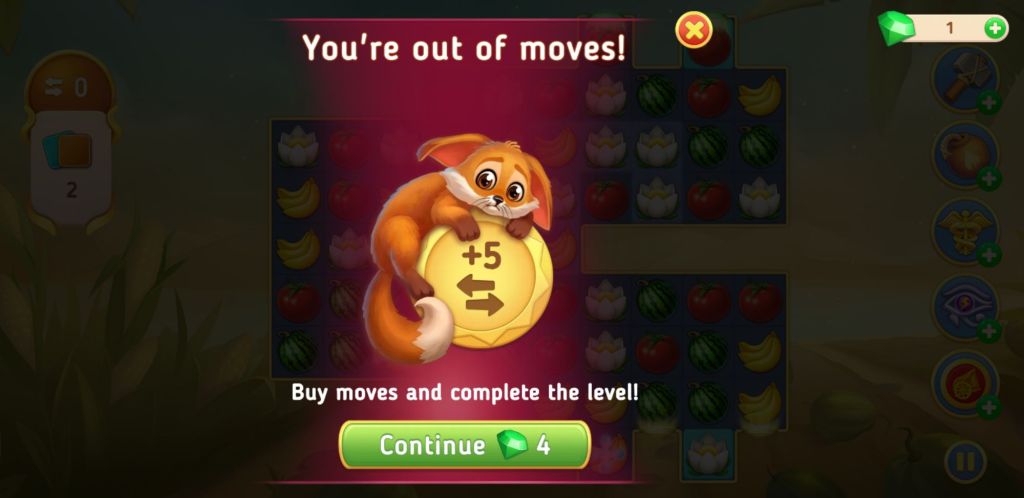
Oh no! No more moves! Ah well. I have no green jewels, so I just tap the cross.
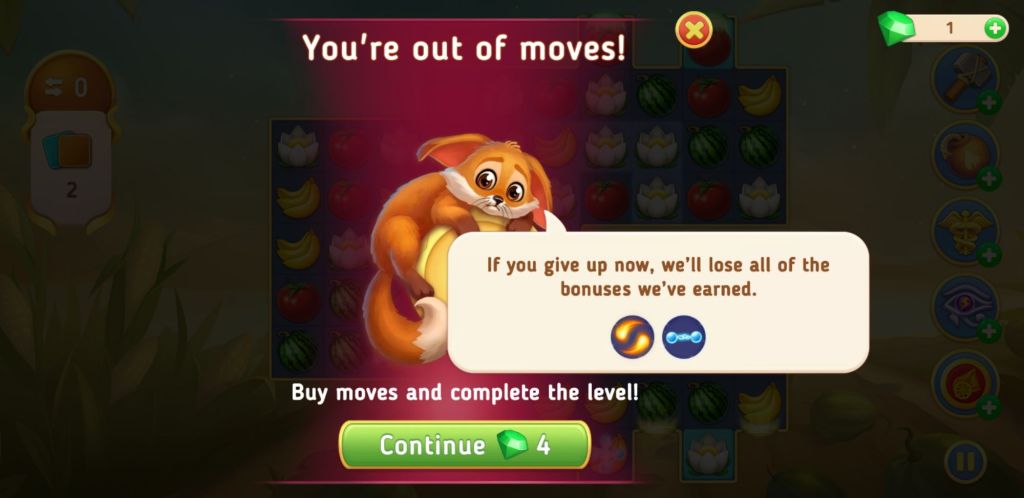
Are you sure? (The alternative is to buy, with real money, green jewels and spend them here.)
Okay. This game has lots of different kinds of levels. I’ll just play another one.
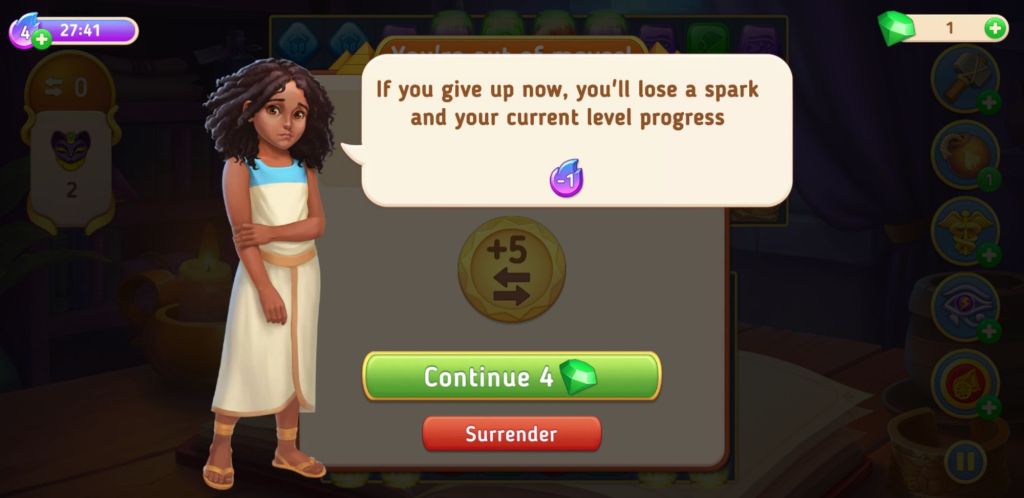
Oh no! No more moves. Ah well. I have no green jewels, so I just tap the cross.
Are you sure?
Sigh.
It’s actually a good game. I haven’t seen all of the game techniques before, and there’s usually a level I can play, here or there, or some bonus to collect. But…
Jeg har nu (på rette tid for ikke biografen, ikke blueray, men streaming via abonnement) set The Creator. Det her er ikke en helstøbt anmeldelse, men mere et par funderinger, efter også at have set lidt ekstramateriale. Spoilers.
Den ene fundering er meget kortfattet. Vi ser, at robotter og kunstig intelligens lever side om side med mennesker i Asien-ish. Vi ser ikke umiddelbart nogle begrænsninger, omend det kan være svært at se, om en given robot har rigtig kunstig intelligens eller “bare” er programmeret. Der er robot-munke. Robotter kan adoptere (i praksis) menneskebørn.
Så hvad hulen betyder det, når en robot siger “jeg vil være fri”?
Fri for at få en amerikansk bombe i hovedet? Fordi det ville jeg ikke formulere på den måde.
Den anden fundering går på, at vi bliver præsenteret for en konflikt med 3 sider: USA-ish, Asien-ish og AI. AI var vældig nyttigt et stykke tid, men så gik en af dem amok. USA har ganske fornuftigt forbudt alt sådan noget. Asien er ikke lige så fornuftige, men bare rolig, det skal USA nok fikse. Ingen problemer i at komme på besøg og ordne sagerne. Fornylig er der kommet nyt om et AI-supervåben. Det skal selvfølgelig stoppes. Så amerikanerne sadler deres jetjagere, og så afsted.
Bortset fra, at jeg som tilskuer ikke tror på den udlægning i 5 minutter. AI virker som nogle flinke fyre. Supervåbnet skal ikke overvinde USA, men overvinde krig. Faktisk er konflikten mellem USA og hvem de nu end synes er forkert på den. Amerikanerne er de onde! Det er ikke så tit, Hollywood giver os den version.
Underligt nok taler forfatteren/instruktøren om dilemma, nuance og sådan noget. Er det den samme film, vi snakker om? Der er måske 5 mm nuance.
Derudover vil jeg egentlig bare nævne, at filmen er flot. Når der har været behov for at filme rismarker, så har de fundet nogle rismarker. Og så vil jeg også nævne, at de 2 primære skuespillere er gode.
Nikoli the snake wants to slither along a loop through a four-by-four grid of points. To form a loop, Nikoli can connect any horizontally or vertically adjacent points with a line segment. However, Nikoli has certain standards when it comes to loop construction. In particular:
– The loop can never cross over itself. – No two corners of the loop can meet at the same point. – Once Nikoli has crossed the connection between two points, Nikoli can’t cross it again (in either direction).
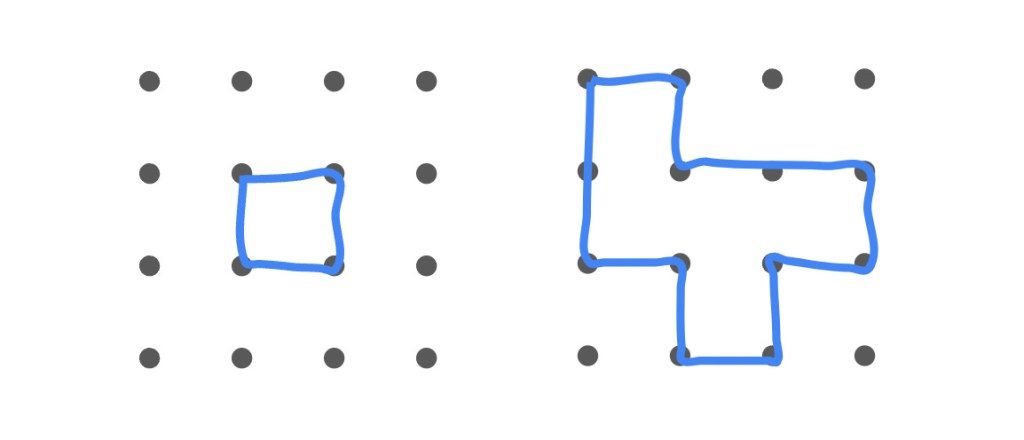
For example, the following two constructions are valid loops:
Meanwhile, the following three constructions are not valid. The one on the left crosses over itself, the one in the middle has two corners that meet at a single point, and the one on the right requires Nikoli to pass over the same line segment twice.
How many unique loops can Nikoli make on the four-by-four grid? (For any given loop, Nikoli can travel in two directions around it. However, these should still be counted as a single loop.)
And here’s my suggested solution, highlight to reveal:
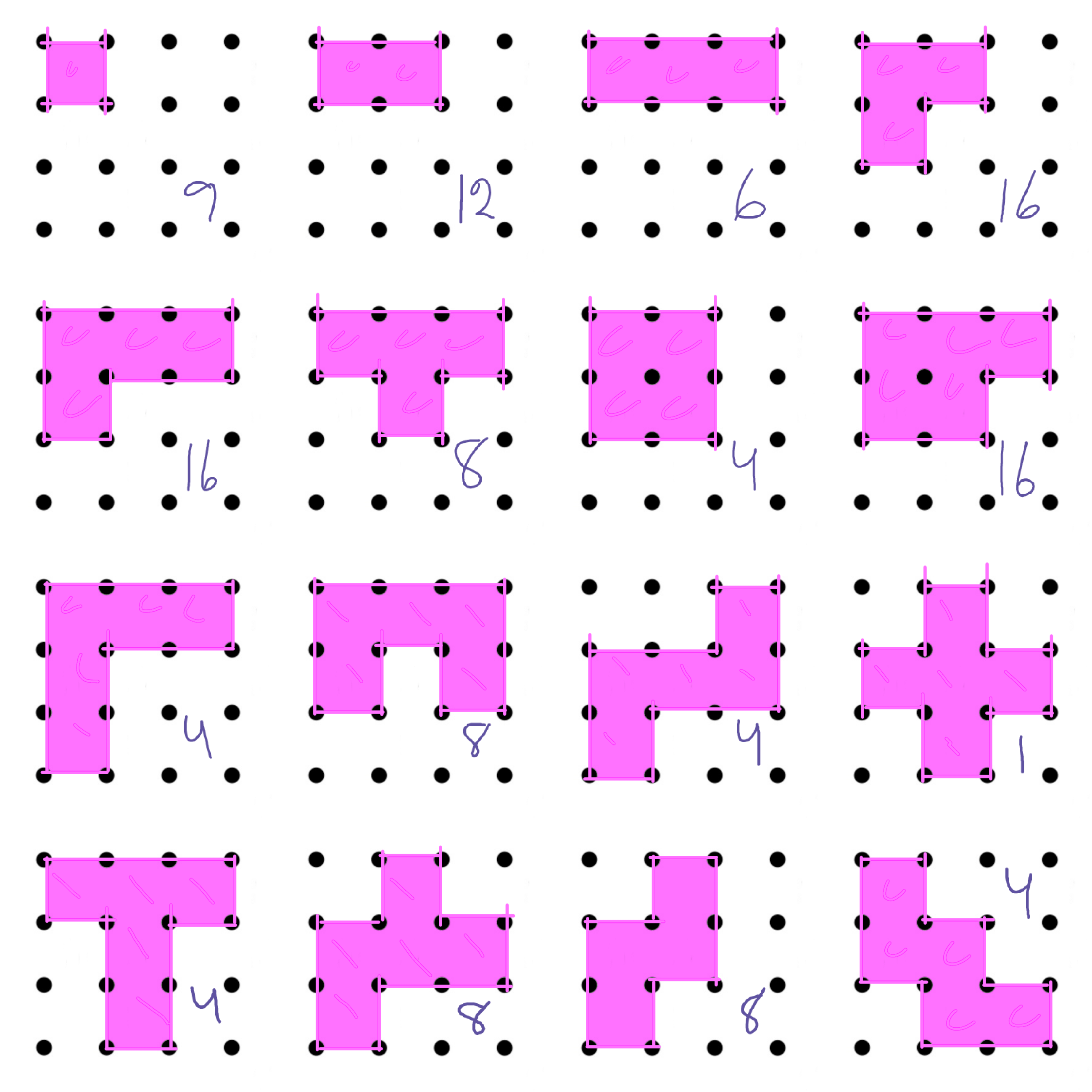
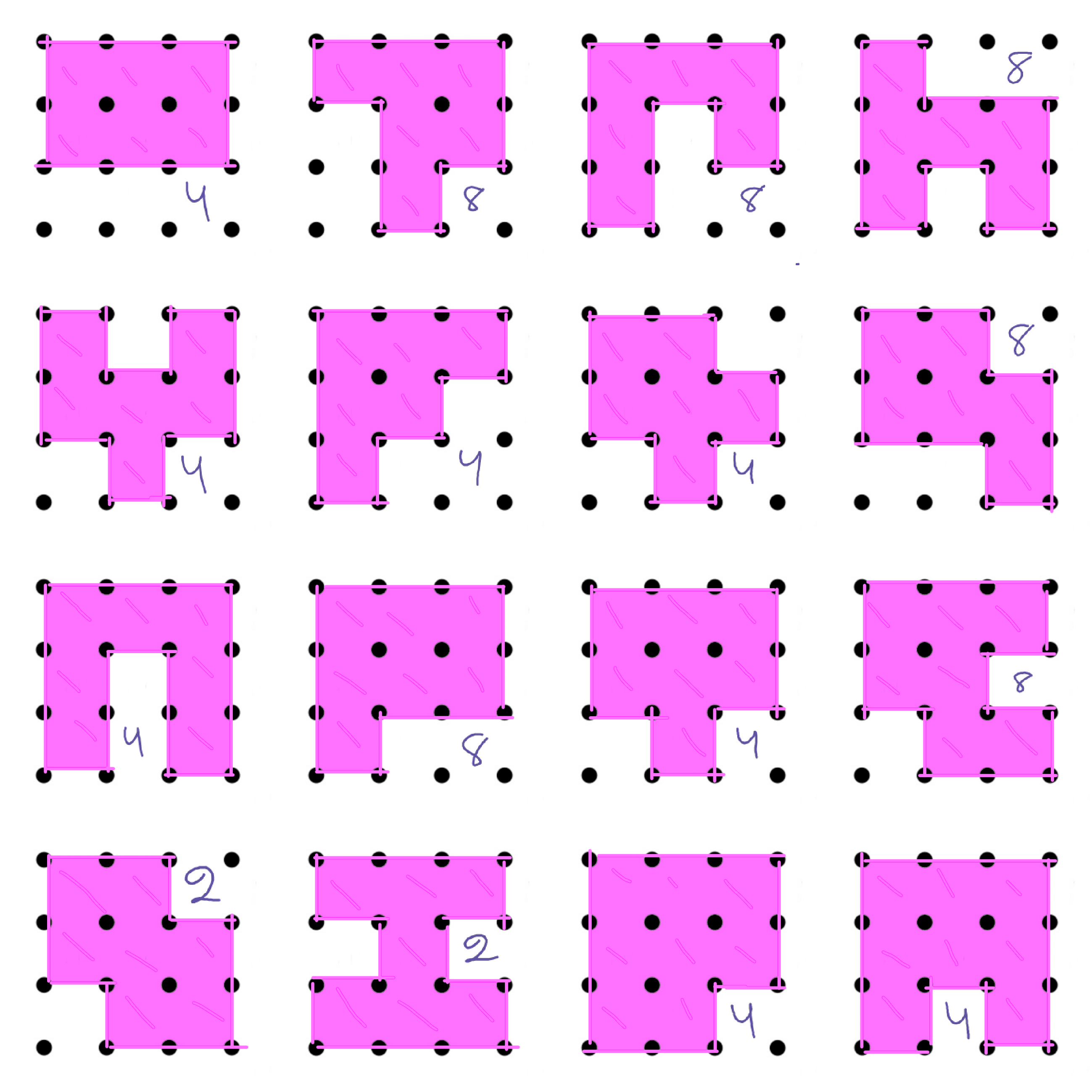
Instead of focusing on the loop, I looked at the squares within the loop. E.g. the first valid loop above encloses one small square, the square in the middle of the grid. If I translate the conditions, I’m looking for a combination of squares, combining into one figure, where all squares are connected side to side. No corner connections, please. I then tried to write all the possible figures down. This is easy enough with 1, 2, 3, 8 and 9 squares. With the rest I got some assistance from Wikipedia, with list of tetrominoes, pentominoes etc.
Once I had my list, for each figure I counted, how many ways it could be placed in the grid. If we look again at the first valid loop above, counting all mirrors, rotations and simple moves, there are 9 versions of this loop.
The video has a solution, but mine is a little different.
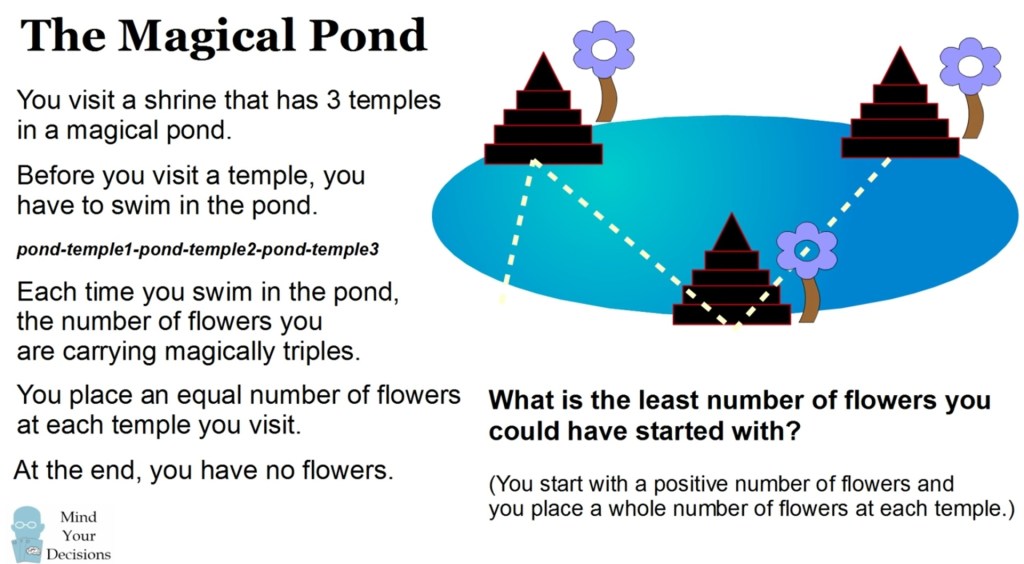
I construct a reverse timeline. Below I write all my actions, and I count the flowers. For now I assume I leave 1 flower at each temple, and that fractions are okay.
*
0 flowers
*
Leave 1 flower at temple 3
*
1 flower
*
Swim
*
1/3 flowers
*
Leave 1 flower at temple 2
*
4/3 flowers
*
Swim
*
4/9 flowers
*
Leave 1 flower at temple 1
*
13/9 flowers
*
Swim
*
13/27 flowers
If I take all these numbers, they are: 0, 1, 1/3, 4/3, 4/9, 13/9, 13/27.
In reality, I don’t know how many flowers I leave each time. If I leave n flowers, my numbers would be: 0*n, 1*n, 1/3*n, 4/3*n, 4/9*n, 13/9*n, 13/27*n. All of these numbers have to be nonnegative integers. To accomplish that, n has to be a multiple of 27. To use the smallest number of flowers, n is simply 27. So we had 13 flowers to begin with.
For any positive, base-10 integer N, define f(N) as the number of times you have to add up its digits until you get a one-digit number. For example, f(23) = 1 because 2+3 = 5, a one-digit number. Meanwhile, f(888) = 2, since 8+8+8 = 24, a two-digit number, and then adding up those digits gives you 2+4 = 6, a one-digit number.
Find the smallest whole number N such that f(N) = 4.
And let’s look at the extra credit puzzle too:
For how many whole numbers N between 1 and 10,000 (inclusive, not that it matters) does f(N) = 3?
And here’s my suggested solution, highlight to reveal:
For the first puzzle, I created a small program, to explore what’s going on.
If I’m looking for the lowest N, f(N) = 2, 19 is a good bet. Likewise, for f(N) = 3, we can use 199. Then my program broke down, when I tried to move to 4…
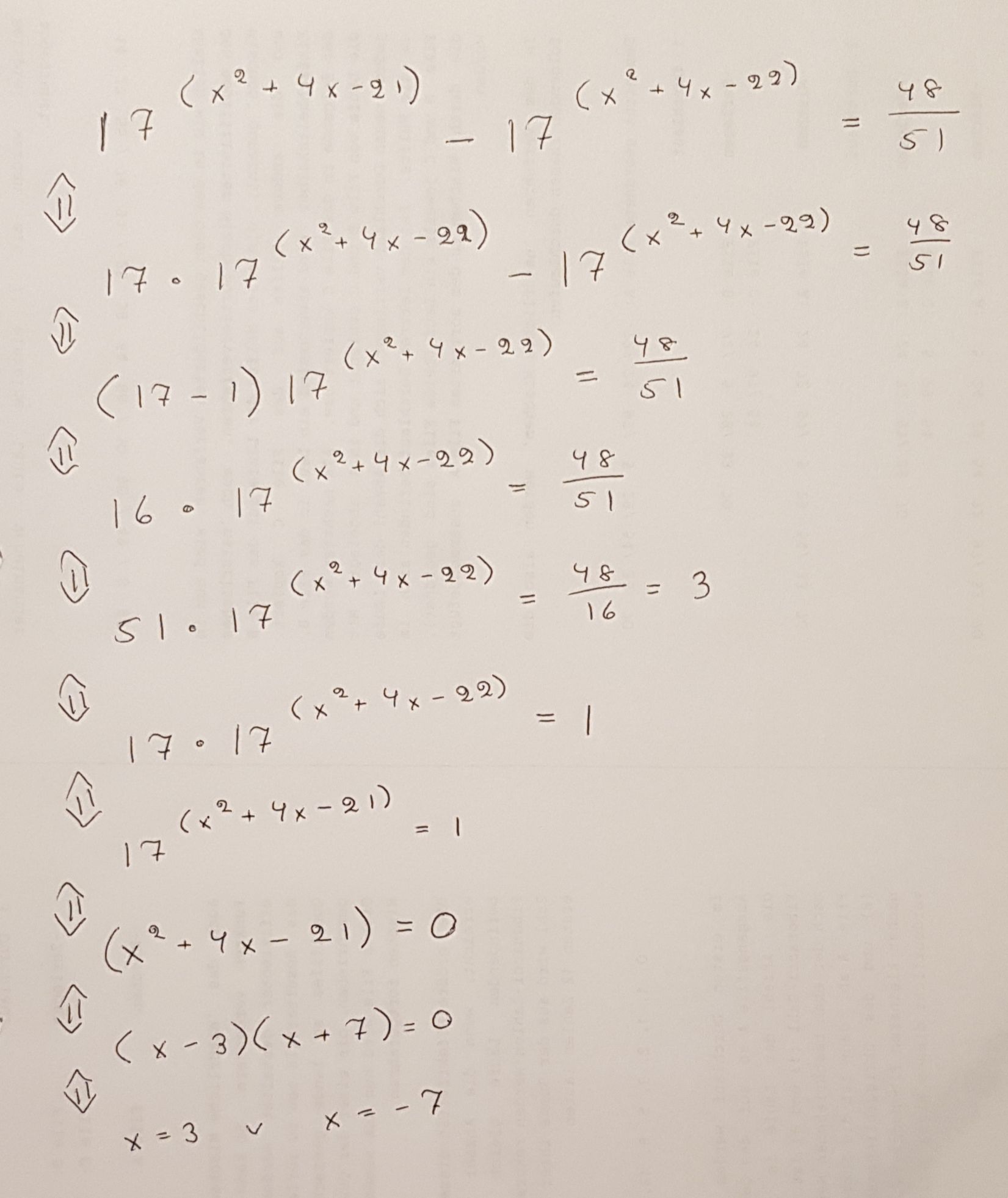
Let’s look at this a different way. The digit sum for 199 is 19. The digit sum for 19 is 10. The digit sum for 10 is 1. Aha! There’s something going on here. N = 19 (read, one 1, one 9) gets me to f(N)=2. N = 199 (read, one 1, two 9s) gets me to f(N)=3. There’s something very efficient about using 9s. Few digits, big sum. Question is, how do we take the next step? Well, 199 = 1 + 22*9. So it might be 19999999999999999999999 (read, one 1, twentytwo 9s). And I can’t think of a reason, why anything smaller would work.
For the second puzzle, I modified the earlier code into a new program. This time I’m testing all the numbers, counting all those where I get 3. And the answer is 945.
This is an attempt to list the differences between the book and the movie, The Prestige. I have recently read the book for the first time and watched the movie again. They are both great, but the differences are interesting. Heavily inspired by The Prestige Book vs Movie. Presented somewhat chronologically. Spoilers!
Book
Movie
Abbreviations: Robert Angier (RA) and Alfred Borden (AB).
The story is in 5 parts. Each part has its own chronology. The parts are clearly separated and sequential. Several parts may cover the same time. Mostly the different parts are told from different points of view. The secret of both RA and AB are kept secret for a long time, but not until the very end. The climax isn’t in the movie.
The story is roughly in 3 parts. The parts cover different parts of the time line. The parts are separated by geography and locations, and a limp is in some parts. We cut back and forth between the parts, and there are occasional flashbacks as well. The climax is the reveal of the secrets of first AB, then RA.
We learn about RA and AB’s childhood. We learn about RA’s family and his relationship to a lord.
We learn a lot about how RA met and married Julia.
RA and AB became aware of each other as they were both starting out as magicians.
RA and AB became aware of each other while working as assistants for another magician.
For a while, RA works as a spiritualist. AB sees a big difference between working this way and as a magician.
Trying to sabotage RA, AB ends up causing (probably) the miscarriage of RA and Julia’s child. Julia has 3 other children, and then RA and Julia become estranged.
Trying to prove a point, AB ends up causing (probably) the death of Julia.
RA and AB regularly sabotage each other, but mostly not violently.
RA shoots AB, causing him to lose 2 fingers. AB interferes in an act, causing RA to break a leg.
We learn a lot about how AB and Sarah met, and how she feels about the double life of AB.
The alternate AB mainly keeps away.
The alternate AB is called Fallon and is disguised. At one point, Fallon is kidnapped by RA.
RA’s double, Root, is manipulated by AB.
Olive is American and joins RA in USA.
Olive is British.
Olive agrees to spy on AB, and gives RA one word: Tesla.
Olive agrees to spy on AB, and gives RA AB’s diary and later a word to decipher it: Tesla.
Sarah doesn’t suspect the double life of AB.
Sarah suspects plenty and commits suicide.
Tesla’s machine duplicates a metal rod.
Tesla’s machine duplicates RA’s tophat.
When duplicating someone alive, the original almost dies.
When duplicating someone alive, the original is basically exactly like the copy.
It has a great effect on RA being duplicated, first great pain and depression, later exhilaration. Sometimes he does it for fun.
When doing the act, the original is first hidden, then quietly killed and stored in a family tomb.
When doing the act, the original is drowned immediately and then stored in an unused theatre.
RA makes amends and reconnects with Julia.
AB sneaks behind the scenes. He shuts down the machine for safety reasons, without knowing this interfers with the act. He then leaves.
AB sneaks behind the scenes. He sees an original RA drowning and tries to save him. He is unsuccessful and is framed for murdering RA.
While in prison, AB reads RA’s diary. RA takes steps to adopt AB’s daughter. AB is executed.
After the interference of AB, RA has to end his career, and the burial of the magician is conducted. The botched copy has a separate life for a while, among other things trying to kill AB. 3 days later the alternate AB dies of a heart attack, but this is completely hushed up.
The surviving AB kills RA. He then gets his daughter back.
Facing economic problems, Olive decides to sell AB’s diary to RA. RA reads it and has an edited version published.
Seriously ill, the original RA later dies for real.
Part of the story takes place in “our time”, 3 generations after the main story between AB and RA.
The story is only about AB and RA.
There’s an argument to be made, that one difference between book and movie is, who the protagonist is.
As always, it’s a satisfying exercise to write something like this down. It sort of crystallizes for me, whether I accept the changes made. Like, some of the changes seem big, but are actually cases of combining elements.
Hopefully it proves useful to someone else as well.