[Pizza and snake.] The [pizza] slice … is an equilateral triangle with a side length of 10 inches. I specifically want to request the smallest rectangle of foil (by area) such that I can completely cover the slice above and below. I can’t fold the pizza, but I’m allowed to make as many straight folds in the foil as I want, without tearing it. What is the area of the smallest such rectangle of foil that would do the trick?
I suggest that the slice can be wrapped in this piece of foil, no less. (That picture has both the top and the bottom of the slice visible. Before cutting the foil, it would actually look more like this.) After a few calculations, I deduce that the area of the foil is 15 * 5√3 = 75√3 = 130, approximately.
ETA: I have since seen a solution with 115. So there…
Reddit has a lot of great puzzles, like this one: MATH PROBLEM
Vehicles are traveling on the same route. First they pass point A, then point B. Vehicles pass point A in equal time steps in the following order: a bus, a motorcycle, and a car. They pass by point B at the same time intervals again transportation: bus, car and motorcycle. Find the speed of the bus if the speed of the car is 90 km/h and the speed of the motorcycle is 60 km/h.
So here’s the situation, for B(us), M(otorcycle) and C(ar).
At t0 + 0δ B passes point A.
At t0 + 1δ M passes point A.
At t0 + 2δ C passes point A.
At t1 + 0δ B passes point B.
At t1 + 1δ C passes point B.
At t1 + 2δ M passes point B.
Whatever the distance is between the 2 points, this is how long the vehicles spend crossing.
C: t1 – t0 – δ
M: t1 – t0 + δ
B: t1 – t0
We know that v * t = d, velocity * time = distance. This gives us 3 new equations. For now, I’m not using any units, and t = t1 – t0, and we’re looking for vb.
Recently I have reread The Dispossessed, Le Guin. Going into it, I had a vague feeling he had short hair on his whole body, but I couldn’t remember anything else about his appearance. So I tried to gather what I could find, and here it is, from knobby baby to tall adult.
a knobby [baby]
a lanky eight-year-old with long hands and feet
His eyes were light, and the light from the window filled them so they seemed clear as water.
his colorless face, silvered with fine short hair
He was still lanky, with big hands, protruding ears, and angular joints, but in the perfect health and strength of early manhood he was very beautiful. His dun-colored hair, like the others’, was fine and straight, worn at its full length and kept off the forehead with a band.
the thin boy with big ears
light, steady, intelligent eyes
His light skin had tanned and the fine down that covered his face had bleached to silver
His hands, work-hard and blackened by frostbite, lay loose on his thighs; his face in relaxation was lined and sad.
the splendid reticent face, full of life but worn down, worn to the bone
light, remote eyes
a tall, frail figure
the fine shaggy head
his height, his long hair
the very fine, soft, short body hair of his race
He read that he was a towering giant of a man, that he was unshaven and possessed a ‘mane,’ whatever that was, of greying hair
his long, thin figure and narrow feet
two legs, two arms, and a head with some kind of brain in it
count his fingers and toes, add them up to twenty
his long, rough, dun-grey hair tied back with a piece of string
[Football, football, football.] Every time your team is on offense, suppose there’s a 1-in-3 chance they score a touchdown (which we’ll say is worth a total of 7 points, as we won’t bother with 2-point conversions here), a 1-in-3 chance they score a field goal (worth 3 points), and a 1-in-3 chance they don’t score any points (i.e., they punt or turn the ball over on downs). After any of these three things happens, your team will then be on defense.
Now, here’s how overtime will work: Your team is on offense first. No matter how many points your team does or does not score, the other team then gets a chance at offense. If the game is still tied beyond this point, the teams will continue alternating between offense and defense. Whichever team scores next wins immediately.
Again, your team is on offense first. What is your team’s probability of winning?
And let’s include the extra credit puzzle too:
If your team happens to score a touchdown on its first possession, then it doesn’t make sense for your opponent to then attempt a field goal, since they’d be guaranteed to lose. Instead, they would attempt to score a tying touchdown.
So let’s add the following to our model: When either team is on offense, they now have a choice. They can still opt for a strategy that results in 7 points, 3 points, or 0 points, each with a 1-in-3 chance. Alternatively, they can opt for a more aggressive strategy that results in 7 points or 0 points, each with a 1-in-2 chance.
Your team remains on offense first. Assuming both teams play to maximize their own chances of Super Bowl victory, now what is your team’s probability of winning?
And here’s my suggested solution, highlight to reveal:
This is the basis of the situation: Every time a team is on offense, p(7 points) = 1/3, p(3 points) = 1/3 and p(0 points) = 1/3. I am on offense once, on defense once, and then it’s sudden death (we take turns, first to score wins, I begin on offense).
Let’s look at just the first 2 plays (I think it’s called?).
Team 1 \ Team 2
7 points
3 points
0 points
7 points
Tie
Win for team 1
Win for team 1
3 points
Loss for team 1
Tie
Win for team 1
0 points
Loss for team 1
Loss for team 1
Tie
Each column and each row has probability 1/3, hence each cell has probability 1/9. Summing the cells, we have probability 1/3 for a win, a loss and more plays for either team.
So what happens in sudden death? The points don’t matter anymore. Every time I’m on offense, I win with probability 2/3, otherwise there’s another play. Every time I’m on defense, I lose with probability 2/3, otherwise there’s another play.
What is the chance I win or lose?
I win
I lose
Game continues
Play 1 + 2:
1/3
1/3
1/3
Play 3:
2/3
0
1/3
Play 4:
0
2/3
1/3
Play 5:
2/3
0
1/3
Play 6:
0
2/3
1/3
Actually it’s more interesting to look at the “real” probability, not just the “remember that play x only happens because all the preceding plays didn’t settle the score”.
I win
I lose
Play 1 + 2:
1/3
1/3
Play 3:
1/3 * 2/3
0
Play 4:
0
1/32 * 2/3
Play 5:
1/33 * 2/3
0
Play 6:
0
1/34 * 2/3
Just a quick check, does all of these probabilities add up to 1? The first row is 2/3, and every row after that is 1/3n * 2/3, from n = 1. Actually, the whole sum can be written as beginning with 1/3n * 2/3, from n = 0. Sum of terms, first term 1, each next term multiplies previous term with r, infinitely many terms, the sum is 1 / (1 – r). In our case, r = 1/3. So the sum is 1 / 2/3 = 3/2. Sum of 1/3n * 2/3 (n from 0 to infinity) = 2/3 * sum of 1/3n = 2/3 * 3/2 = 1. Great.
However, I only want to sum the cases, where I win.
Just to make sure, I also wrote a program to simulate this thing. It also reports the probability as something like 58.3%.
And for extra credit:
Once we go into sudden death, the optimal strategy is to go for 7/3/0, as that means a 2/3 chance for points (compared to 7/0 giving a 1/2 chance for points). So, nothing changes. Once we reach this stage, it’s the same chance as above, 2/3 * 9/8 = 3/4 chance for me to win.
For my enemy team, if I originally scored 7 points, the optimal strategy is to go for 7/0, as that gives them 1/2 chance of equalizing (compared to 7/3/0 giving only 1/3 chance). If I scored 0 points, the optimal strategy is to go for 7/3/0, as that gives them 2/3 chance of winning (compared to 7/0 giving only 1/2 chance). But what about 3 points? It’s a little more complicated.
Going for 7/3/0 gives them 1/3 chance of win, 1/3 chance of tie and 1/3 chance of loss. Going for 7/0 gives them 1/2 chance of win, 1/2 chance of loss. Multiplying with the chances for winning the sudden death (1 – 3/4 = 1/4) gives them a chance to win in the first case of 1/3 + 1/3 * 1/4 = 4/12 + 1/12 = 5/12, compared to 1/2 in the second case. So the optimal strategy here is also 7/0.
Let’s look at the numbers so far, seeing how often I win.
If team 1 scores
Team 2 chooses
Team 2 scores
Team 2 scores
Team 2 scores
Team 1 wins
7
3
0
7
7/0
Tie, p = 1/2
Win, p = 1/2
p = 1/2 * 3/4 + 1/2 = 7/8
3
7/0
Loss, p = 1/2
Win, p = 1/2
p = 1/2
0
7/3/0
Loss, p = 1/3
Loss, p = 1/3
Tie, p = 1/3
p = 1/3 * 3/4 = 1/4
And now we’ve worked our way back to my initial choice. If I go for 7/3/0, my chance of winning is 1/3 * 7/8 + 1/3 * 1/2 + 1/3 * 1/4 = 13/24 = 26/48. If I go for 7/0, my chance of winning is 1/2 * 7/8 + 1/2 * 1/4 = 9/16 = 27/48. So my optimal strategy is 7/0. And then my chance of winning is 9/16 = 0.5625 = 56.25%. Ouch. Neat. (I had a math mistake, so at first got less than 50%.)
Let’s celebrate ancient Egypt. With a match 3 game!
Further, let’s celebrate with a couple of dark patterns.
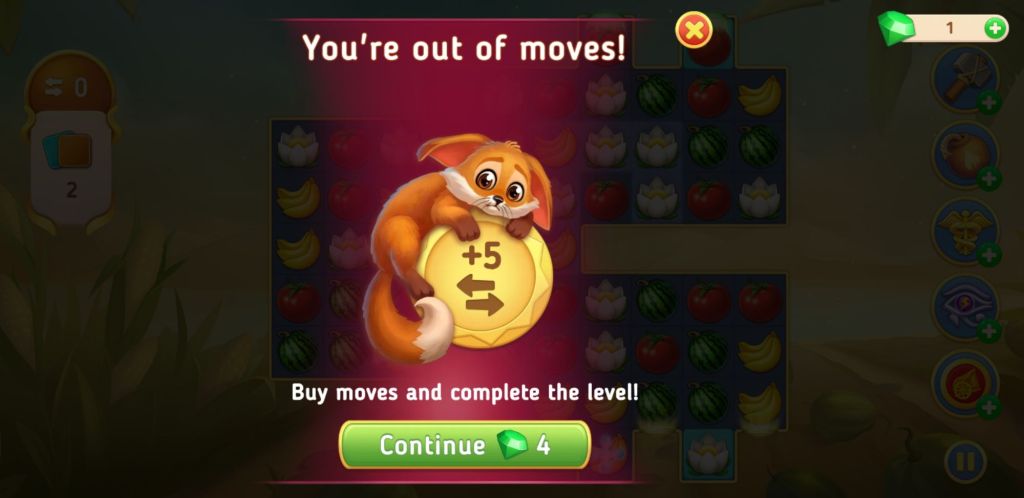
Oh no! No more moves! Ah well. I have no green jewels, so I just tap the cross.
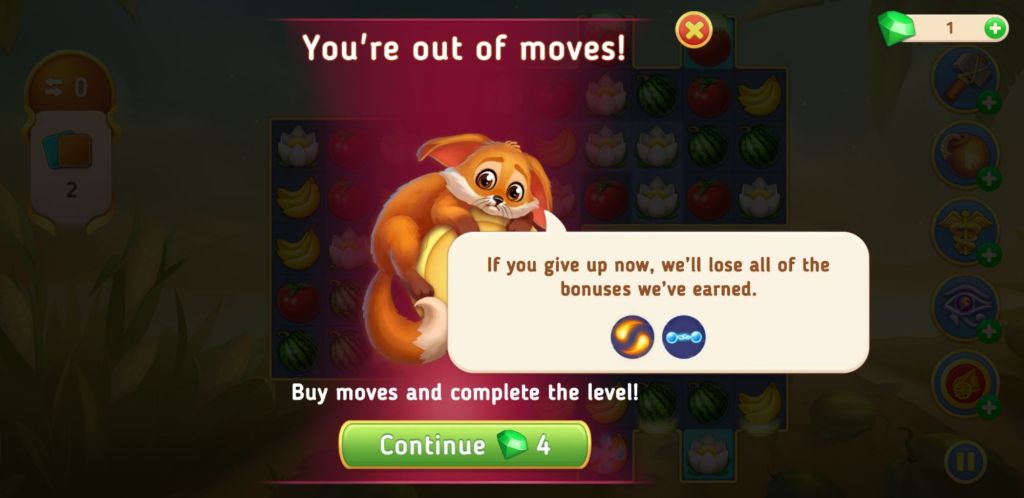
Are you sure? (The alternative is to buy, with real money, green jewels and spend them here.)
Okay. This game has lots of different kinds of levels. I’ll just play another one.
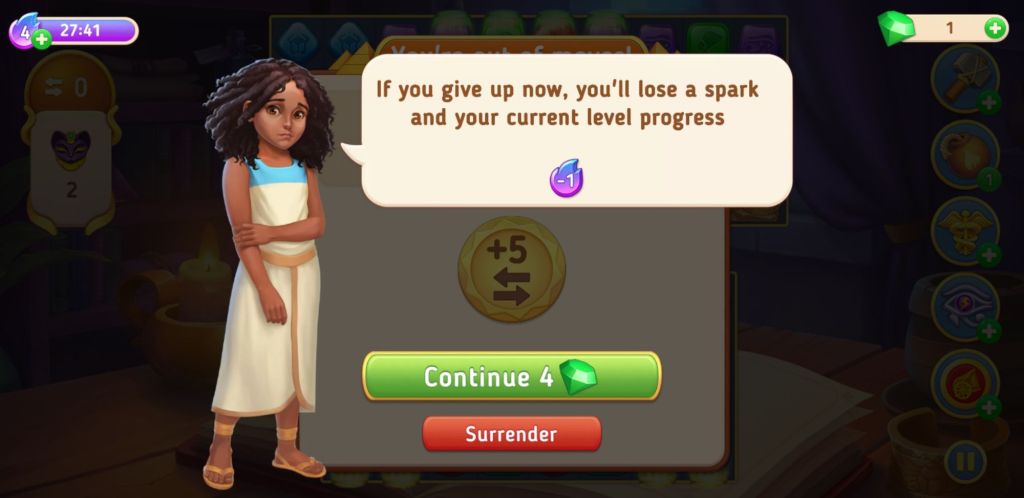
Oh no! No more moves. Ah well. I have no green jewels, so I just tap the cross.
Are you sure?
Sigh.
It’s actually a good game. I haven’t seen all of the game techniques before, and there’s usually a level I can play, here or there, or some bonus to collect. But…
Jeg har nu (på rette tid for ikke biografen, ikke blueray, men streaming via abonnement) set The Creator. Det her er ikke en helstøbt anmeldelse, men mere et par funderinger, efter også at have set lidt ekstramateriale. Spoilers.
Den ene fundering er meget kortfattet. Vi ser, at robotter og kunstig intelligens lever side om side med mennesker i Asien-ish. Vi ser ikke umiddelbart nogle begrænsninger, omend det kan være svært at se, om en given robot har rigtig kunstig intelligens eller “bare” er programmeret. Der er robot-munke. Robotter kan adoptere (i praksis) menneskebørn.
Så hvad hulen betyder det, når en robot siger “jeg vil være fri”?
Fri for at få en amerikansk bombe i hovedet? Fordi det ville jeg ikke formulere på den måde.
Den anden fundering går på, at vi bliver præsenteret for en konflikt med 3 sider: USA-ish, Asien-ish og AI. AI var vældig nyttigt et stykke tid, men så gik en af dem amok. USA har ganske fornuftigt forbudt alt sådan noget. Asien er ikke lige så fornuftige, men bare rolig, det skal USA nok fikse. Ingen problemer i at komme på besøg og ordne sagerne. Fornylig er der kommet nyt om et AI-supervåben. Det skal selvfølgelig stoppes. Så amerikanerne sadler deres jetjagere, og så afsted.
Bortset fra, at jeg som tilskuer ikke tror på den udlægning i 5 minutter. AI virker som nogle flinke fyre. Supervåbnet skal ikke overvinde USA, men overvinde krig. Faktisk er konflikten mellem USA og hvem de nu end synes er forkert på den. Amerikanerne er de onde! Det er ikke så tit, Hollywood giver os den version.
Underligt nok taler forfatteren/instruktøren om dilemma, nuance og sådan noget. Er det den samme film, vi snakker om? Der er måske 5 mm nuance.
Derudover vil jeg egentlig bare nævne, at filmen er flot. Når der har været behov for at filme rismarker, så har de fundet nogle rismarker. Og så vil jeg også nævne, at de 2 primære skuespillere er gode.
Nikoli the snake wants to slither along a loop through a four-by-four grid of points. To form a loop, Nikoli can connect any horizontally or vertically adjacent points with a line segment. However, Nikoli has certain standards when it comes to loop construction. In particular:
– The loop can never cross over itself. – No two corners of the loop can meet at the same point. – Once Nikoli has crossed the connection between two points, Nikoli can’t cross it again (in either direction).
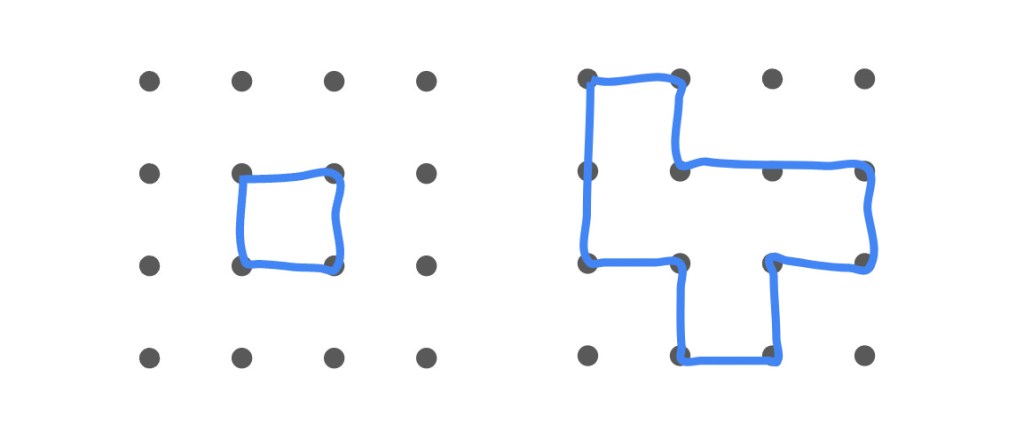
For example, the following two constructions are valid loops:
Meanwhile, the following three constructions are not valid. The one on the left crosses over itself, the one in the middle has two corners that meet at a single point, and the one on the right requires Nikoli to pass over the same line segment twice.
How many unique loops can Nikoli make on the four-by-four grid? (For any given loop, Nikoli can travel in two directions around it. However, these should still be counted as a single loop.)
And here’s my suggested solution, highlight to reveal:
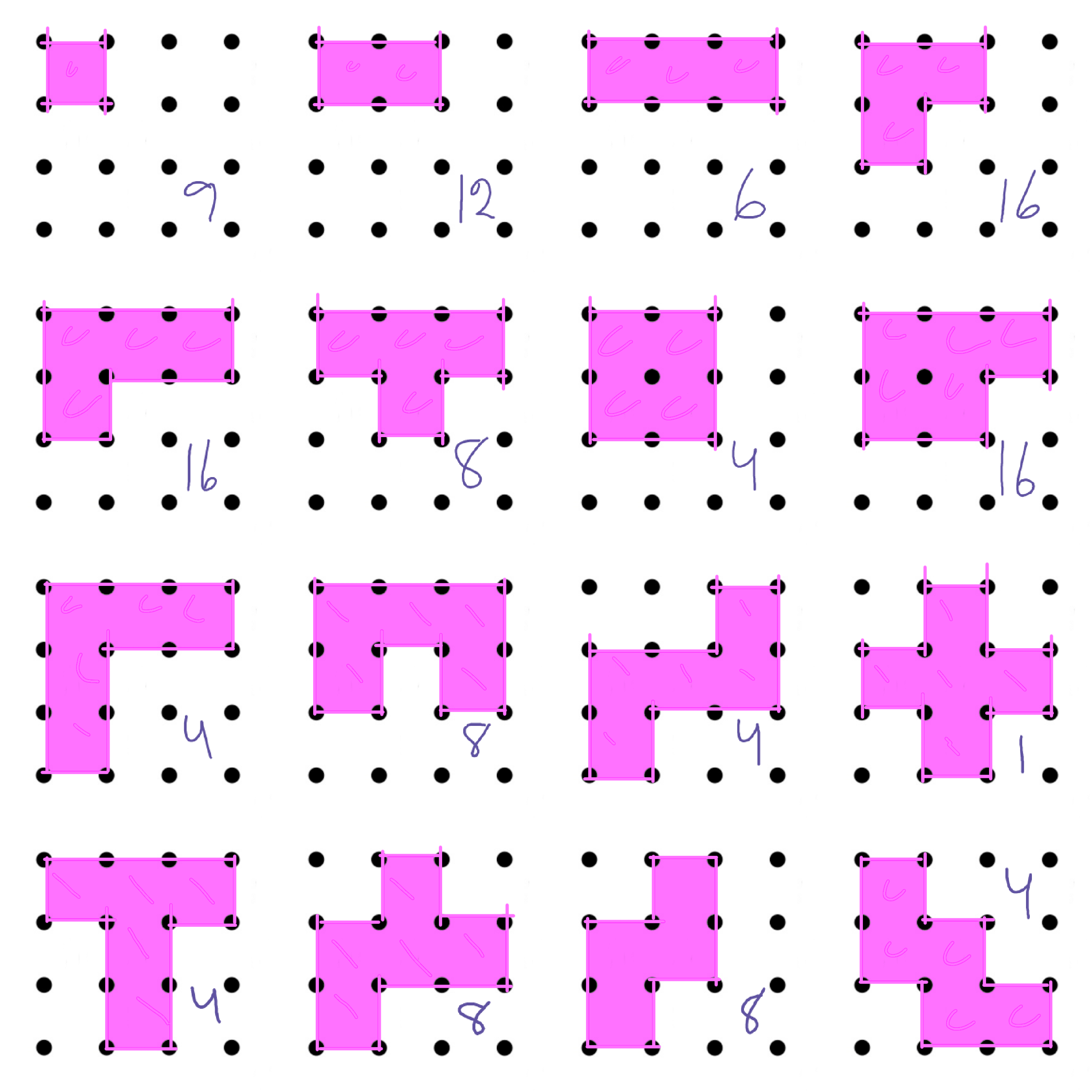
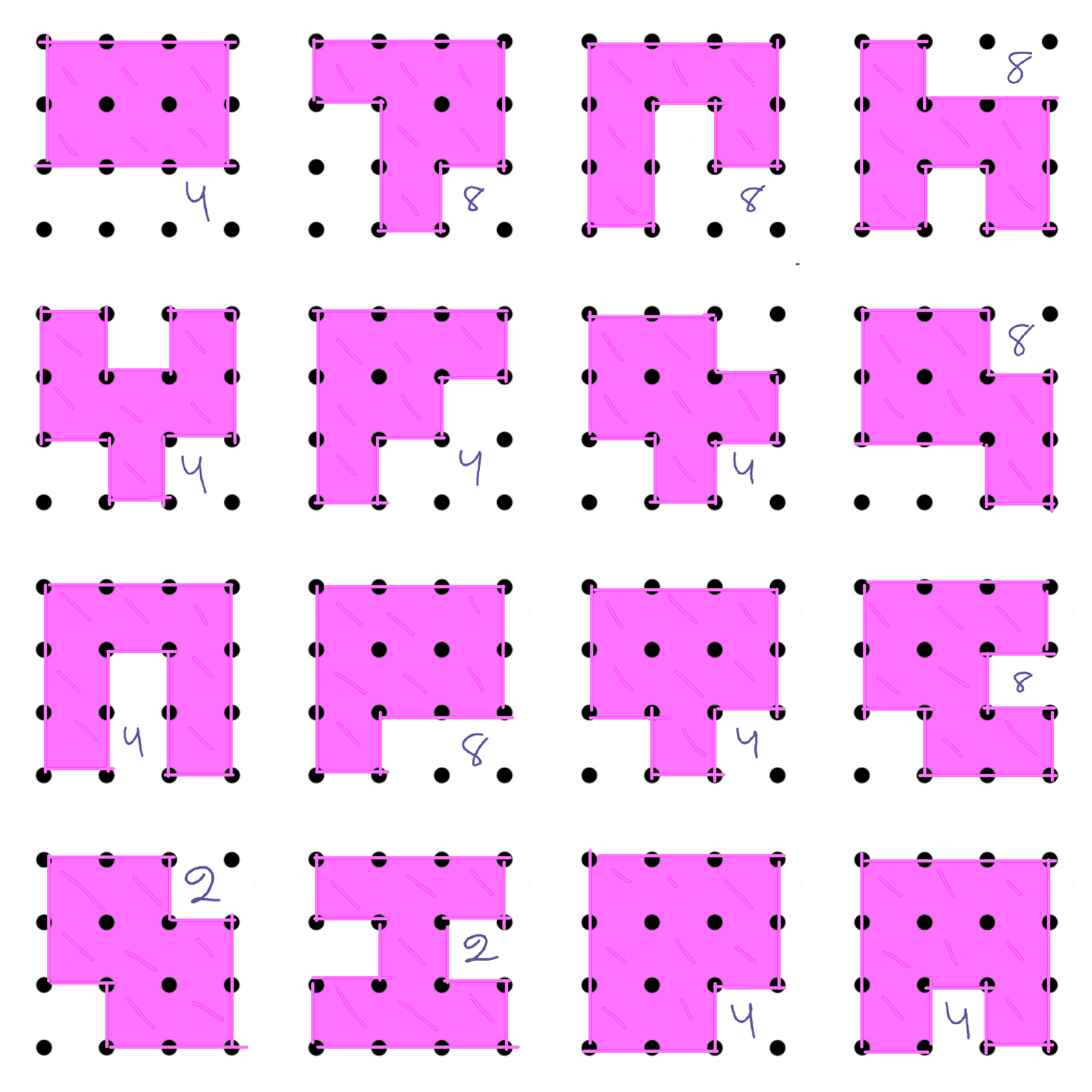
Instead of focusing on the loop, I looked at the squares within the loop. E.g. the first valid loop above encloses one small square, the square in the middle of the grid. If I translate the conditions, I’m looking for a combination of squares, combining into one figure, where all squares are connected side to side. No corner connections, please. I then tried to write all the possible figures down. This is easy enough with 1, 2, 3, 8 and 9 squares. With the rest I got some assistance from Wikipedia, with list of tetrominoes, pentominoes etc.
Once I had my list, for each figure I counted, how many ways it could be placed in the grid. If we look again at the first valid loop above, counting all mirrors, rotations and simple moves, there are 9 versions of this loop.
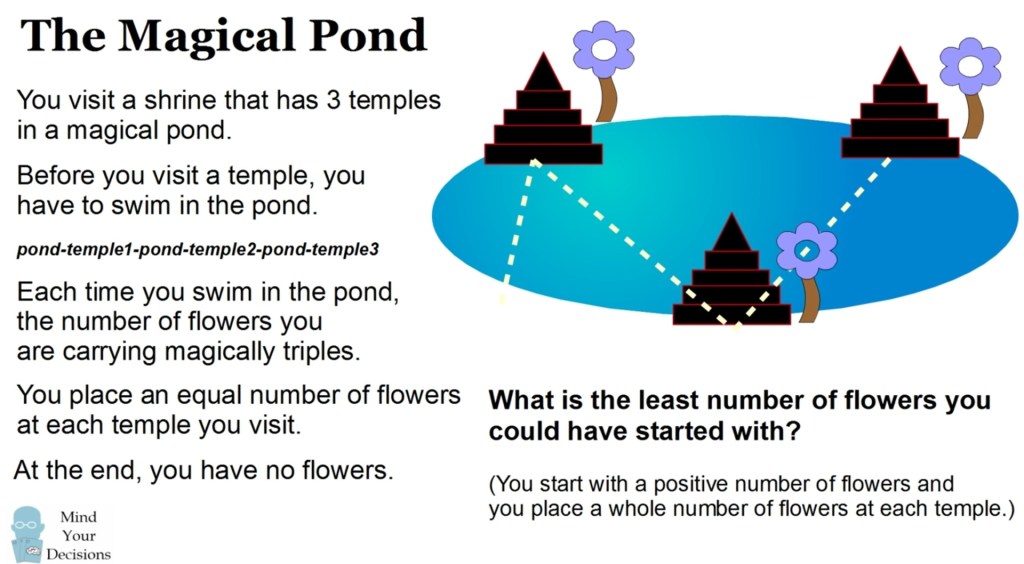
The video has a solution, but mine is a little different.
I construct a reverse timeline. Below I write all my actions, and I count the flowers. For now I assume I leave 1 flower at each temple, and that fractions are okay.
*
0 flowers
*
Leave 1 flower at temple 3
*
1 flower
*
Swim
*
1/3 flowers
*
Leave 1 flower at temple 2
*
4/3 flowers
*
Swim
*
4/9 flowers
*
Leave 1 flower at temple 1
*
13/9 flowers
*
Swim
*
13/27 flowers
If I take all these numbers, they are: 0, 1, 1/3, 4/3, 4/9, 13/9, 13/27.
In reality, I don’t know how many flowers I leave each time. If I leave n flowers, my numbers would be: 0*n, 1*n, 1/3*n, 4/3*n, 4/9*n, 13/9*n, 13/27*n. All of these numbers have to be nonnegative integers. To accomplish that, n has to be a multiple of 27. To use the smallest number of flowers, n is simply 27. So we had 13 flowers to begin with.





 Stuff from ommadawn.dk (Lise Andreasen)