Anmeldelse af “Life Does Not Allow Us to Meet”, af 何夕 (He Xi). Kortroman. 2023. Hugo-finalist.
Skitse: 2 unge mennesker har vist sig at være de ypperste kandidater til at blive astronauter i den her omgang. Nu tager de forskud på glæderne ved at bryde ind i et arkiv, så de kan blive klogere på det næste trin. De bliver dog afbrudt af deres guide. Så nu taler de i stedet om planeterne derude, rumskibe med ormehulsteknologi osv.
Er det science fiction? Ja.
Temaer: Udover det allerede nævnte, så er en del af historien også, at guiden i sin tid var ved at blive forelsket, men de var astronauter og skulle på forskellige missioner, så det blev der ikke noget af.
Er det godt? Jeg læste den ærligt talt ikke i sin helhed. Så meget tell, så lidt show. Så mange infodumps. Jeg tror egentlig, oversættelsen er okay. Så det er kun noget, som vi (i den vestlige verden) finder gammeldags. 👽💀💀
Tingene må være faldet lidt bedre den her gang med min kalender. Jeg var i hvert fald ikke i tvivl om, at jeg skulle besøge Fantasticon, afholdt på Blågårds Plads.
Allerede ved døren var der en lille oplevelse. Jeg var fulgtes med formanden (2016-) for SFC, Niels Dalgaard, bedre kendt som min kæreste, og Lea Thume, tidligere formand (2011-13). Og der stod Knud Larn så, også tidligere formand (2008-09). Det skulle vi da lige have et billede af.
SFC’s stand stod klar, og selvom jeg i den forbindelse bare er påhæng, så måtte jeg godt sidde der lidt. Således kunne jeg deltage i en lille snak om, at SFC fylder 50 år 9/6, og at Anders And samme dag fylder 90. Omend han officielt er 20, så det må være noget med at han altid er 19 og “et par måneder”. Hej, Mogens.
Så trissede jeg hen til åbningsceremoni. Jesper Rugård startede med at byde velkommen og lidt praktisk (og munter) information. Såsom: Jeg kunne ikke finde et billede af den her bygning, så her er et billede af kirken.
Og så var der fri snak om udødelighed. Jane Mondrup interviewede æresgæsterne Catherynne M. Valente og Domonic Mitchell. Mitchell har bl.a. været forfatter på Westworld. Han bidrog med, at bevidsthed måske opstår, når man erkender sin dødelighed. Valente har humoristisk sans, dejligt.
Bagefter var der lejlighed til at få Valentes autograf. Jeg havde Massachusetts-havet med, så “Fremtiden er blå” kunne blive pyntet lidt. Desværre var det noget med at stå i kø, så mine ben blev noget trætte. Jeg er helt med på, at hun gerne vil signere hver enkelts medbragte stak og også sludre lidt. Jeg er med på det. Mine ben er ikke.
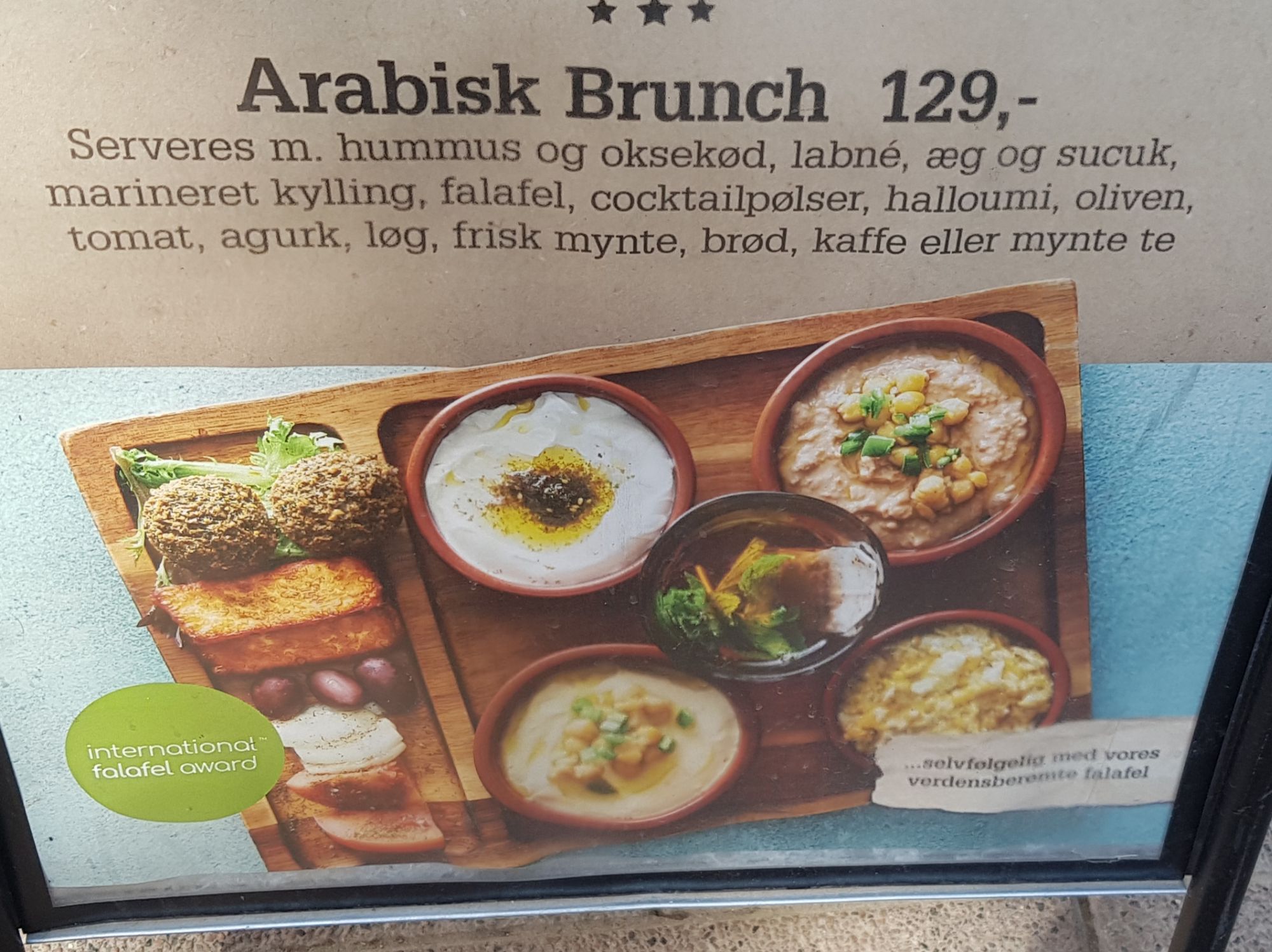
Så var det tid til frokost. Vi fandt et sted i nærheden med prisbelønnede falafler! 👍🏻
Så tilbage for at høre GoH-interviewet med Valente.
Det er en af de der forfattere, hvor jeg har en stærk fornemmelse af, at jeg har læst noget af hende. Men hvad? Det var først bagefter jeg fik søgt mig frem til Trappevid og Amerikas synd. Jeg har også læst “The Difference Between Love and Time” (gratis online). Og ganske sikkert mere, jeg ikke lige kan huske. Og så fik jeg noteret et par titler.
Okay så. Tilbage til det store område, hvor der var bøger til salg, café og sådan bare mulighed for at sidde. Jeg havde brug for krølle mig sammen om en bog et blødt og stille sted. I stedet var der livlig snak. Pladsen var der også gang i, med en fest med musik og hoppeborg osv. Jeg kunne ikke lige se, hvordan jeg skulle finde et rart sted der. Så jeg endte med at stavre hjem, et par timer tidligere end planlagt.
You’re playing a modified version of blackjack, where the deck consists of exactly 10 cards numbered 1 through 10. Unlike traditional blackjack, in which the ace can count as 1 or 11, the 1 here always has a value of 1.
You shuffle the deck so the order of the cards is completely random, after which you draw one card at a time. You keep drawing until the sum of your drawn cards is at least 21. If the sum is exactly 21, you win! But if the sum is greater than 21, you “bust,” or lose.
What are your chances of winning, that is, of drawing a sum that is exactly 21?
And for extra credit:
You’re playing the same modified version of blackjack again, but this time, whenever there’s even the slightest chance you could bust on the next card, you quit the round and start over. On average, how many rounds should you expect to start until you finally win?
Highlight to reveal solution:
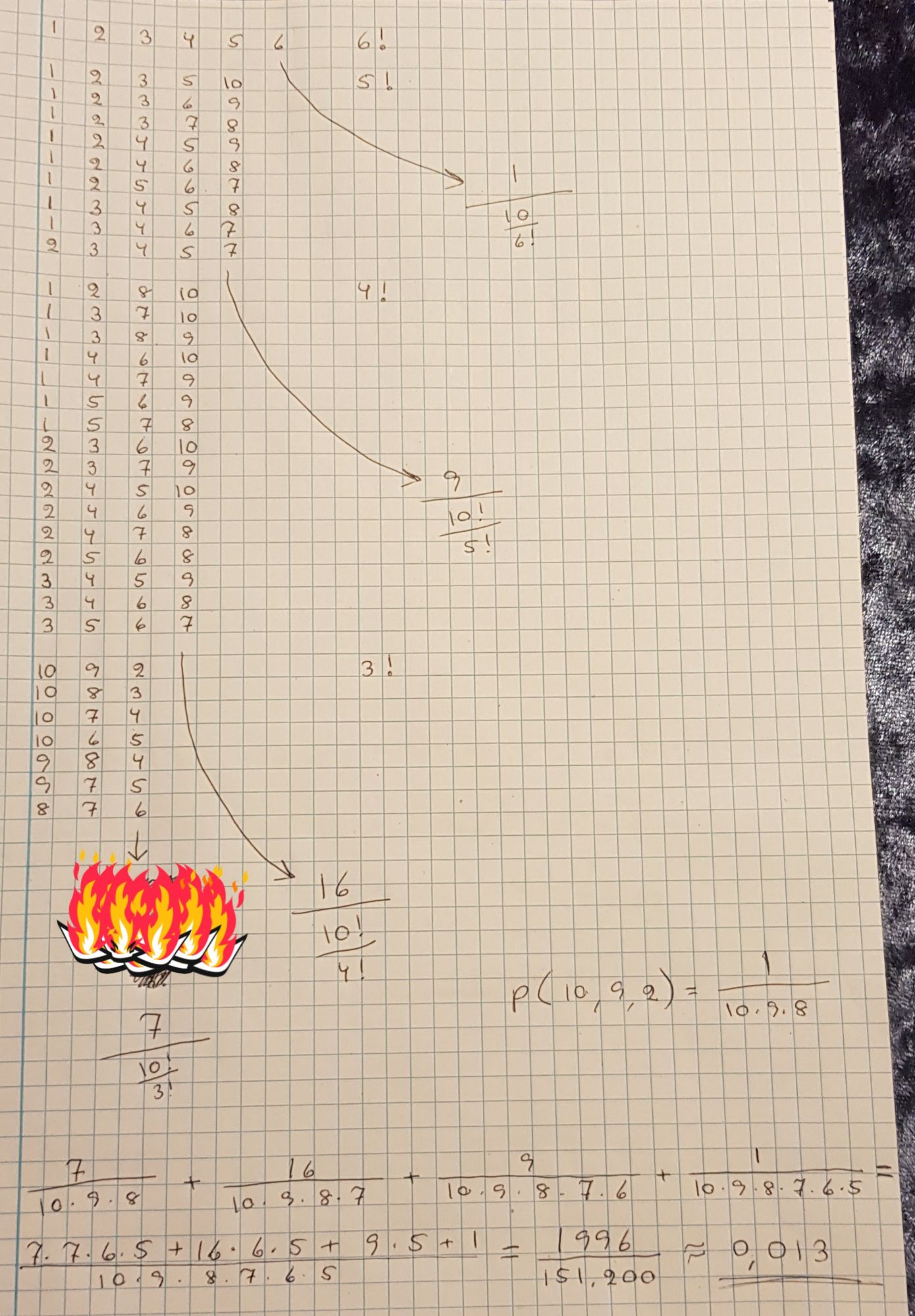
In short: I find all the possible card combinations, and add together their probabilities. One possible combination is 1+2+3+4+5+6. It’s the only possible one with 6 cards. So its probability is 1/(10*9*8*7*6*5). (I can draw these 6 cards in 10*9*8*7*6*5 different ways, depending on their order.) Another possible combination is 1+2+3+5+10. It turns out, there are 9 different combinations with 5 cards. Their combined probability is 9/(10*9*8*7*6*5). Notice that these 2 cases (5 cards and 6 cards) aren’t overlapping. Like, one of the 5 card combinations can’t be combined with 1 more card into a 6 card combination, because we already hit the right sum with 5 cards. So we can safely add these probabilities together. If I keep going in this way, the resulting probability is 1996/151200 or approximately 0.013. Assumption: that I listed all the possible combinations.
If there’s the slightest chance of busting, I start over. This translates to:
The sum is 10 or less, and I can’t reach 21 with 1 more card, but I keep going.
The sum is 11, and I can reach 21, if I draw a 10.
The sum is 12 or more, and I stop.
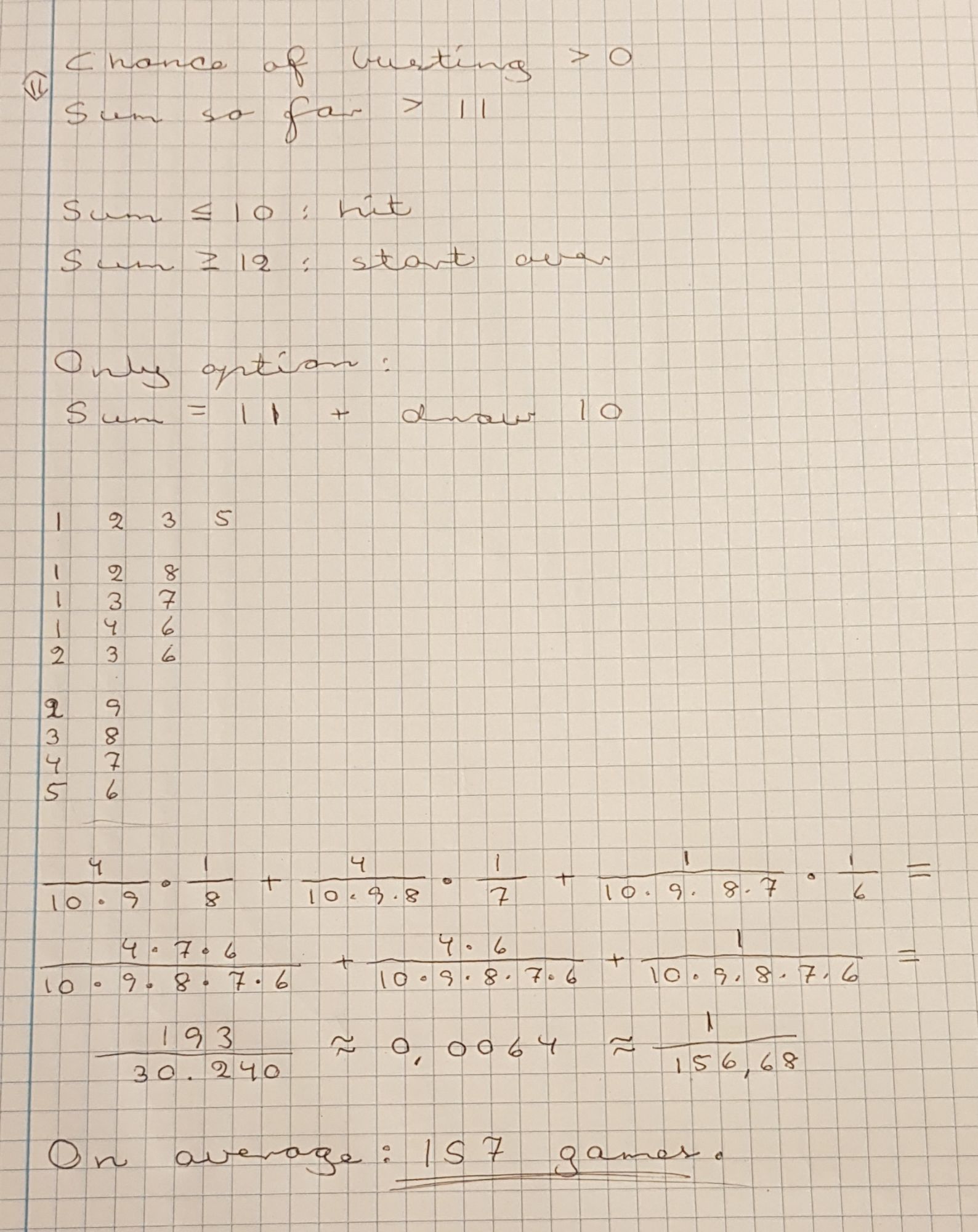
Case 1 turns into either case 2 or 3, depending on the next card. My only chance of winning is case 2, drawing a 10. This case reduces to: What is my chance of getting the sum 11, and then drawing a 10? After some calculations, the result is 193/30240, or approximately 1/157. On average, I have to play 157 games to win.
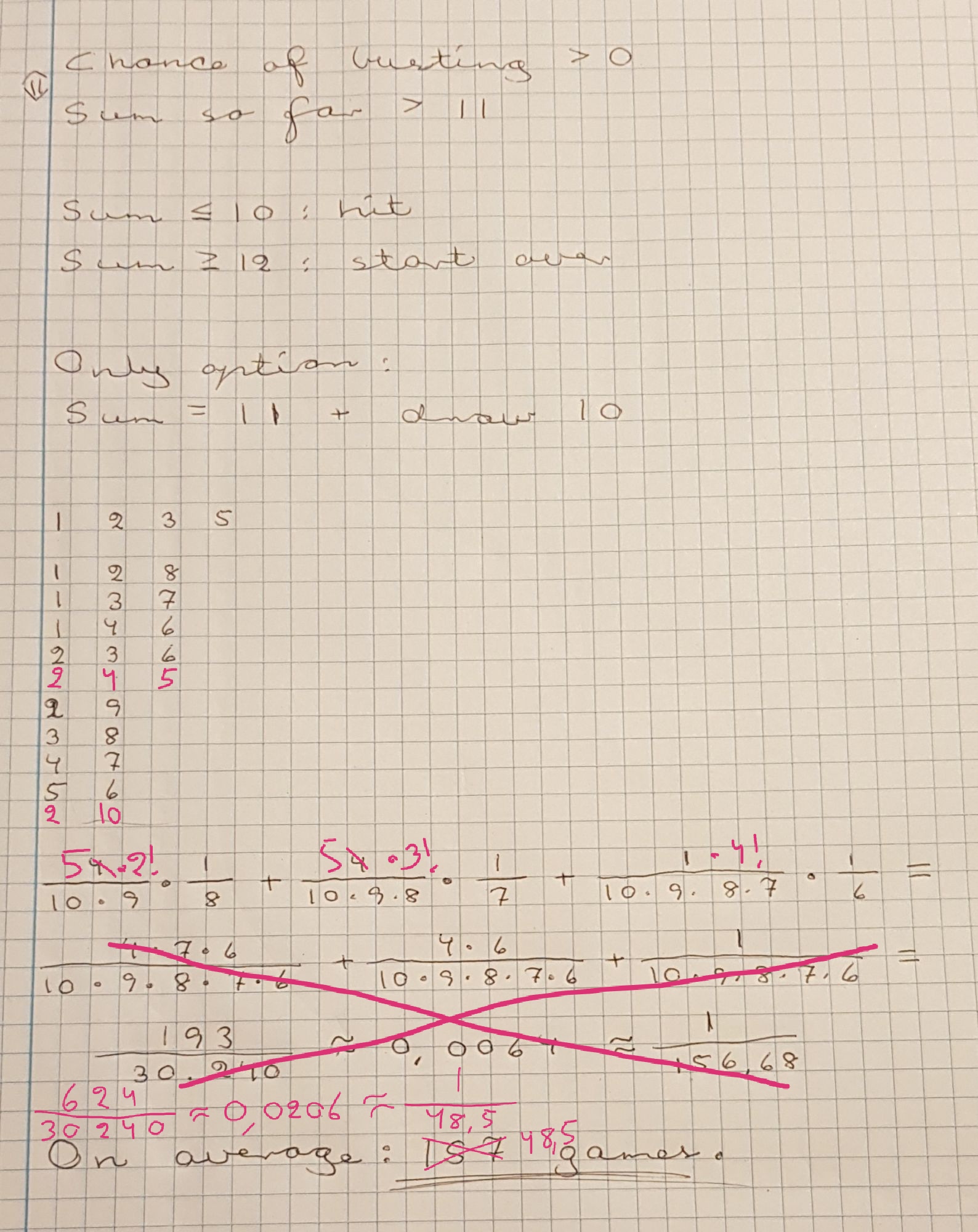
Addendum: In both puzzles I forgot that, e.g., the card combination (2,9) can also be (9,2), so I need to multiply by 2! in this case. Also in extra credit I forgot the valid combinations (before drawing the final card) (2,4,5) and (2,10), the latter followed by a 9. Sigh. Updated calculations for puzzle and extra credit .
… let’s define the term “differential radius.” The differential radius r of a shape with area A and perimeter P (both functions of r) has the property that dA/dr = P. (Note that A always scales with r2 and P always scales with r.)
For example, consider a square with side length s. Its differential radius is r = s/2. The square’s area is s2, or 4r2, and its perimeter is 4s, or 8r. Sure enough, dA/dr = d(4r2)/dr = 8r = P.
What is the differential radius of an equilateral triangle with side length s?
Highlight to reveal solution:
I pretty much just worked through equations for equilateral triangles. I also assumed r = a * s. In other words, a simple relationship. After some calculations, I got r = s / (2 * √3).
There are 25 sprinters at a meet, and there is a well-defined order from fastest to slowest. That is, the fastest sprinter will always beat the second-fastest, who will in turn always beat the third-fastest, and so on. However, this order is not known to you in advance.
To reveal this order, you can choose any 10 sprinters at a time to run in a heat. For each heat, you only know the ordinal results, so which runner finishes first, second, third, and so on up to 10th. You do not know the specific finishing time for any runner, making it somewhat difficult to compare performances across heats.
Your goal is to determine with absolute certainty which of the 25 sprinters is fastest, which is second-fastest, and which is third-fastest. What is the fewest number of heats needed to guarantee you can identify these three sprinters?
And for extra credit:
At a different meet, suppose there are six sprinters that can race head-to-head. (In other words, there are only two sprinters per heat.) Again, they finish races in a consistent order that is not known to you in advance.
This time, your goal is to determine the entire order, from the fastest to the slowest and everywhere in between. What is the fewest number of head-to-head races needed to guarantee you can identify this ordering?
After a heat, I can eliminate the 7 slowest sprinters. I need to narrow the field to 3 sprinters. 25 – 3 = 22 = 3 * 7 and a bit. So I need 4 heats, just to find the top 3.
(Assume there is no faster way to do this, like choosing the sprinters for the 3rd heat in a clever way. I can’t think of such a clever procedure.)
Luckily that’s also enough to determine their order. Spend 3 heats eliminating 21 sprinters (always choosing sprinters that haven’t been eliminated yet), and there’s 4 left. The 4th heat will clearly show their internal order.
We need 4 heats.
And for extra credit:
With 2 sprinters, it’s easy. A and B race, we’re done.
With 3 sprinters, we need a little more. A and B race, turns out (WLOG) that A is the fastest. We want to check whether C fits in between them. So we race C against (WLOG) A. If C wins, we’re done. If not, we also need to race C against B. At most 3 races.
Order
Race
Winner
Order
(1) A B
A
A B
(1) A B
B
B A
A B
(2) A C
A
A (B or C)
A B
(2) A C
C
C A B
B A
(2) B C
B
B (A or C)
B A
(2) B C
C
C B A
A (B or C)
(3) B C
B
A B C
A (B or C)
(3) B C
C
A C B
B (A or C)
(3) A C
A
B A C
B (A or C)
(3) A C
C
B C A
(Going forward, I assume it’s possible to just add the nth sprinter to n-1 ordered sprinters, and that this is efficient. That I can’t do something clever like, I don’t know, shuffling 2 ordered groups into each other.)
With 4 sprinters, the complexity grows again. Assume we need 3 heats to order A, B and C. Turns out (WLOG) that the order is A B C. First we race B and D. If D wins, race A and D. If D wins again, it’s D A B C. If D loses, it’s A D B C. If on the other hand D loses to B, race D and C. If D wins, it’s A B D C. If D loses, it’s A B C D. 3 + 2 heats.
Notice D didn’t have to race everybody. Racing against B eliminates some options.
With 5 sprinters, there’s a little leap again. We use 5 races to obtain (WLOG) the order A B C D. Race E against (WLOG) B. Worst case, B loses and loses to C and will have to race D. 5 + 3 races.
With 6 sprinters, it’s more of the same. I want to add F to (WLOG) A B C D E, obtained after at most 8 races. Race against C, then against A or D, and worst case against B or E. 8 + 3 = 11 races.
Note: Binary Insertion Sort. There’s something going on with log2 here. I need 1 race to add a 2nd sprinter, 2 races to add a 3rd sprinter, 3 races to add a 5th sprinter. log2( x – 1) + 1 races to add the xth sprinter?
One of the mechanisms in this game is that some of the time the player is rewarded for completing a lot of levels in a row. This is shown by Fennec gradually having more boosters for you. And it looks like this:
















 Stuff from ommadawn.dk (Lise Andreasen)