Advent of Code, day 20

This December I participated in Advent of Code.

More Dijkstra! Part 1 was sort of easy: Remove one wall part and try again. But what I ended up with in part 2 runs for both parts, and much better, and also is much closer to what the puzzle said in words. Though I struggled a bit with interpreting the rules: Question. And with an off by one error: Question.

Part 1 and 2:

<?php

function find($char) {
  global $map, $mapwid, $maphei;
  for($x=0;$x<$mapwid;$x++) {
    for($y=0;$y<$maphei;$y++) {
      if($map[$y][$x] == $char) {
        return array($x,$y);
      }
    }
  }
}


////////////////////////////////////////////////////////////////

$input = file_get_contents('./d20input2.txt', true);
// limit: how many steps saved, before a route counts
// part 1, test: 2, actual: 100
// part 2: test: 50, actual: 100
$limit = 100;
// cheat: how many steps in a row can ignore walls
// part 1: 2
// part 2: testa: 4, testb: 20, actual: 20
$cheat = 20;

foreach(preg_split("/((\r?\n)|(\r\n?))/", $input) as $line) {
  if(strlen($line)>2) {
    $map[] = str_split($line);
  }
}

$maphei = sizeof($map);
$mapwid = sizeof($map[0]);

$coords = find("S");
$orgx = $coords[0];
$orgy = $coords[1];

function dijkstra($map) {
  global $orgx, $orgy, $maphei, $mapwid, $visit;
  
  $unvis[] = array($orgx, $orgy, 0, array());

  // Create a set of all unvisited nodes: the unvisited set.
  // Assign to every node a distance from start.
  for($x=0;$x<$mapwid;$x++) {
    for($y=0;$y<$maphei;$y++) {
      if($map[$y][$x] == "." || $map[$y][$x] == "E") {
        $unvis[] = array($x, $y, 1000000, array());
      }
    }
  }

  $wearedone = 0;
  while($wearedone == 0) {
    //From the unvisited set, select the current node to be the one with the smallest (finite) distance
    $dist = 1000000;
    foreach($unvis as $key => $node) {
      if($node[2] < $dist) {
        $dist = $node[2];
        $x = $node[0];
        $y = $node[1];
        $mykey = $key;
      }
    }
    
    // For the current node, consider all of its unvisited neighbors and update their distances through the current node
    foreach($unvis as $key => $node) {
      $neighb = abs($x - $node[0]) + abs($y - $node[1]);
      if($neighb == 1) {
        //print("neighbour:\n");
        //print_r($node);
        if($x - $node[0] == 1) {
          // neighbour to the left
          $newdist = $dist + 1;
          if($newdist < $node[2]) {
            $unvis[$key][2] = $newdist;
            $unvis[$key][3] = array($x, $y);
          }
        }
        if($x - $node[0] == -1) {
          // neighbour to the right
          $newdist = $dist + 1;
          if($newdist < $node[2]) {
            $unvis[$key][2] = $newdist;
            $unvis[$key][3] = array($x, $y);
          }
        }
        if($y - $node[1] == 1) {
          // neighbour above
          $newdist = $dist + 1;
          if($newdist < $node[2]) {
            $unvis[$key][2] = $newdist;
            $unvis[$key][3] = array($x, $y);
          }
        }
        if($y - $node[1] == -1) {
          // neighbour below
          $newdist = $dist + 1;
          if($newdist < $node[2]) {
            $unvis[$key][2] = $newdist;
            $unvis[$key][3] = array($x, $y);
          }
        }
      }
    }
    
    // the current node is removed from the unvisited set
    $visit[$x][$y][] = $unvis[$mykey];
    unset($unvis[$mykey]);
    if($map[$y][$x] == "E") {
      return $dist;
    }
  }
}

$best = dijkstra($map);

for($i=1;$i<$maphei-1;$i++) {
  for($j=1;$j<$mapwid-1;$j++) {
    // if i am a free cell, no. 0
    // my cheat begins
    
    // my destination will be at most n cells away
    // but still has to be on the map
    
    // check all free cells within n steps distance
        
    // always assume efficient routes
    // as meandering ones will be longer
    if($map[$i][$j] == "#") {
      continue;
    }
    for($a=max($i-$cheat,0);$a<=min($i+$cheat,$maphei-1);$a++) {
      for($b=max($j-$cheat,0);$b<=min($j+$cheat,$mapwid-1);$b++) {
        $ytmp = abs($a-$i);
        $xtmp = abs($b-$j);
        $alltmp = $xtmp + $ytmp;
        if(1<$alltmp && $alltmp<=$cheat) {
          // we have a candidate!
          if($map[$a][$b] != "#") {
            $newdist = $best - ($visit[$j][$i][0][2] - $visit[$b][$a][0][2]) + $alltmp;
            if(isset($alldist[$newdist])) {
              $alldist[$newdist]++;
            } else {
              $alldist[$newdist] = 1;
            }
          }
        } 
      }
    } // end big loop
  }
}

$cheats = 0;
for($i=0;$i<10000;$i+=2) {
  if(!isset($alldist[$i])) {
    $alldist[$i] = 0;
  }
}
for($i=$best-$limit;$i>0;$i-=2) {
  $lgt = $i;
  $no = $alldist[$i];
  if($no > 0) {
    print("There are $no cheats that save ".$best-$lgt." picoseconds.\n");
  }
  if($lgt <= $best - $limit) {
    $cheats += $no;
  }
}
echo $cheats."\n";
?>

Scroggs, day 20

A new December and a new bunch of puzzles from mscroggs.co.uk.

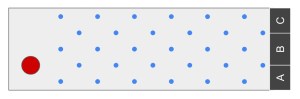
First let’s look at this landscape. For now ignore the green curve.

A solution p(x) has to fit between the blue and the red lines. It has to fit under the blue and over the red.

Could p(x) = a? No, a straight horizontal line wouldn’t be able to stay over the red line always.

Could p(x) = a + bx? Then p(0) = a, a positive integer. Then p(1) = a + b. The blue line goes through (1,1). And p(1) is an integer, at most 0. So this p(x) goes through (0,a), down to (1,a+b) and then up, up, up to stay above the red line. Not possible.

Could p(x) = a + bx + cx2? This is similar to the blue line, so maybe we choose p(x) = x2 – 2x + 2 – a-little-bit. This would always be under the blue line. First guess: p(x) = x2 – 2x + 1.

Is this above the red line? That’s equivalent to this being true:

4x – 9 < x2 – 2x + 1 <=>

0 < x2 – 6x + 10 <=>

0 < x2 – 6x + 9 + 1 <=>

0 < (x – 3)2 + 1

And yes, this is always true.

I haven’t checked whether this is the only solution.

p(23) = 232 – 2*23 + 1 = 484.

A closeup:

Advent of Code, day 19

This December I participated in Advent of Code.

The program was rather easy to build. This day I had to learn a new trick to scale it: Memoization. Question, early version of part 1. I only show part 2 below, because the only difference between the 2 parts is a bit at the end of the program. (Probably there were more differences originally, but I forgot to save the part 1 version.)

Part 2:

<?php
function dig($design, $level) {
  // towels are at most 8 characters long
  global $towels, $dug;
  if(isset($dug[$design])) {
    return $dug[$design];
  }
  $hit = 0;
  for($i=8;$i>0;$i--) {
    // if the beginning of this design is towel
    if(in_array(substr($design, 0, $i), $towels)) {
      if(strlen($design) == $i) {
        $dug[$design] = 1;
        $hit += 1;
      }
      $tmphit = dig(substr($design, $i), $level+1);
      if($tmphit > 0) {
        $dug[$design] = $tmphit;
        $hit += $tmphit;
      }
    }
  }
  $dug[$design] = $hit;
  return $hit;
}
///////////////////////////////////////////////////////////
$input = file_get_contents('./d19input2.txt', true);
$phase = 1;
foreach(preg_split("/((\r?\n)|(\r\n?))/", $input) as $line) {
  if(strlen($line)>2) {
    if($phase == 1) {
      $towels = explode(", ", $line);
    } else {
      $designs[] = $line;
    }
  } else {
    $phase = 2;
  }
}
$hits = 0;
foreach($designs as $design) {
  echo "$design\n";
  $tmphit = dig($design, 0);
  if($tmphit > 0) {
    // part 1:
    //$hits++;
    
    // part 2:
    $hits += $tmphit;
  }
}
echo $hits."\n";

Scroggs, day 19

A new December and a new bunch of puzzles from mscroggs.co.uk.

I actually did this in a slow way and then realized, there was a quick way.

Slow way: how many ways can you do a 1 digit number (1, the number 9), a 2 digit number (8, the numbers 18, 27, 36 etc.), a 3 digit number etc. Add these together: 1+8+… = 256.

Quick way: This is stars and bars like. Imagine we have 9 stars. *********

If we add no bars, this represents the number 9. All the stars end up in the same bin.

If we add 1 bar, this is a 2 digit number. **|******* represents 27, 2 stars in the first bin, 7 in the second.

If we add 8 bars, it represents the 9 digit number 111111111. Every star is alone in a bin.

With 9 stars, there are 8 positions available between them, 8 ways to add 1 bar between 2 stars. For every one of these 8 positions, we make a decision: add a bar, yes or no? 8 choices, each with 2 options, 28 = 256.

Advent of Code, day 18

This December I participated in Advent of Code.

More Dijkstra! I just modified some program from an earlier day for part 1. For part 2, I added functionality to walk x steps, and then played around with x, until I rather quickly got what I wanted, the coordinates of the offending byte.

Part 1:

<?php

// array of coordinates in
function print_coords() {
  global $map, $coords, $mapwid, $maphei;
  $done = 0;
  foreach($coords as $coord) {
    $x = $coord[0];
    $y = $coord[1];
    $map[$x][$y] = "#";
    $done++;
    if($done == 1024) {
      break;
    }
  }
  print_map();
}

function print_map() {
  global $map, $mapwid, $maphei;
  for($y=-1;$y<=$maphei;$y++) {
    for($x=-1;$x<=$mapwid;$x++) {
      if(isset($map[$x][$y])) {
        echo $map[$x][$y];
      } else {
        echo ".";
      }
    }
    echo "\n";
  }
  echo "\n";
}

function find($char) {
  global $map, $mapwid, $maphei;
  for($x=0;$x<$mapwid;$x++) {
    for($y=0;$y<$maphei;$y++) {
      if($map[$y][$x] == $char) {
        return array($x,$y);
      }
    }
  }
}

////////////////////////////////////////////////////////////////

$input = file_get_contents('./d18input2.txt', true);

foreach(preg_split("/((\r?\n)|(\r\n?))/", $input) as $line) {
  if(strlen($line)>2) {
    preg_match_all('/-?\d+/', $line, $byte);
    $coords[] = $byte[0];
  }
}

// test: 0-6, actual: 0-70
$maphei = 71;
$mapwid = 71;

for($i=0;$i<$mapwid;$i++) {
  for($j=0;$j<$maphei;$j++) {
    $map[$j][$i] = ".";
  }
}
for($i=-1;$i<=$mapwid;$i++) {
  $map[-1][$i] = "#";
  $map[$maphei][$i] = "#";
}
for($j=-1;$j<=$maphei;$j++) {
  $map[$j][-1] = "#";
  $map[$j][$mapwid] = "#";
}
$map[0][0] = "S";
$map[70][70] = "E";

print_coords($map);

$coords = find("S");
$x = $coords[0];
$y = $coords[1];
$unvis[] = array($x, $y, 0, ">");

// Create a set of all unvisited nodes: the unvisited set.
// Assign to every node a distance from start.
for($x=0;$x<$mapwid;$x++) {
  for($y=0;$y<$maphei;$y++) {
    if($map[$y][$x] == "." || $map[$y][$x] == "E") {
      $unvis[] = array($x, $y, 1000000, ".");
    }
  }
}

$wearedone = 0;
while($wearedone == 0) {
  //From the unvisited set, select the current node to be the one with the smallest (finite) distance
  $dist = 1000000;
  foreach($unvis as $key => $node) {
    if($node[2] < $dist) {
      $dist = $node[2];
      $x = $node[0];
      $y = $node[1];
      $dir = $node[3];
      $mykey = $key;
    }
  }
  
  // shortest path: 83432
  if($dist > 83435) {
    $wearedone = 1;
    continue;
  }

  // For the current node, consider all of its unvisited neighbors and update their distances through the current node
  foreach($unvis as $key => $node) {
    $neighb = abs($x - $node[0]) + abs($y - $node[1]);
    if($neighb == 1) {
      //print("neighbour:\n");
      //print_r($node);
      if($x - $node[0] == 1) {
        // neighbour to the left
        if($dir == "<") {
          // i am headed left
          $newdist = $dist + 1;
          if($newdist < $node[2]) {
            $unvis[$key][2] = $newdist;
            $unvis[$key][3] = "<";
          }
        }
        if($dir == "^") {
          // i am headed up
          $newdist = $dist + 1;
          if($newdist < $node[2]) {
            $unvis[$key][2] = $newdist;
            $unvis[$key][3] = "<";
          }
        }          
        if($dir == "v") {
          // i am headed down
          $newdist = $dist + 1;
          if($newdist < $node[2]) {
            $unvis[$key][2] = $newdist;
            $unvis[$key][3] = "<";
          }
        }
      }
      if($x - $node[0] == -1) {
        // neighbour to the right
        if($dir == ">") {
          // i am headed right
          $newdist = $dist + 1;
          if($newdist < $node[2]) {
            $unvis[$key][2] = $newdist;
            $unvis[$key][3] = ">";
          }
        }
        if($dir == "^") {
          // i am headed up
          $newdist = $dist + 1;
          if($newdist < $node[2]) {
            $unvis[$key][2] = $newdist;
            $unvis[$key][3] = ">";
          }
        }          
        if($dir == "v") {
          // i am headed down
          $newdist = $dist + 1;
          if($newdist < $node[2]) {
            $unvis[$key][2] = $newdist;
            $unvis[$key][3] = ">";
          }
        }
      }
      if($y - $node[1] == 1) {
        // neighbour above
        if($dir == "^") {
          // i am headed up
          $newdist = $dist + 1;
          if($newdist < $node[2]) {
            $unvis[$key][2] = $newdist;
            $unvis[$key][3] = "^";
          }
        }
        if($dir == "<") {
          // i am headed left
          $newdist = $dist + 1;
          if($newdist < $node[2]) {
            $unvis[$key][2] = $newdist;
            $unvis[$key][3] = "^";
          }
        }          
        if($dir == ">") {
          // i am headed right
          $newdist = $dist + 1;
          if($newdist < $node[2]) {
            $unvis[$key][2] = $newdist;
            $unvis[$key][3] = "^";
          }
        }
      }
      if($y - $node[1] == -1) {
        // neighbour below
        if($dir == "v") {
          // i am headed down
          $newdist = $dist + 1;
          if($newdist < $node[2]) {
            $unvis[$key][2] = $newdist;
            $unvis[$key][3] = "v";
          }
        }
        if($dir == "<") {
          // i am headed left
          $newdist = $dist + 1;
          if($newdist < $node[2]) {
            $unvis[$key][2] = $newdist;
            $unvis[$key][3] = "v";
          }
        }          
        if($dir == ">") {
          // i am headed right
          $newdist = $dist + 1;
          if($newdist < $node[2]) {
            $unvis[$key][2] = $newdist;
            $unvis[$key][3] = "v";
          }
        }
      }
    }
  }
  
  // the current node is removed from the unvisited set
  $visit[] = array($x, $y, $dist, $dir);
  unset($unvis[$mykey]);
  if($map[$y][$x] == "E") {
    print_map();
print("shortest path: $dist\n");
    $wearedone = 1;
    continue;
  }
}

?>

Part 2:

<?php

// test: 0-6, actual: 0-70
$actual = 1;
if($actual == 0) {
  // test
  $donemax = 12;
  $maxsz = 6;
  $inputfile = './d18input1.txt';
} else {
  // actual
  $donemax = 1024;
  $maxsz = 70;
  $inputfile = './d18input2.txt';
}

function add_coord($now) {
  global $map, $coords, $newestcoord;
  $x = $coords[$now][0];
  $y = $coords[$now][1];
  $map[$x][$y] = "#";
  $newestcoord = "($x,$y)";
}

// array of coordinates in
function print_coords() {
  global $map, $coords, $mapwid, $maphei, $donemax;
  $done = 0;
  foreach($coords as $coord) {
    $x = $coord[0];
    $y = $coord[1];
    $map[$x][$y] = "#";
    $done++;
    if($done == $donemax) {
      break;
    }
  }
  print_map();
}

function print_map() {
  global $map, $mapwid, $maphei;
  for($y=-1;$y<=$maphei;$y++) {
    for($x=-1;$x<=$mapwid;$x++) {
      if(isset($map[$x][$y])) {
        echo $map[$x][$y];
      } else {
        echo ".";
      }
    }
    echo "\n";
  }
  echo "\n";
}

function find($char) {
  global $map, $mapwid, $maphei;
  for($x=0;$x<$mapwid;$x++) {
    for($y=0;$y<$maphei;$y++) {
      if($map[$y][$x] == $char) {
        return array($x,$y);
      }
    }
  }
}

////////////////////////////////////////////////////////////////

$input = file_get_contents($inputfile, true);

foreach(preg_split("/((\r?\n)|(\r\n?))/", $input) as $line) {
  if(strlen($line)>2) {
    preg_match_all('/-?\d+/', $line, $byte);
    $coords[] = $byte[0];
  }
}

$maphei = $maxsz + 1;
$mapwid = $maxsz + 1;

for($i=0;$i<$mapwid;$i++) {
  for($j=0;$j<$maphei;$j++) {
    $map[$j][$i] = ".";
  }
}
for($i=-1;$i<=$mapwid;$i++) {
  $map[-1][$i] = "#";
  $map[$maphei][$i] = "#";
}
for($j=-1;$j<=$maphei;$j++) {
  $map[$j][-1] = "#";
  $map[$j][$mapwid] = "#";
}
$map[0][0] = "S";
$map[$maxsz][$maxsz] = "E";

$xy = find("S");
$orgx = $xy[0];
$orgy = $xy[1];

function dijkstra() {
  global $map, $orgx, $orgy, $mapwid, $maphei;
  $x = $orgx;
  $y = $orgy;
  $wearedone = 0;

  // Create a set of all unvisited nodes: the unvisited set.
  // Assign to every node a distance from start.
  $unvis[] = array($orgx, $orgy, 0, ">");
  for($x=0;$x<$mapwid;$x++) {
    for($y=0;$y<$maphei;$y++) {
      if($map[$y][$x] == "." || $map[$y][$x] == "E") {
        $unvis[] = array($x, $y, 1000000, ".");
      }
    }
  }

  while($wearedone == 0) {
    //From the unvisited set, select the current node to be the one with the smallest (finite) distance
    $dist = 1000000;
    foreach($unvis as $key => $node) {
      if($node[2] < $dist) {
        $dist = $node[2];
        $x = $node[0];
        $y = $node[1];
        $dir = $node[3];
        $mykey = $key;
      }
    }
    
    // shortest path: 83432
    if($dist > 83435) {
      $wearedone = 1;
      continue;
    }

    // For the current node, consider all of its unvisited neighbors and update their distances through the current node
    foreach($unvis as $key => $node) {
      $neighb = abs($x - $node[0]) + abs($y - $node[1]);
      if($neighb == 1) {
        //print("neighbour:\n");
        //print_r($node);
        if($x - $node[0] == 1) {
          // neighbour to the left
          if($dir == "<") {
            // i am headed left
            $newdist = $dist + 1;
            if($newdist < $node[2]) {
              $unvis[$key][2] = $newdist;
              $unvis[$key][3] = "<";
            }
          }
          if($dir == "^") {
            // i am headed up
            $newdist = $dist + 1;
            if($newdist < $node[2]) {
              $unvis[$key][2] = $newdist;
              $unvis[$key][3] = "<";
            }
          }          
          if($dir == "v") {
            // i am headed down
            $newdist = $dist + 1;
            if($newdist < $node[2]) {
              $unvis[$key][2] = $newdist;
              $unvis[$key][3] = "<";
            }
          }
        }
        if($x - $node[0] == -1) {
          // neighbour to the right
          if($dir == ">") {
            // i am headed right
            $newdist = $dist + 1;
            if($newdist < $node[2]) {
              $unvis[$key][2] = $newdist;
              $unvis[$key][3] = ">";
            }
          }
          if($dir == "^") {
            // i am headed up
            $newdist = $dist + 1;
            if($newdist < $node[2]) {
              $unvis[$key][2] = $newdist;
              $unvis[$key][3] = ">";
            }
          }          
          if($dir == "v") {
            // i am headed down
            $newdist = $dist + 1;
            if($newdist < $node[2]) {
              $unvis[$key][2] = $newdist;
              $unvis[$key][3] = ">";
            }
          }
        }
        if($y - $node[1] == 1) {
          // neighbour above
          if($dir == "^") {
            // i am headed up
            $newdist = $dist + 1;
            if($newdist < $node[2]) {
              $unvis[$key][2] = $newdist;
              $unvis[$key][3] = "^";
            }
          }
          if($dir == "<") {
            // i am headed left
            $newdist = $dist + 1;
            if($newdist < $node[2]) {
              $unvis[$key][2] = $newdist;
              $unvis[$key][3] = "^";
            }
          }          
          if($dir == ">") {
            // i am headed right
            $newdist = $dist + 1;
            if($newdist < $node[2]) {
              $unvis[$key][2] = $newdist;
              $unvis[$key][3] = "^";
            }
          }
        }
        if($y - $node[1] == -1) {
          // neighbour below
          if($dir == "v") {
            // i am headed down
            $newdist = $dist + 1;
            if($newdist < $node[2]) {
              $unvis[$key][2] = $newdist;
              $unvis[$key][3] = "v";
            }
          }
          if($dir == "<") {
            // i am headed left
            $newdist = $dist + 1;
            if($newdist < $node[2]) {
              $unvis[$key][2] = $newdist;
              $unvis[$key][3] = "v";
            }
          }          
          if($dir == ">") {
            // i am headed right
            $newdist = $dist + 1;
            if($newdist < $node[2]) {
              $unvis[$key][2] = $newdist;
              $unvis[$key][3] = "v";
            }
          }
        }
      }
    }
    
    // the current node is removed from the unvisited set
    $visit[] = array($x, $y, $dist, $dir);
    unset($unvis[$mykey]);
    if($map[$y][$x] == "E") {
      return $dist;
      $wearedone = 1;
      continue;
    }
  }
  return 1000000;
}

$now = 0;
$newdist = 0;
$newestcoord = "";
for($i=0;$i<2750;$i++) {
  add_coord($now);
  $now++;
}
while($newdist < 1000000) {
  add_coord($now);
  $now++;
  $newdist = dijkstra();
  echo $newdist." ";
}
echo "\n".$newestcoord."\n";

?>

Advent of Code, day 17

This December I participated in Advent of Code.

Part 1 was easy, satisfying, kind of nice to do.

Part 2 on the other hand… I tried a lot of different approaches. What ended up working for me was a combination of spreadsheet and paper. My input is reproduced below in full, as I can’t really explain this without it.

First I translated a bit of the program, say “2,4”, into something I could understand, B = A modulo 8. In the pictures below you find this in cell b19 and k4. I kept going, until I had the whole program. I then filtered out some stuff. The second picture represents the core program. (B3 = 7-B1 is a shortcut I discovered along the way.) The only variables at this point are B1 and C1, the rest depend on these 2. So I create the full table, with all the possible values of B1 and C1. I also create the binary column: This will be part of the number in A from the beginning (let’s call it AA). I throw away some combinations that won’t work, because a bit can’t have 2 values at the same time. Then I go hunting.

My expected output (let’s call it OO) ends with a 0. My full table suggests the smallest possible input (part of AA) is 7, because this only contributes 7 to AA. I register (on paper) 7 (in octal) and ????000111 (in binary) and keep going. The next part of OO is 3. The corresponding input can’t be 0 (the 111 from the previous step would then have to also be 100), but 4 works. This is the smallest option. I register 74 (in octal) and ????000111100 (in binary) and keep going.

And that’s it! That’s how I build AA. The only exception is, that sometimes there are no options for a part of the number, then I go back and choose a bigger part of the input in a previously settled spot. 740 doesn’t work for the next part? Try 741.

Phew!

Part 1:

<?php
$input = file_get_contents('./d17input2.txt', true);
foreach(preg_split("/((\r?\n)|(\r\n?))/", $input) as $line) {
	if(preg_match("/Register A/",$line,$matches)) {
		if(preg_match("/(\d+)/",$line,$matches)) {
			$a = $matches[0];
		}
	}
	if(preg_match("/Register B/",$line,$matches)) {
		if(preg_match("/(\d+)/",$line,$matches)) {
			$b = $matches[0];
		}
	}
	if(preg_match("/Register C/",$line,$matches)) {
		if(preg_match("/(\d+)/",$line,$matches)) {
			$c = $matches[0];
		}
	}
	if(preg_match("/Program/",$line,$matches)) {
		if(preg_match_all("/(\d+)/",$line,$matches)) {
			$prg = $matches[0];
		}
	}
}
$inspoi = 0;
$prgend = sizeof($prg);
$commas = "";
while($inspoi < $prgend) {
	$opcode = $prg[$inspoi];
	$operand = $prg[$inspoi+1];
/*
There are two types of operands; each instruction specifies the type of its operand. The value of a literal operand is the operand itself. For example, the value of the literal operand 7 is the number 7. The value of a combo operand can be found as follows:
    Combo operands 0 through 3 represent literal values 0 through 3.
    Combo operand 4 represents the value of register A.
    Combo operand 5 represents the value of register B.
    Combo operand 6 represents the value of register C.
    Combo operand 7 is reserved and will not appear in valid programs.
*/
	switch($operand) {
		case 0:
		case 1:
		case 2:
		case 3:
			$combo = $operand;
			break;
		case 4:
			$combo = $a;
			break;
		case 5:
			$combo = $b;
			break;
		case 6:
			$combo = $c;
			break;
	}
/*The adv instruction (opcode 0) performs division. The numerator is the value in the A register. The denominator is found by raising 2 to the power of the instruction's combo operand. (So, an operand of 2 would divide A by 4 (2^2); an operand of 5 would divide A by 2^B.) The result of the division operation is truncated to an integer and then written to the A register.*/
	if($opcode == 0) {
		$a = (int) ($a / pow(2, $combo));
	}
/*The bxl instruction (opcode 1) calculates the bitwise XOR of register B and the instruction's literal operand, then stores the result in register B.*/
	if($opcode == 1) {
		$b = $b ^ $operand;
	}
/*The bst instruction (opcode 2) calculates the value of its combo operand modulo 8 (thereby keeping only its lowest 3 bits), then writes that value to the B register.*/
	if($opcode == 2) {
		$b = $combo % 8;
	}
/*The jnz instruction (opcode 3) does nothing if the A register is 0. However, if the A register is not zero, it jumps by setting the instruction pointer to the value of its literal operand; if this instruction jumps, the instruction pointer is not increased by 2 after this instruction.*/
	if($opcode == 3) {
		if($a != 0) {
			$inspoi = $operand;
			continue;
		}
	}
/*The bxc instruction (opcode 4) calculates the bitwise XOR of register B and register C, then stores the result in register B. (For legacy reasons, this instruction reads an operand but ignores it.)*/
	if($opcode == 4) {
		$b = $b ^ $c;
	}
/*The out instruction (opcode 5) calculates the value of its combo operand modulo 8, then outputs that value. (If a program outputs multiple values, they are separated by commas.)*/
	if($opcode == 5) {
		$tmp = $combo % 8;
		echo "$commas$tmp";
		if($commas == "") {
			$commas = ",";
		}
	}
/*The bdv instruction (opcode 6) works exactly like the adv instruction except that the result is stored in the B register. (The numerator is still read from the A register.)*/
	if($opcode == 6) {
		$b = (int) ($a / pow(2, $combo));
	}
/*The cdv instruction (opcode 7) works exactly like the adv instruction except that the result is stored in the C register. (The numerator is still read from the A register.)*/
	if($opcode == 7) {
		$c = (int) ($a / pow(2, $combo));
	}
	$inspoi = $inspoi + 2;
}
echo "\n";
?>

Part 2:

Input:

Register A: 50230824
Register B: 0
Register C: 0
Program: 2,4,1,3,7,5,0,3,1,4,4,7,5,5,3,0

Spreadsheet.

Advent of Code, day 16

This December I participated in Advent of Code.

The day I didn’t finish within 24 hours.

Ah yes. Shortest path. Dijkstra. My first program for part 1 brute forced, but when I saw part 2, I rewrote part 1. And good thing too! I needed that later in the month.

Even then part 2 needed a long think. I ended up building a model of the map, where every cell occurred 4 times. The 4 parts of each cell represented the direction, I was headed. Going from “left” to “up” was expensive. On the other hand, going from my “up” to the cell above me, to its “up” part, was rather cheap. Anyway. Once I broke down and coded this the right way, the program ran fine. It took some time, but it ran. But this was still just part 1! The program I had now written 3 times.

Part 2 was replacing “<” with “<=”. Don’t just register a shortest path, register them all. And remember to register where this path was going. Which neighbor visited me, resulting in a shortest path. Because later, I needed to retrace all these shortest paths. Recursively.

Part 1:

<?php
function print_map() {
  global $map, $mapwid, $maphei;
  for($y=0;$y<$maphei;$y++) {
    for($x=0;$x<$mapwid;$x++) {
      if(isset($map[$y][$x])) {
        echo $map[$y][$x];
      } else {
        echo ".";
      }
    }
    echo "\n";
  }
  echo "\n";
}
function find($char) {
  global $map, $mapwid, $maphei;
  for($x=0;$x<$mapwid;$x++) {
    for($y=0;$y<$maphei;$y++) {
      if($map[$y][$x] == $char) {
        return array($x,$y);
      }
    }
  }
}
function find_short() {
  global $unvis, $maphei, $mapwid;
  $dist = 10000000;
  $newx = -1;
  $newy = -1;
  $newdir = "";
  for($x=0;$x<$mapwid;$x++) {
    if(!isset($unvis[$x])) {
      continue;
    }
    for($y=0;$y<$maphei;$y++) {
      if(!isset($unvis[$x][$y])) {
        continue;
      }
      foreach($unvis[$x][$y] as $dir => $val) {
        if($unvis[$x][$y][$dir][1] < $dist) {
          $newx = $x;
          $newy = $y;
          $newdir = $dir;
          $dist = $unvis[$x][$y][$dir][1];
        }
      }
    }
  }
  return array($newx, $newy, $newdir);
}
function isempty($map, $x, $y) {
  if($map[$y][$x] == ".") {
    return 1;
  } else {
    return 0;
  }
}
////////////////////////////////////////////////////////////////
$input = file_get_contents('./d16input2.txt', true);
foreach(preg_split("/((\r?\n)|(\r\n?))/", $input) as $line) {
  //print("$line\n");
  if(strlen($line)>2) {
    $map[] = str_split($line);
  }
}
$maphei = sizeof($map);
$mapwid = sizeof($map[0]);
// Assign to every node a distance from start value.
// explode map - every cell turns into 4 cells
// $map[$y][$x]
// $dimap[$x][$y][dir][type,dist,neigh]
for($x=0;$x<$mapwid;$x++) {
  for($y=0;$y<$maphei;$y++) {
    $dimap[$x][$y]["^"] = array($map[$y][$x], 10000000, array());
    $dimap[$x][$y][">"] = array($map[$y][$x], 10000000, array());
    $dimap[$x][$y]["v"] = array($map[$y][$x], 10000000, array());
    $dimap[$x][$y]["<"] = array($map[$y][$x], 10000000, array());
  }
}
// neigh: (x, y, type, dist)
// vertical neigh
for($x=0;$x<$mapwid;$x++) {
  for($y=1;$y<$maphei-1;$y++) {
    // neigh above?
    if($dimap[$x][$y-1]["^"][0] != "#") {
      $dimap[$x][$y]["^"][2][] = array($x, $y-1, "^", 1);
    }
    // neigh below?
    if($dimap[$x][$y+1]["v"][0] != "#") {
      $dimap[$x][$y]["v"][2][] = array($x, $y+1, "v", 1);
    }
  }
}
// horizontal neigh
for($x=1;$x<$mapwid-1;$x++) {
  for($y=0;$y<$maphei;$y++) {
    // neigh to the right?
    if($dimap[$x+1][$y][">"][0] != "#") {
      $dimap[$x][$y][">"][2][] = array($x+1, $y, ">", 1);
    }
    // neigh to the left?
    if($dimap[$x-1][$y]["<"][0] != "#") {
      $dimap[$x][$y]["<"][2][] = array($x-1, $y, "<", 1);
    }
  }
}
// internal neigh
for($x=0;$x<$mapwid;$x++) {
  for($y=0;$y<$maphei;$y++) {
    $dimap[$x][$y]["^"][2][] = array($x, $y, ">", 1000);
    $dimap[$x][$y]["^"][2][] = array($x, $y, "<", 1000);
    $dimap[$x][$y][">"][2][] = array($x, $y, "^", 1000);
    $dimap[$x][$y][">"][2][] = array($x, $y, "v", 1000);
    $dimap[$x][$y]["v"][2][] = array($x, $y, "<", 1000);
    $dimap[$x][$y]["v"][2][] = array($x, $y, ">", 1000);
    $dimap[$x][$y]["<"][2][] = array($x, $y, "^", 1000);
    $dimap[$x][$y]["<"][2][] = array($x, $y, "v", 1000);
  }
}
// Create a set of all unvisited nodes: the unvisited set.
$unvis = $dimap;
// Assign to every node a distance from start value: for the starting node, it is zero.
$coords = find("S");
$x = $coords[0];
$y = $coords[1];
$unvis[$x][$y]["^"][1] = 1000;
$unvis[$x][$y][">"][1] = 0;
$unvis[$x][$y]["v"][1] = 1000;
$unvis[$x][$y]["<"][1] = 10000000;
$dist = 0;
// begin loop
//for($i=0;$i<2;$i++) {
while($dist<83500) {
  $coords = find_short();
  $x = $coords[0];
  $y = $coords[1];
  if($x == -1 || $y == -1) {
    break;
  }
  $dir = $coords[2];
  $dist = $unvis[$x][$y][$dir][1];
if($dist % 100 == 0) {
  echo "$dist ";
}
  if(sizeof($unvis[$x][$y][$dir][2]) > 0) {  
    // For the current node, consider all of its unvisited neighbors
    // and update their distances through the current node
    foreach($unvis[$x][$y][$dir][2] as $num => $neigh) {
      $neighx = $neigh[0];
      $neighy = $neigh[1];
      $neighdir = $neigh[2];
      $dist2neigh = $neigh[3];
      if(isset($unvis[$neighx][$neighy][$neighdir])) {
        $neighcurdist = $unvis[$neighx][$neighy][$neighdir][1];
        if($dist + $dist2neigh < $neighcurdist) {
          $unvis[$neighx][$neighy][$neighdir][1] = $dist + $dist2neigh;
        }
      } else {
        unset($unvis[$x][$y][$dir][2][$num]);
      }
    }
  }
  
  // After considering all of the current node's unvisited neighbors,
  // the current node is removed from the unvisited set.
  $dimap[$x][$y][$dir][1] = $dist;
  if($dimap[$x][$y][$dir][0] == "E") {
    break;
  }
  unset($unvis[$x][$y][$dir]);
// end loop
}
$coords = find("E");
$x = $coords[0];
$y = $coords[1];
print_r($dimap[$x][$y]);
?>

Part 2:

<?php
function print_map() {
  global $map, $mapwid, $maphei;
  for($y=0;$y<$maphei;$y++) {
    for($x=0;$x<$mapwid;$x++) {
      if(isset($map[$y][$x])) {
        echo $map[$y][$x];
      } else {
        echo ".";
      }
    }
    echo "\n";
  }
  echo "\n";
}
function find($char) {
  global $map, $mapwid, $maphei;
  for($x=0;$x<$mapwid;$x++) {
    for($y=0;$y<$maphei;$y++) {
      if($map[$y][$x] == $char) {
        return array($x,$y);
      }
    }
  }
}
function find_short() {
  global $unvis, $maphei, $mapwid;
  $dist = 10000000;
  $newx = -1;
  $newy = -1;
  $newdir = "";
  for($x=0;$x<$mapwid;$x++) {
    if(!isset($unvis[$x])) {
      continue;
    }
    for($y=0;$y<$maphei;$y++) {
      if(!isset($unvis[$x][$y])) {
        continue;
      }
      foreach($unvis[$x][$y] as $dir => $val) {
        if($unvis[$x][$y][$dir][1] < $dist) {
          $newx = $x;
          $newy = $y;
          $newdir = $dir;
          $dist = $unvis[$x][$y][$dir][1];
        }
      }
    }
  }
  return array($newx, $newy, $newdir);
}
////////////////////////////////////////////////////////////////
$input = file_get_contents('./d16input2.txt', true);
foreach(preg_split("/((\r?\n)|(\r\n?))/", $input) as $line) {
  //print("$line\n");
  if(strlen($line)>2) {
    $map[] = str_split($line);
  }
}
$maphei = sizeof($map);
$mapwid = sizeof($map[0]);
// Assign to every node a distance from start value.
// explode map - every cell turns into 4 cells
// $map[$y][$x]
// $dimap[$x][$y][dir][type,dist,prev,neigh]
for($x=0;$x<$mapwid;$x++) {
  for($y=0;$y<$maphei;$y++) {
    $dimap[$x][$y]["^"] = array($map[$y][$x], 10000000, array(), array());
    $dimap[$x][$y][">"] = array($map[$y][$x], 10000000, array(), array());
    $dimap[$x][$y]["v"] = array($map[$y][$x], 10000000, array(), array());
    $dimap[$x][$y]["<"] = array($map[$y][$x], 10000000, array(), array());
  }
}
// neigh: (x, y, type, dist)
// vertical neigh
for($x=0;$x<$mapwid;$x++) {
  for($y=1;$y<$maphei-1;$y++) {
    // neigh above?
    if($dimap[$x][$y-1]["^"][0] != "#") {
      $dimap[$x][$y]["^"][3][] = array($x, $y-1, "^", 1);
    }
    // neigh below?
    if($dimap[$x][$y+1]["v"][0] != "#") {
      $dimap[$x][$y]["v"][3][] = array($x, $y+1, "v", 1);
    }
  }
}
// horizontal neigh
for($x=1;$x<$mapwid-1;$x++) {
  for($y=0;$y<$maphei;$y++) {
    // neigh to the right?
    if($dimap[$x+1][$y][">"][0] != "#") {
      $dimap[$x][$y][">"][3][] = array($x+1, $y, ">", 1);
    }
    // neigh to the left?
    if($dimap[$x-1][$y]["<"][0] != "#") {
      $dimap[$x][$y]["<"][3][] = array($x-1, $y, "<", 1);
    }
  }
}
// internal neigh
for($x=0;$x<$mapwid;$x++) {
  for($y=0;$y<$maphei;$y++) {
    $dimap[$x][$y]["^"][3][] = array($x, $y, ">", 1000);
    $dimap[$x][$y]["^"][3][] = array($x, $y, "<", 1000);
    $dimap[$x][$y][">"][3][] = array($x, $y, "^", 1000);
    $dimap[$x][$y][">"][3][] = array($x, $y, "v", 1000);
    $dimap[$x][$y]["v"][3][] = array($x, $y, "<", 1000);
    $dimap[$x][$y]["v"][3][] = array($x, $y, ">", 1000);
    $dimap[$x][$y]["<"][3][] = array($x, $y, "^", 1000);
    $dimap[$x][$y]["<"][3][] = array($x, $y, "v", 1000);
  }
}
// Create a set of all unvisited nodes: the unvisited set.
$unvis = $dimap;
// Assign to every node a distance from start value: for the starting node, it is zero.
$coords = find("S");
$x = $coords[0];
$y = $coords[1];
$unvis[$x][$y]["^"][1] = 1000;
$unvis[$x][$y][">"][1] = 0;
$unvis[$x][$y]["v"][1] = 1000;
$unvis[$x][$y]["<"][1] = 10000000;
$dist = 0;
// begin loop
while(0 < 1) {
  $coords = find_short();
  $x = $coords[0];
  $y = $coords[1];
  if($x == -1 || $y == -1) {
    break;
  }
  $dir = $coords[2];
  $dist = $unvis[$x][$y][$dir][1];
if($dist % 100 == 0) {
  echo "$dist ";
}
  if(sizeof($unvis[$x][$y][$dir][3]) > 0) {  
    // For the current node, consider all of its unvisited neighbors
    // and update their distances through the current node
    foreach($unvis[$x][$y][$dir][3] as $num => $neigh) {
      $neighx = $neigh[0];
      $neighy = $neigh[1];
      $neighdir = $neigh[2];
      $dist2neigh = $neigh[3];
      if(isset($unvis[$neighx][$neighy][$neighdir])) {
        $neighcurdist = $unvis[$neighx][$neighy][$neighdir][1];
        if($dist + $dist2neigh <= $neighcurdist) {
          $unvis[$neighx][$neighy][$neighdir][1] = $dist + $dist2neigh;
          // remember previous
          $unvis[$neighx][$neighy][$neighdir][2][] = array($x, $y, $dir);
        }
      } else {
        unset($unvis[$x][$y][$dir][3][$num]);
      }
    }
  }
  
  // After considering all of the current node's unvisited neighbors,
  // the current node is removed from the unvisited set.
  $dimap[$x][$y][$dir][1] = $dist;
  $dimap[$x][$y][$dir][2] = $unvis[$x][$y][$dir][2];
  if($dimap[$x][$y][$dir][0] == "E") {
    break;
  }
  unset($unvis[$x][$y][$dir]);
// end loop
}
// output distance
$coords = find("E");
$x = $coords[0];
$y = $coords[1];
$min = 10000000;
foreach($dimap[$x][$y] as $key => $distarr) {
  if($distarr[1] < $min) {
    $min = $distarr[1];
    $dir = $key;
  }
}
echo "$min\n";
// traverse all the shortest paths
$points = array( array($x, $y, $dir));
// begin loop
while(sizeof($points) > 0) {
  // i just need the first
  foreach($points as $key => $point) {
    $x = $point[0];
    $y = $point[1];
    $dir = $point[2];
    $prev = $dimap[$x][$y][$dir][2];
    break;
  }
  unset($points[$key]);
  $map[$y][$x] = "O";
  foreach($prev as $pre) {
    $points[] = array($pre[0], $pre[1], $pre[2]);
  }
// end loop
}
print_map();
$cells = 0;
for($i=0;$i<sizeof($map);$i++) {
  for($j=0;$j<sizeof($map[$i]);$j++) {
    if($map[$i][$j] == "O") {
      $cells++;
    }
  }
}
print("$cells\n");
?>

Scroggs, day 16

A new December and a new bunch of puzzles from mscroggs.co.uk.

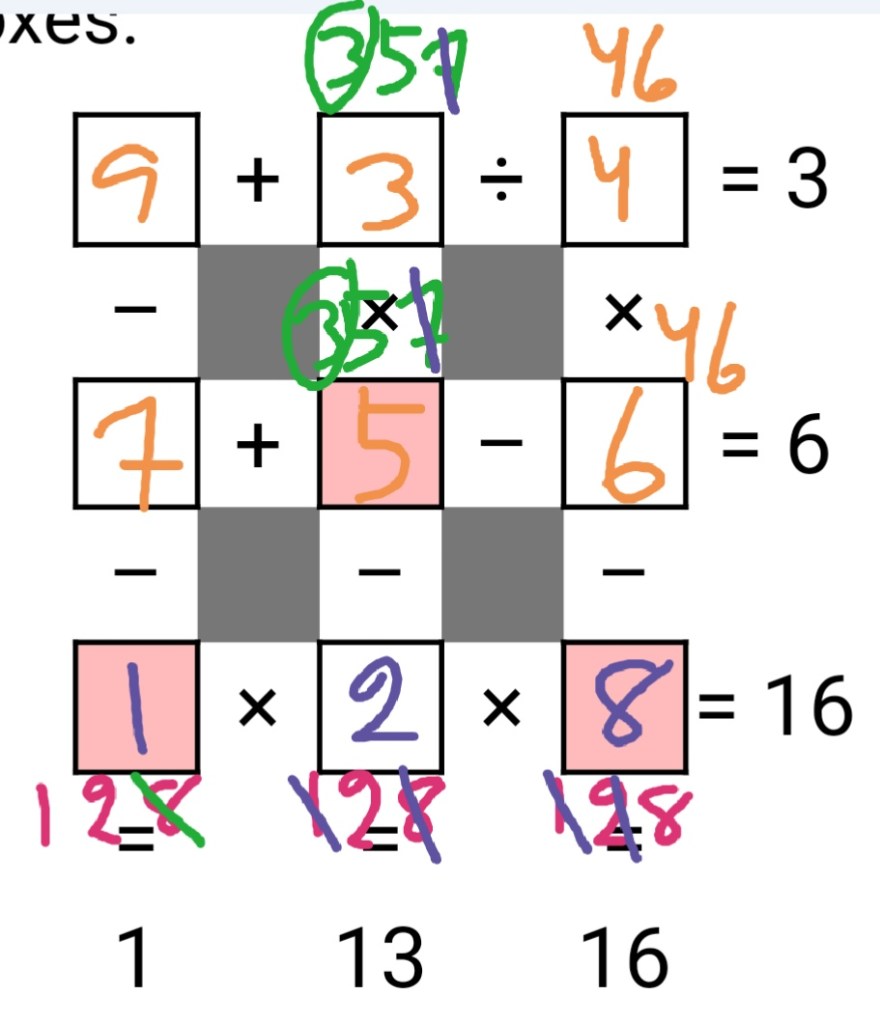
Let’s name these numbers:

abc
def
ghi

a * b + c = 46: 5*9+1, 9*5+1, 6*7+4, 7*6+4, 5*8+6, 8*5+6

a, b: 5, 6, 7, 8, 9

c: 1, 4, 6

b + e * h = 12: 3+9*1, 4+8*1, 5+7*1, 7+5*1, 8+4*1, 9+3*1, 1+5*2, 5+1*2, 1+2*4, 2+1*4

New b: 5, 7, 8, 9

e: 1, 3, 4, 5, 7

h: 1, 2

a / d / g = 1: 6/2/3, 6/3/2, 8/2/4, 8/4/2

New a: 6, 8

d, g: 2, 3, 4

Because new a and b: a * b + c = 46: 5*9+1, 9*5+1, 6*7+4, 7*6+4, 5*8+6, 8*5+6

New a: 6, 8

New b: 5, 7

Because new b: b + e * h = 12: 3+9*1, 4+8*1, 5+7*1, 7+5*1, 8+4*1, 9+3*1, 1+5*2, 5+1*2, 1+2*4, 2+1*4

e: 1, 5, 7

h: 1, 2

g – h / i = 1, g = 2, 3, 4, h = 1, 2: 3-1/2, 3-2/1, 4-1/3

New g: 2, 3, 4

i: 1, 2, 3

d, g, h and i can only be among 1, 2, 3, 4, therefore a, b, c, e and f can’t

c = 6

a = 8, b = 5

Because new a: a / d / g = 1: 6/2/3, 6/3/2, 8/2/4, 8/4/2

New d, g: 2, 4

e: 7

h = 1

i = 3

g = 4

d = 2

f = 9

856279413

The product of the red digits is 8*6*7 = 336.