Anmeldelse af “Loneliness Universe” (gratis), af Eugenia Triantafyllou. (Link nedenfor.) Langnovelle. 2024. Hugo-finalist.
Skitse: Nefeli beslutter at kontakte en gammel ven, hun ikke rigtig har forbindelse med mere. De aftaler at mødes ved et busstoppested, men et eller andet går galt.
Er det science fiction? Det er jo lidt en fortolkning. Men svaret kan godt være ja.
Temaer: Nefeli oplever i stigende grad, at hun ikke kan være i stue sammen med sine venner og bekendte. Helt bogstaveligt. Hun kan sende en tekst-besked til sin bror, og hun kan spise de chips, han lige har lagt på bordet, men derudover er det, som om han lige har forladt lokalet. For ham er det, som om hun lige er gået.
Fænomenet spreder sig, og videnskabsfolk prøver at finde årsagen. Nefeli har også et bud.
Det er her, det muligvis mere bliver symbolsk det hele. At dagsordenen er at skælde ud på folk, der fysisk er sammen, men faktisk har næsen i mobilen, hver for sig.
Er det godt? Jeg var spændt på slutningen, på opklaringen. Som altid er det lidt irriterende, når fortolkningen ikke er entydig. 👽👽☠️
Anmeldelse af “Lake of Souls”, af Ann Leckie. Langnovelle. 2024. Hugo-finalist.
Skitse: Via at skifte ham har lille Spawn allerede været gennem faserne æg og larve og kan se frem til at blive rigtig voksen med et navn næste gang. Han er optaget af spørgsmålet om væsner uden sjæl.
Er det science fiction? Ja.
Temaer: Der er også et menneske, en antropolog, der studerer livet på den her fremmede planet. Han har ellers været frosset ned i lang tid, men nu er han her og prøver at undgå alt for tæt kontakt med de lyserøde kravlefiduser, mens han leder efter ekspeditionens ansible.
Spawn foretager en lang rejse. Da han støder på antropologen, er det afgørende, at de hver især kan se, at den anden har en taske. Taske = intelligens.
Er det godt? Det kører egentlig meget godt. Var det nødvendigt at have et menneske med? Jeg var spændt på slutningen. 👽👽👽
Skitse: Firion kan stor magi! Men på det sidste har hun været lidt distraheret, fordi hendes magiske batterier er flade. Hun har ikke fået tjekket sin inbox, så det er en overraskelse, da der står en elev ved døren.
Er det science fiction? Nej da. Fantasy.
Temaer: Firion skal have det hele til at gå op i en højere enhed. Få sin magi tilbage, forhåbentlig. Uddanne eleven. Beskytte den nærliggende landsby mod en superdrage. Der bliver i hvert fald en historie ud af det.
(Det er sært, lige at have læst noget indviklet, hvor man skal lede efter meningen, og så læse noget, der er ret lige ud ad landevejen. Fordi det er jo bare forskelligt, ikke dårligt. Ikke?)
Er det godt? Det virker. Men nok ikke stor kunst. 👽👽☠️
This week the #puzzle is: Happy 100th Fiddler! #counting #permutations #triangles #parallelograms #dozo #flag
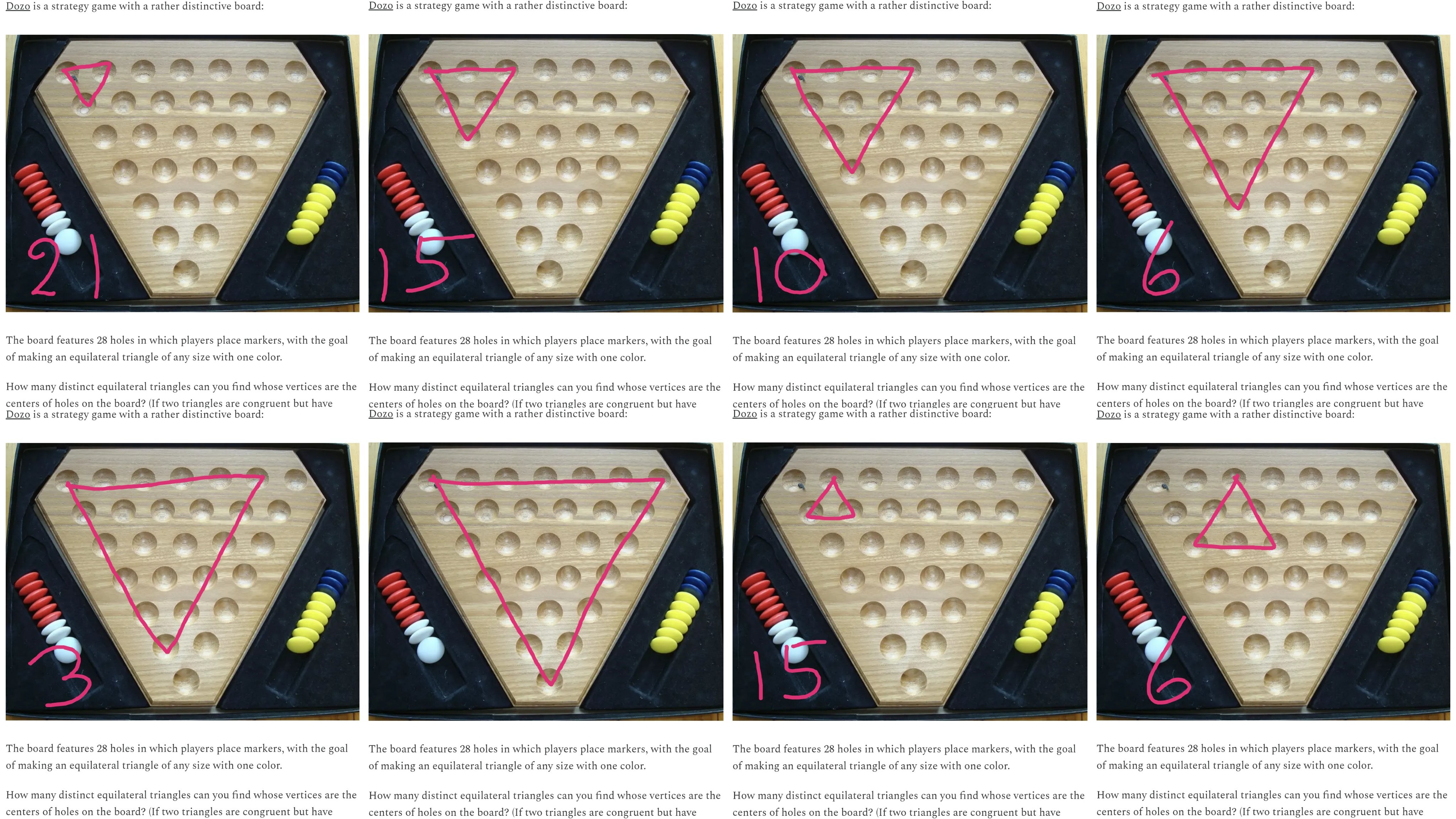
Dozo is a strategy game with a rather distinctive board:
The board features 28 holes in which players place markers, with the goal of making an equilateral triangle of any size with one color.
How many distinct equilateral triangles can you find whose vertices are the centers of holes on the board? (If two triangles are congruent but have different vertices, they should still be counted as distinct.)
And for extra credit:
Happy Fourth of July! In celebration of America’s birthday, let’s count more shapes—not in a board game, but in the American flag:
In particular, consider the centers of the 50 stars depicted on the flag. How many distinct parallelograms can you find whose vertices are all centers of stars? (If two parallelograms are congruent but have different vertices, they should still be counted as distinct.)
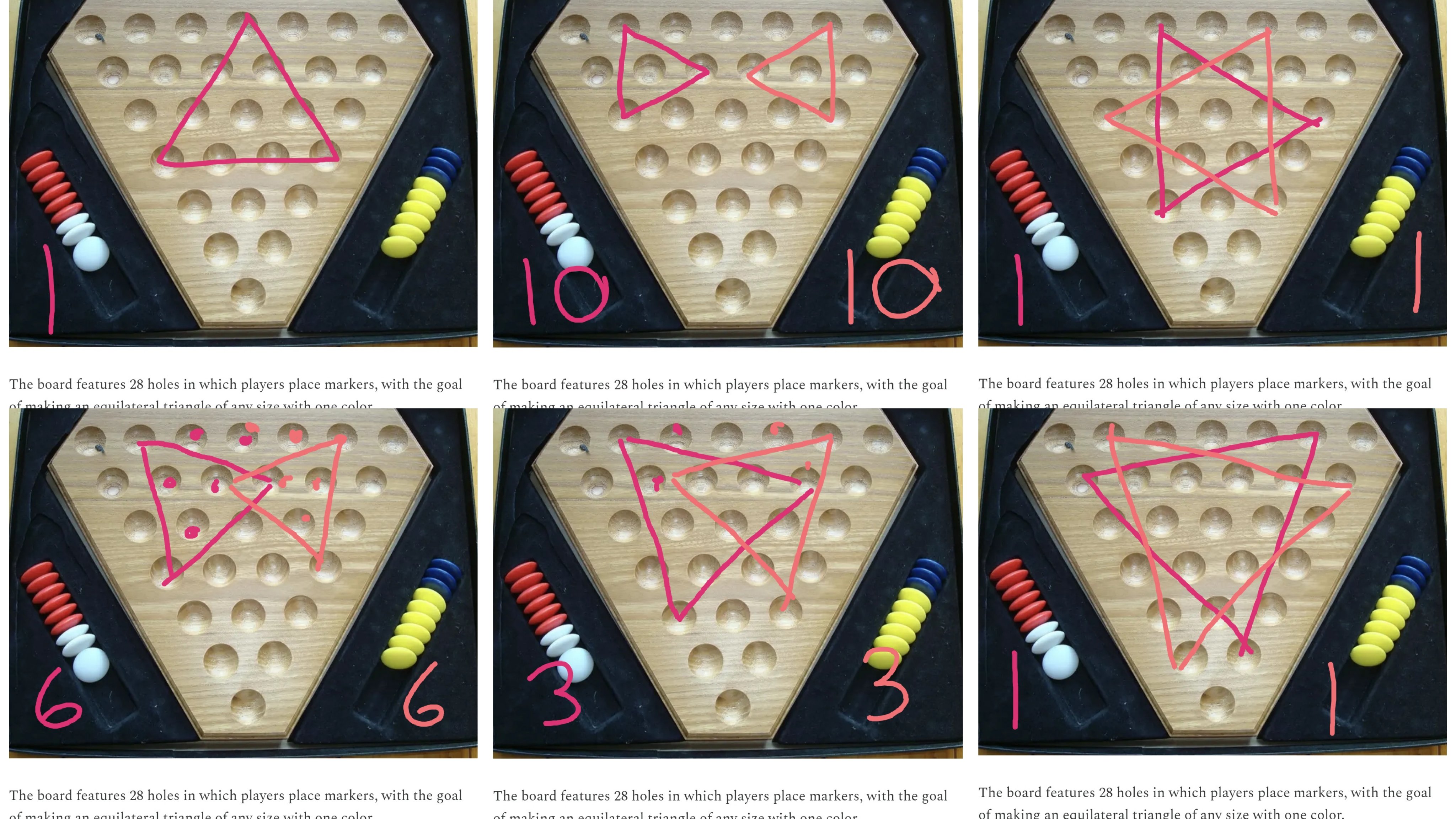
I tried counting triangles both by hand and with a program. The handcount illustrated is actually a little wrong, because in a certain case (6 + 6) I forgot to count the triangles, where the tip pointed up. The program goes through all the options for the 1st and 2nd vertex, constructing the 3rd and testing whether this hypothetical 3rd is on the board. This was a little tricky, because my model of the board didn’t preserve angles and distances from the board. But I think I got there in the end. Result: 126 triangles.
This time I went straight to the program. It goes through all the options for 3 vertices, constructing the 4th. There’s actually a charming set of formulas for constructing the 3 options for the 4th vertex. This time it didn’t matter that angles and distances weren’t preserved. Only tricky part was to detect, when the 1st, 2nd and 3rd vertex were on a line. Result: 5918 parallelograms.
***
For the 3rd time I’ve come back to weaving the web. This time because a friend kindly helped me turn a 3d object file into a physical object:
This week the #puzzle is: Can You Crack the Roman Code? #combinations #recursion (Link at the bottom.)
You are breaking into a vault that contains ancient Roman treasure. The vault is locked, and can be opened via a modern-day keypad. The keypad contains three numerical inputs, which are (of course) expressed using Roman numerals: “I,” “II,” and “III.”
It’s a good thing your accomplice was able to steal the numerical key code to the vault. Earlier in the day, they handed you this code on a scroll of paper. Once at the keypad, you remove the scroll from your pocket and unfurl it. It reads: “IIIIIIIIII.” That’s ten vertical marks, without any clear spacing between them.
With some quick mental arithmetic, you realize the combination to unlock the door could be anywhere from four digits long to 10 digits long. (Or is it IV digits to X digits?) How many distinct combinations are possible? If two combinations use the same numbers but in a different order, they are considered distinct.
And for extra credit:
Having successfully hacked your way through the first keypad, the door opens to reveal a second door with yet another keypad that has eight numerical inputs: “I,” “II,” “III,” “IV,” “V,” “VI,” “VII,” and “VIII.”
You were expecting this, which is why your accomplice had handed you a second scroll of paper. You unfurl this one as well, hoping they remembered to add spaces between the numbers.
No such luck. This paper reads: “IIIVIIIVIIIVIII.” That’s 15 characters in total. How many distinct combinations are possible for this second door?
Highlight to reveal (possibly incorrect) solution:
Good thing I wrote that program! I can simply use it again. It says there are 4000 solutions.
Just to make sure, I also made a spreadsheet, counting in another way. Same result. I am happy.
***
Last week I actually didn’t do that well. I made a lot of assumptions, and some of them were wrong. In both puzzles my pass no. 2 didn’t correspond with the official solution. I’ve discovered, that for the fiddler this happened, because I made a mistake in my calculations. The area of my tilted 2nd pass is not 1.0472, but 0.7585. Oops.
This week the #puzzle is: How Greedily Can You Mow the Lawn? #geometry #area #volume #GreedyAlgorithm (Link at the bottom.)
You’re mowing a circular lawn with a radius of 1 unit. You can mow in straight strips that are 1 unit wide.
The fewest number of passes you would need to mow the entire lawn is two, as shown below. In one pass (shown in blue) you can mow half the circle, and in the second pass (shown in red) you can mow the other half of the circle.
However, instead of minimizing the number of passes, you greedily choose how to orient each pass so it cuts as much of the unmowed grass as possible. A pass doesn’t have to go through the center of the circle and can be in any direction, but must be straight and cannot bend.
With this “greedy” approach, how many passes will it take for you to mow the entire lawn?
And for extra credit:
Instead of mowing a two-dimensional lawn, now you’re boring cylinders through a three-dimensional unit sphere. Each cylinder has a diameter of 1 (and a radius of 1/2).
Once again, you are greedily choosing the orientation of your boreholes so that they carve out as much of the remaining sphere as possible with each pass.
With this “greedy” approach, how many passes will it take for you to pulverize the entire sphere?
Highlight to reveal (possibly incorrect) solution:
Obviously the 1st pass is simply symmetrical, the middle of the pass going through the center. If it didn’t go through the center, it would cover less area. In my model this pass is horizontal.
The 2nd pass might simply be the same, just in the other direction? It would get a lot of the 2 remaining bits, leaving 4 bits behind. If this pass is indeed vertical, again, the middle of it goes through the center, to cover as much area as possible. This area would be 0.9132. [ETA: Oops, should be 2 * 0.9132. Wrong conclusions follow.]
Then I would need 2 passes to cover the remaining 4 bits, either 2 horizontal (or vertical) passes, covering 2 bits every time, or 2 passes crisscrossing, one going up, the other going down, again covering 2 bits every time.
That would be 4 passes in all.
Can it be done in a better way?
I need at least 3 passes, because I can’t cover the 2 remaining bits after the 1st pass in just 1 more pass.
What if the 2nd pass simply covered 1 of the remaining bits? This area turns out to be 0.6142. So this wouldn’t happen, as it is less than 0.9132.
There’s an interesting option. What if the 2nd pass was tilted just right, so that it wouldn’t create 4 remaining bits, but only 2? This covers an area of 1.0472. Yes! This is indeed possible. A 3rd pass, tilted the other way, would cover the rest.
I don’t know whether this is exactly the optimal way to do things. But it proves, that 3 passes can do the job.
There’s something interesting going on at Researchgate, suggesting that a non-greedy solution would need at least 20 circles / 10 cylinders. Because the angular radius of each circle is 30o.
This one is just me guessing most of the way, illustrated in Desmod:
1st and 2nd pass are symmetrical, with the middle of the cylinder passing through the center. They are also perpendicular.
I assume the same goes for the 3rd pass.
The next 4 passes (red in my model) are closing some gaps on the surface of the sphere between the 3 existing passes. E.g. one of these cylinders has x=y=z in the middle.
This leaves 8 bits. I would need 4 more passes to cover these, again using cylinders passing through the center.
Using this method, with the whole surface covered and all cylinders passing through the center, all of the volume has been covered.
This week the #puzzle is: Can You Race Against Zeno? #integration #summation #speed #distance #time (Link at the bottom.)
I’ve been experimenting with different strategies in 5000-meter races (known as “5K”s). If I run the distance at a steady pace, I’ll finish in precisely 23 minutes.
However, I tend to find a burst of energy as I near the finish line. Therefore, I’ve tried intentionally running what’s called a “negative split,” meaning I run the second half of the race faster than the first half—as opposed to a “positive split,” where I run a slower second half.
I want to take the concept of a negative split to the next level. My plan for an upcoming race—the “Zeno Paradox 5K”—is to start out with a 24-minute pace (i.e., running at a speed such that if I ran the whole distance at that speed, I’d finish in 24 minutes). Halfway through the race by distance (i.e., after 2500 meters), I’ll increase my speed (i.e., distance per unit time) by 10 percent. Three-quarters of the way through, I’ll increase by another 10 percent. If you’re keeping track, that’s now 21 percent faster than my speed at the start.
I continue in this fashion, upping my speed by 10% every time I’m half the distance to the finish line from my previous change in pace. (Let’s put aside the fact that my speed will have surpassed the speed of light somewhere near the finish line.)
Using this strategy, how long will it take me to complete the 5K? I’m really hoping it’s faster than my steady 23-minute pace, even though I start out slower (at a 24-minute pace).
And for extra credit:
I still want to run a negative split, but upping my tempo in discrete steps is such a slog. Instead, my next plan is to continuously increase my pace in the following way:
At the beginning of the race, I’ll start with a 24-minute pace. Then, wherever I am on the race course, I’m always running at a 10 percent faster speed than I was when I was twice as far from the finish line. Also, my speed should always be increasing in a continuous and smooth fashion.
(On the off chance you find more than one speed as a function of distance that satisfies all these conditions, I’m interested in seeing how. If only one such function exists, can you prove it? Regardless, my expectation is for the function to be as straightforward as possible.)
Using this strategy, how long will it take me to complete the 5K? Once again, I’m hoping it’s faster than my steady 23-minute pace, even though I started out slower.
Highlight to reveal (possibly incorrect) solution:
Desmos 1 – just to be confusing, the definition of tZeno1 here is slightly different.
Let’s look at what we know or define:
d: the full distance (5 km – all we metric centric people thank you)
tinit: the time spent running with the initial speed all the way (24 m)
v0: the initial speed (d/tinit) (also, tinit = d/v0)
a: the increase of speed as a factor (1.1)
tZeno1: the time spent running under the new rule
With these definitions in place, let’s go running.
Run at v0 to cover the distance d/21. (Half of the distance is run at the initial speed.)
Then run at v0 * a to cover the distance d/22. (Half of the remaining distance is run after 1 speed increase.)
Then run at v0 * a2 to cover the distance d/23.
Then run at v0 * a3 to cover the distance d/24.
In general run at v0 * ai to cover the distance d/2i+1.
In general spend ti to cover distance d/2i+1.
ti = d/2i+1 / (v0 * ai)
ti = (d/v0) / (2i+1 * ai)
ti = tinit / (2i+1 * ai)
tZeno1 = Σi=0 ti
tZeno1 = Σi=0 tinit / (2i+1 * ai)
tZeno1 = tinit * Σi=0 1 / (2i+1 * ai)
To get a good approximation, I can let the upper bound be finite, but growing.
According to Desmos, tZeno1 = 22 m.
But seeing I am so close, maybe I can do this in a better way.
This week the #puzzle is: Can You Squeeze the Bubbles? #circles #geometry #area #minimize (Link at the bottom.)
Draw a unit circle (i.e., a circle with radius 1). Then draw another unit circle whose center is notinside the first one. Then draw a third unit circle whose center is not inside either of the first two.
Keep doing this until you have drawn a total of seven circles. What is the minimum possible area of the region that’s inside at least one of the circles?
And for extra credit:
Instead of seven unit circles, now suppose you draw N of them. As before, the center of each new circle you draw cannot be inside any of the previous circles.
As N gets very, very large, what is the minimum possible area of the region inside at least one circle in terms of N?
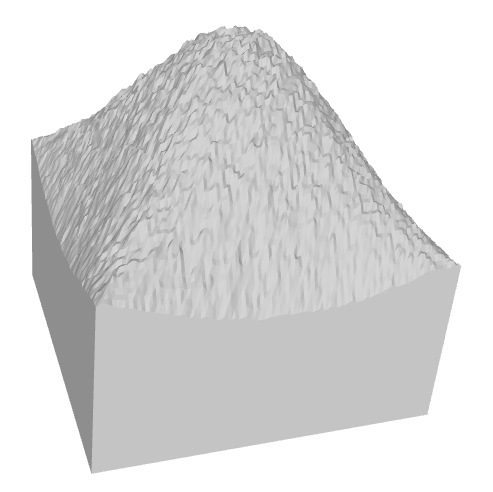
But first. Last week I made a booboo. At some point I began trusting my assumption about the probabilities so much, that I didn’t figure out, why my monte carlo results didn’t line up. This again lead to me saying 2 was the correct answer to the extra credit, when in fact… well, as I said, my monte carlo said something else. Something better. This is a detail from my heat map 5.
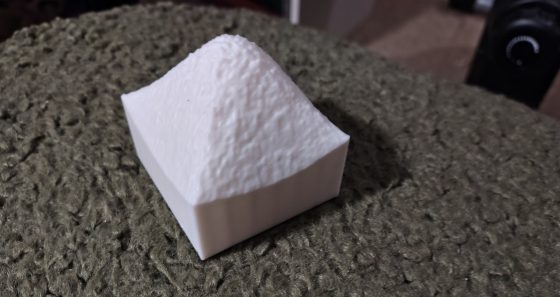
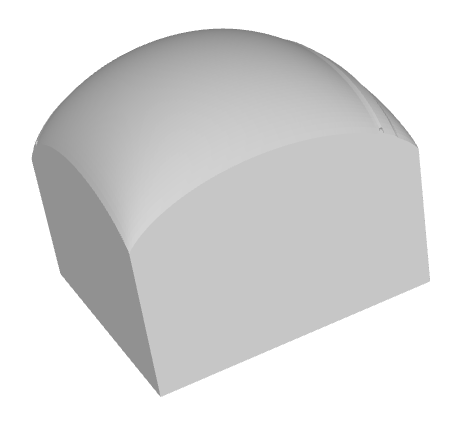
The lowest values occur, not in the corner (4), but towards the middle of the side (3). And the ratio is something like 2.7. Earlier heat maps actually showed this more clearly. Here’s the 3d image based on my monte carlo data, and for comparison the other 3d image again:
The important feature is that there’s a dip along the lower edge. Corner low, middle of side lower. Sigh. Anyway. Back to the puzzles from this week.
Highlight to reveal (possibly incorrect) solution:
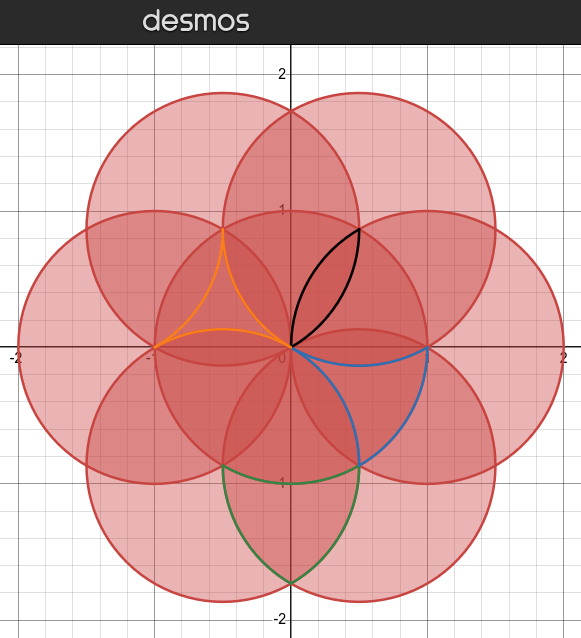
So, here’s the big assumption: The best possible choice for the next center is to tuck it as far into the previous circle(s) as possible. 2nd center goes on the periphery of the 1st. 3rd center goes where the 2 first circles cross each other, into the little “fjord”. Etc. See model on Desmos.
(This is among other things assuming, that being on the periphery, being a distance of 1 from the center, isn’t being inside the circle.)
The next question then is: What is the area of this figure? Looking at the image, we have 7 circles. But then we have to subtract 6 green figures, so as not to double count. And 6 blue figures twice. And 6 black figures 3 times. (Also note, 1 green figure = 1 orange figure + 2 black figures; 1 blue figure = 1 orange figure + 1 black figure.)
Area of circle: π 1² = π = 3.14159.
Area of overlap between 2 circles, like the middle circle and the one to the right of it – this is also 2 orange figures and 5 black figures: From Two Circles Calculator, 1.22837.
Area of black figure: From Two Circles Calculator, 0.18122.
Area of orange figure: (1.22837 – 5 * 0.18122) / 2 = 0.161135.
Area of blue figure: 0.161135 + 0.18122 = 0.342355.
Area of green figure: 0.161135 + 2 * 0.18122 = 0.523575.
Area of the whole figure: 7 * 3.14159 – 6 * 0.523575 – 2 * 6 * 0.342355 – 3 * 6 * 0.18122 = 11.479.
It’s actually easier to look at hexagons and triangles. Each hexagon consists of 6 triangles. Each triangle is actually part of 3 hexagons. Therefore adding 1 hexagon only contributes 6/3 = 2 new triangles.
The area of such 2 triangles is √ 0.75 = 0.8660. The function f(N) is therefore 0.866 * N.
Test: Going from 7 circles in the above fiddler to 19 (in a symmetrical way) adds 12 circles. The area grows by 3 orange figures and 5 black figures for each new circle “on a corner” and 2 orange figures and 3 black figures for each new circle “on an edge”. This is on average 2.5 * 0.161135 + 4 * 0.18122 = 1.1277175. As N goes up, the edge circles will dominate. An edge circle contributes 2 * 0.161135 + 3 * 0.18122 = 0.86593. QED.
Skitse: En mulighed for et computerspil er, at en enkelt spiller kan have et stort publikum. Det kan derfor også have stor betydning, når en spiller gør noget usædvanligt. I et autoritært samfund gør noget forbudt, noget farligt.
Er det science fiction? Jeps.
Temaer: Det omtalte spil er baseret på noget historisk. Der var en gang en kejser og et oprør. Noget historisk kan fortælles på forskellige måder. En historikers forsøg på at få mening i, hvad der egentlig skete, kan føre et nyt sted hen. Hvad var folks motiver? Hvem havde alliancer? Hvad er fortællingen her? Hvis der er en.
Hvis man ønsker at sige noget om sin samtid, så kan man også vinkle noget historisk på en passende måde.
Min fornemmelse er, at forfatteren er intelligent og veluddannet (fx er der fodnoter til novellen) og har valgt en indviklet metode. Bl.a. er der pudsige skift mellem 1. og 2. person. Jeg læste novellen 2 gange, for at være nogenlunde sikker på det hele.










 ti
ti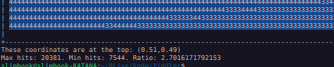

 Stuff from ommadawn.dk (Lise Andreasen)