#ThisWeeksFiddler, 20250131

This week the question is: Can You Spin the Graph?

You’re taking a math exam, and you’ve been asked to draw the graph of a function. That is, your graph must pass the vertical line test, so that no vertical line intersects your function’s graph more than once.

You decide you’re going to graph the absolute value function, y = |x|, and ace the test.

There’s just one problem. You are dealing with a bout of dizziness, and can’t quite make out the x– and y-axes on the exam in front of you. As a result, your function will be rotated about the origin by a random angle that’s uniformly chosen between 0 and 360 degrees.

What is the probability that the resulting graph you produce is in fact a function (i.e., y is a function of x)?

And for extra credit:

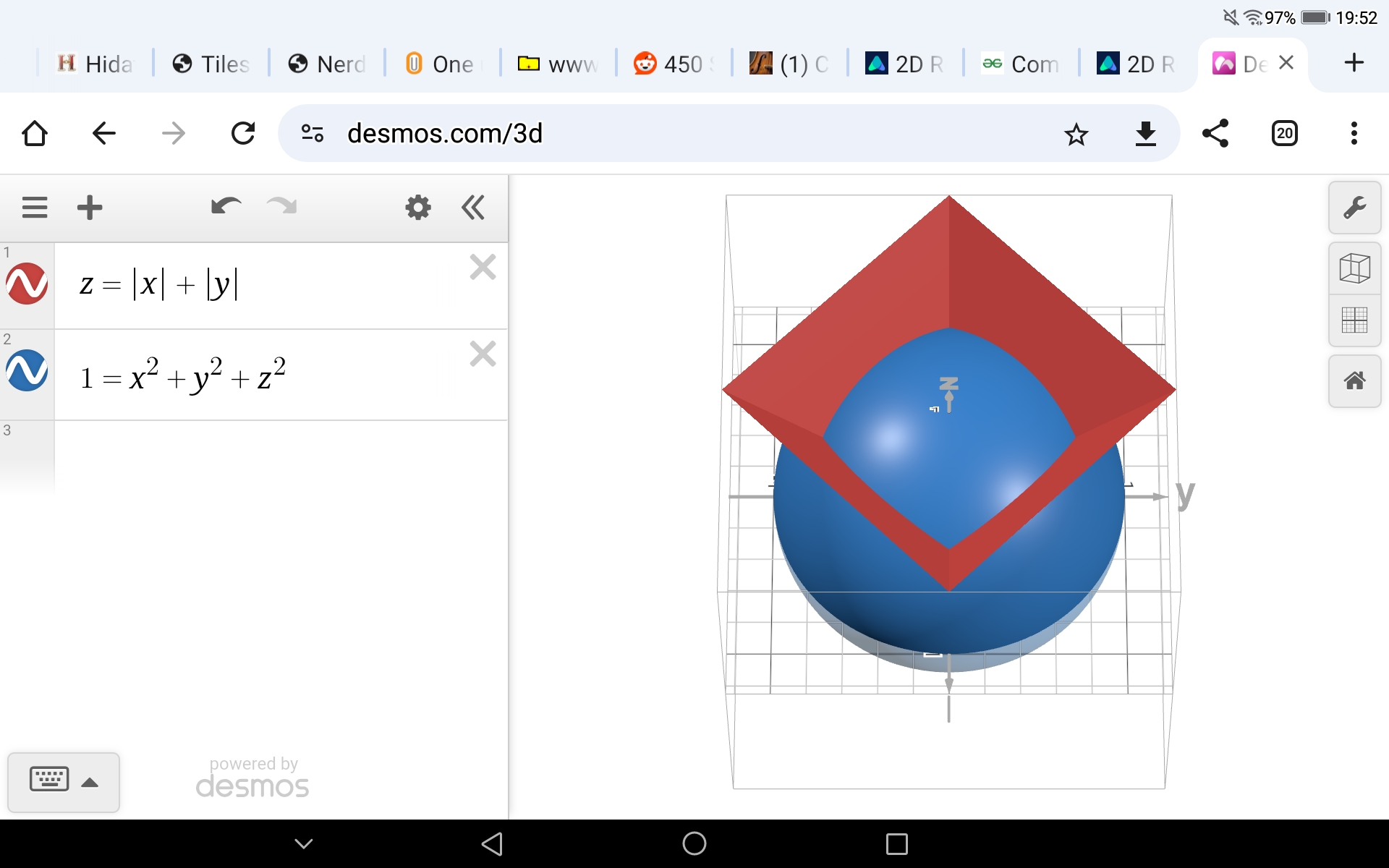
In a more advanced course, you’ve been asked to draw a 3D sketch of the function z = |x| + |y|. As you’re about to do this, you are struck by another bout of dizziness, and your resulting graph is randomly rotated in 3D space.

More specifically, your graph has the correct origin. But the true z-axis is equally likely to point from the origin to any point on the surface of the unit sphere. (Meanwhile, the x-axis is equally likely to point in any direction perpendicular to the z-axis. From there, the y-axis is uniquely determined.)

What is the probability that the resulting graph you produce is in fact a function (i.e., z is a function of x and y)?

Highlight to reveal (possibly incorrect) solution:

And for extra credit:

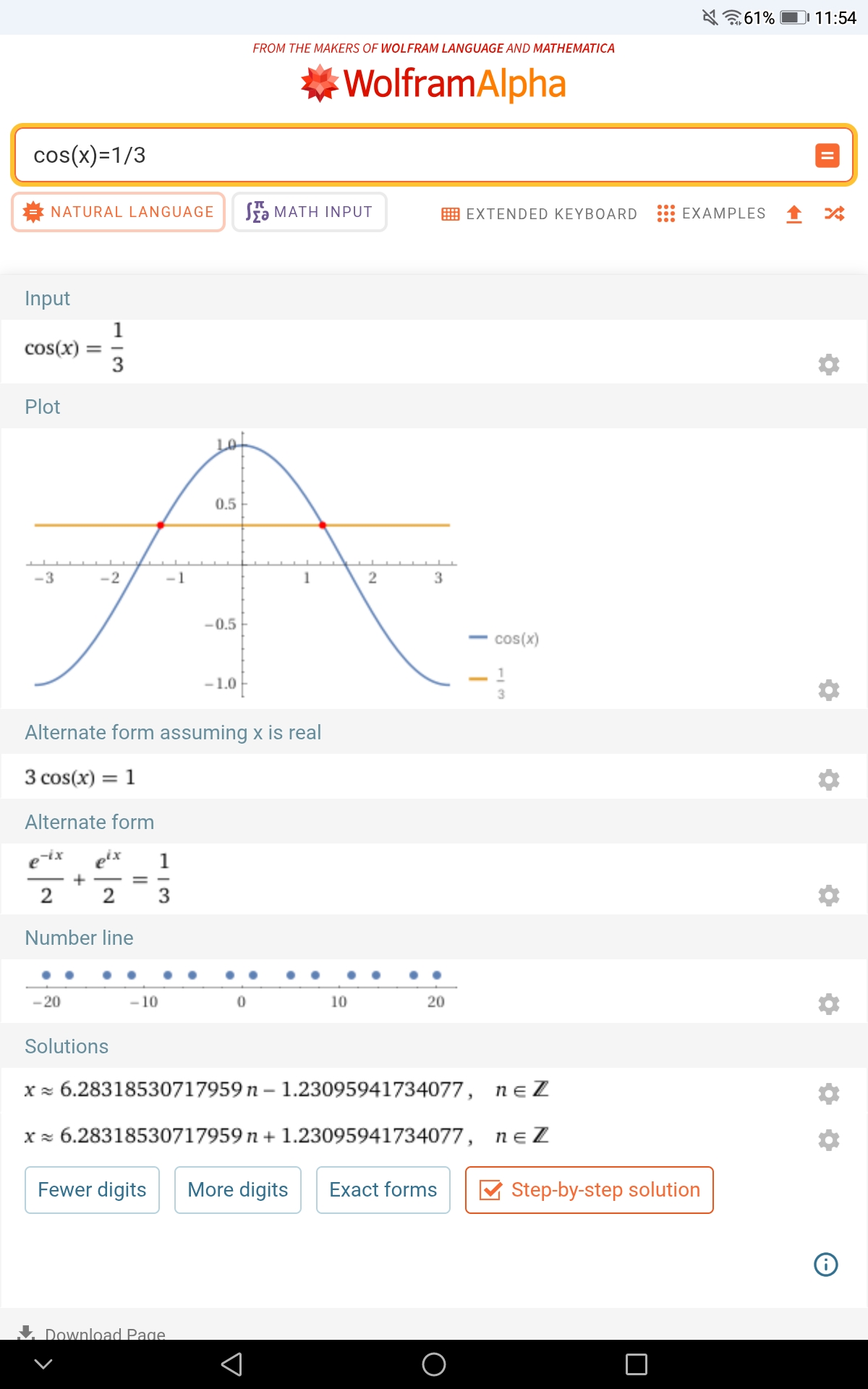
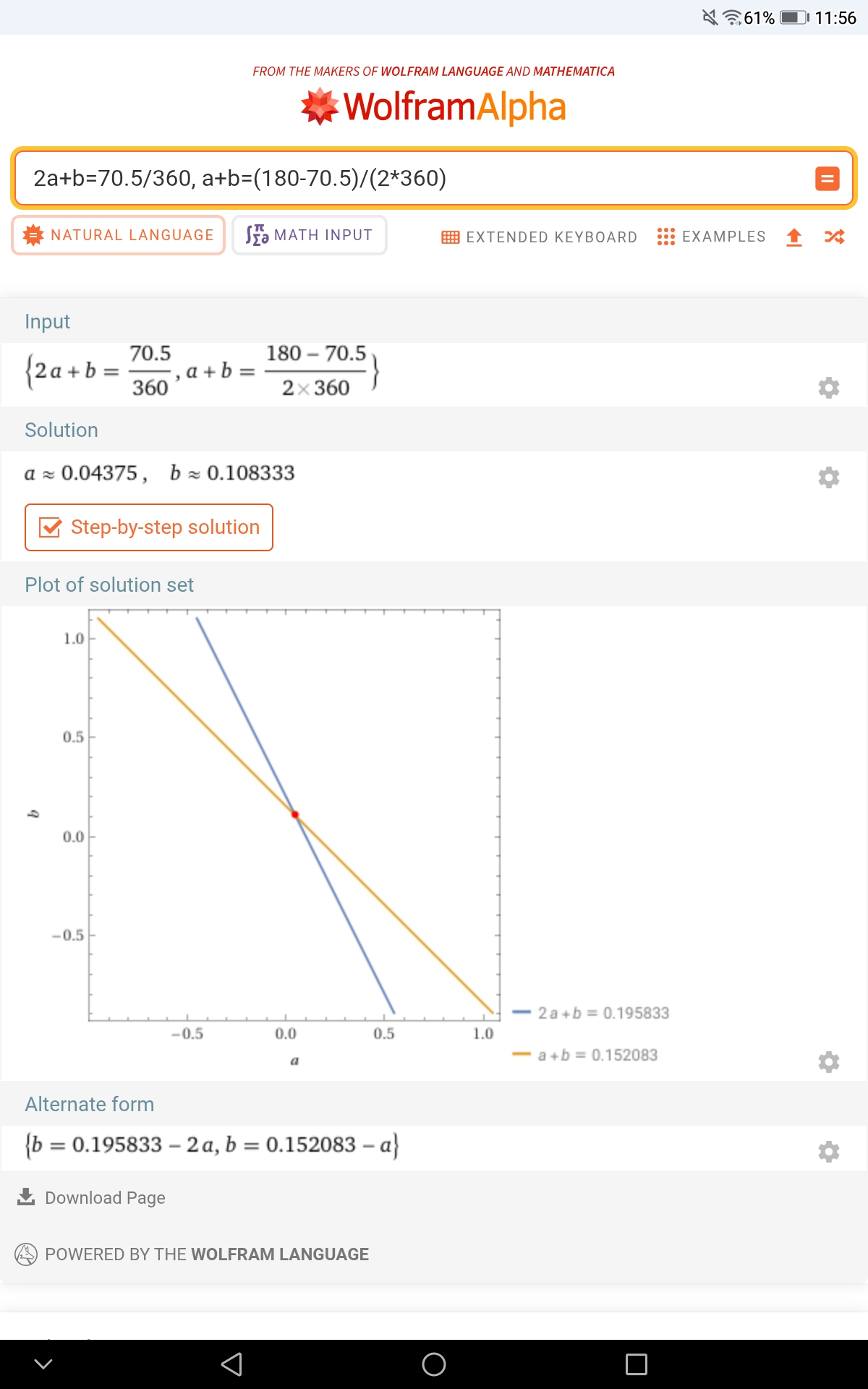
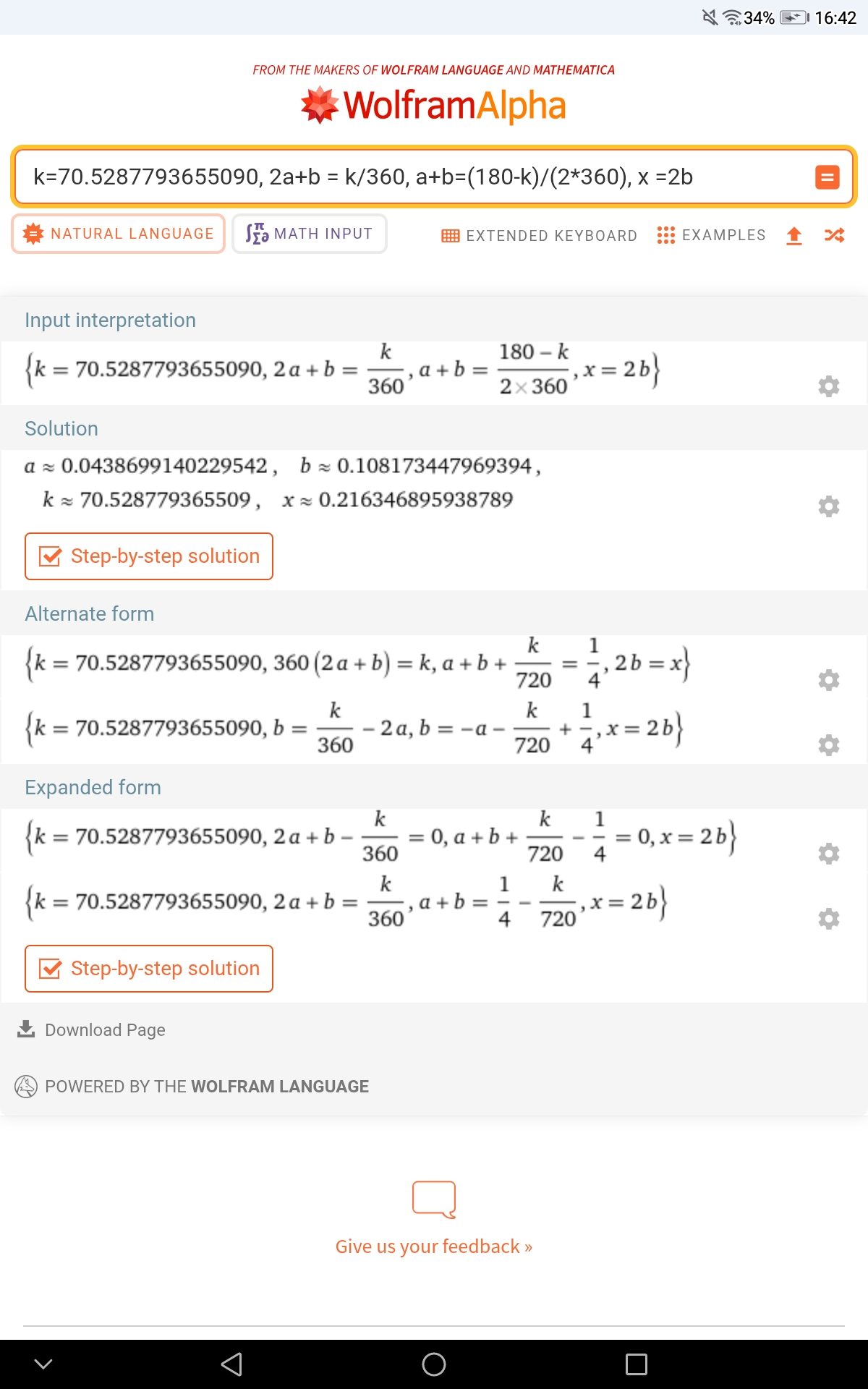
Desmos. Figure 1, 2, 3, 4, 5, 6, 7.

I am not at all sure about this one. It was hard for me.

#ThisWeeksFiddler, 20250124

This week the question is: Can You Hop to the Lily Pad?

You are a frog in a pond with four lily pads, marked “1” through “4.” You are currently on pad 2, and your goal is to make it to pad 1. From any given pad, there are specific probabilities that you’ll jump to another pad:

  • Once on pad 1, you will happily stay there forever.
  • From pad 2, there’s a 1-in-2 chance you’ll hop to pad 1, and a 1-in-2 chance you’ll hop to pad 3.
  • From pad 3, there’s a 1-in-3 chance you’ll hop to pad 2, and a 2-in-3 chance you’ll hop to pad 4.
  • Once on pad 4, you will unhappily stay there forever.

Given that you are starting on pad 2, what is the probability that you will ultimately make it to pad 1 (as opposed to pad 4)?

And for extra credit:

Once again, you are a frog in a pond. But this time, the pond has infinitely many lily pads, which are numbered “1,” “2,” “3,” etc. As before, you are currently on pad 2, and your goal is to make it to pad 1, which you would happily stay on forever.

Whenever you are on pad k, you will hop to pad k−1 with probability 1/k, and you will hop to pad k+1 with probability (k−1)/k.

Now, what is the probability that you will ultimately make it to pad 1?

Highlight to reveal (possibly incorrect) solution:

Program.

And for extra credit:

Advent of Code, day 26

This December I participated in Advent of Code.

So. Looking back. Days 1-10 were fun, because it was fun to code again. Day 16 (1 point for walking forwards, 1000 to turn) was fun, after the fact, because I found an elegant way (with a nice diagram) to represent the labyrinth as a graph, and finally just implemented Dijkstra fully. Day 17 (build a small programming language) was very satisfying to solve, even if it involved a lot of paper. For day 19 (towels) I had to learn memoization. (I never learned this before?) Day 20 (a labyrinth that turns out just to be one long path, and it’s possible to walk through walls) it was an epiphany, that (part 1 of route) + (part 2 of route) – (discarded part in the middle) + (shortcut) was a way to solve the puzzle. Day 24 (a lot of gates) required some paperwork.

This is my attempt to fill out the complete personal times for me. I’m a little sad, that it simply says “more than 24 hours” officially.

Part 1 of days 17, 22 and 23 must have been easy, I spent minutes getting them right (just 2 or 7 or 8 days late). As I remember it, day 25 didn’t take a long time either, but I wanted to be well rested before I attempted it, so, happy surprise.

      --------Part 1--------   --------Part 2--------
Day Time Rank Score Time Rank Score
25 8:03:01 22113 0 8:03:02 14148 0
24 7:10:58 23368 0 8:11:00 15862 0
23 7:20:30 23812 0 8:10:15 21472 0
22 8:17:59 25204 0 8:20:00 21799 0
21 9:10:07 19594 0 9:17:22 16355 0
20 5:05:00 24815 0 6:02:28 21577 0
19 4:06:00 28005 0 4:08:12 25333 0
18 4:11:11 27991 0 4:11:49 27338 0
17 2:09:34 28700 0 3:08:04 20591 0
16 2:06:05 24090 0 3:08:50 25303 0
15 01:19:07 5843 0 07:18:20 8861 0
14 01:28:12 7258 0 02:13:42 6000 0
13 03:04:50 11545 0 03:08:52 7714 0
12 03:55:52 14298 0 04:04:26 7259 0
11 00:24:58 6479 0 01:09:10 5330 0
10 00:44:34 6515 0 00:48:19 6013 0
9 01:26:25 9059 0 02:59:32 8039 0
8 01:53:25 10087 0 02:04:40 9294 0
7 17:55:39 47349 0 18:02:03 44377 0
6 00:45:55 8375 0 02:18:28 8078 0
5 13:07:46 55110 0 13:13:45 44839 0
4 01:51:36 15622 0 02:06:52 13570 0
3 16:51:27 91593 0 17:04:46 80436 0
2 12:11:26 78108 0 13:30:49 60978 0
1 17:12:43 92846 0 17:24:33 87414 0

This is, for completeness, based on these timestamps:

-rw-rw-r-- 1 slimbook slimbook      6773 Dec 19 14:50 d16c.php
-rw-rw-r-- 1 slimbook slimbook 4921 Dec 19 15:34 d17a.php
-rw-rw-r-- 1 slimbook slimbook 93787 Dec 20 14:04 day17b.ods
-rw-rw-r-- 1 slimbook slimbook 6166 Dec 22 17:11 d18a.php
-rw-rw-r-- 1 slimbook slimbook 6679 Dec 22 17:49 d18b.php
-rw-rw-r-- 1 slimbook slimbook 2092 Dec 23 08:43 d19a.php not right!!!
12:00 ?
-rw-rw-r-- 1 slimbook slimbook 1075 Dec 23 16:12 d19b.php
-rw-rw-r-- 1 slimbook slimbook 4482 Dec 25 11:00 d20b.php
-rw-rw-r-- 1 slimbook slimbook 4393 Dec 26 08:28 d20c.php
-rw-rw-r-- 1 slimbook slimbook 9763 Dec 30 16:07 d21c.php
-rw-rw-r-- 1 slimbook slimbook 10164 Dec 30 23:22 d21e.php
-rw-rw-r-- 1 slimbook slimbook 1371 Dec 30 23:59 d22a.php
-rw-rw-r-- 1 slimbook slimbook 1951 Dec 31 02:00 d22b.php
-rw-rw-r-- 1 slimbook slimbook 1645 Dec 31 02:30 d23a.php
-rw-rw-r-- 1 slimbook slimbook 783 Dec 31 16:15 d23tmp.txt

-rw-rw-r-- 1 slimbook slimbook 1878 Dec 31 16:58 d24a.php
-rw-rw-r-- 1 slimbook slimbook 7940 Jan 1 17:00 d24mermaid3.txt
-rw-rw-r-- 1 slimbook slimbook 1217 Jan 2 09:01 d25a.php
09:02

Advent of Code, day 25

This December I participated in Advent of Code.

Part 1 was sort of easy. Check whether a lock pin and key pin overlap in this particular combination, and go through all the possible combinations, counting. Part 2 turned out to be: Complete all the 49 other parts this December, and click this link!

Part 1:

<?php

///////////////////////////////////////////////////

$input = file_get_contents('./d25input2.txt', true);

$item = 0;
foreach(preg_split("/((\r?\n)|(\r\n?))/", $input) as $line) {
  if(strlen($line)>2) {
    $items[$item][] = str_split($line);
  } else {
    $item++;
  }
}

foreach($items as $item) {
  $tmp = implode($item[0]);
  if($tmp == "#####") {
    $locks[] = $item;
  } else {
    $keys[] = $item;
  }
}

foreach($locks as $id => $lock) {
  // each pin, 5 of them
  for($i=0;$i<5;$i++) {
    // each pin element, 7 of them
    $pinh = 0;
    for($j=1;$j<7;$j++) {
      if($lock[$j][$i] == "#") {
        $pinh++;
      }
    }
    $locksig[$id][] = $pinh;
  }
}

foreach($keys as $id => $key) {
  // each pin, 5 of them
  for($i=0;$i<5;$i++) {
    // each pin element, 7 of them
    $pinh = 0;
    for($j=5;$j>0;$j--) {
      if($key[$j][$i] == "#") {
        $pinh++;
      }
    }
    $keysig[$id][] = $pinh;
  }
}

$lockkeymatch = 0;

foreach($locksig as $lock) {
  foreach($keysig as $key) {
    $tmp = array();
    for($i=0;$i<5;$i++) {
      $tmp[] = $lock[$i] + $key[$i];
    }
    if(max($tmp) <= 5) {
      $lockkeymatch++;
    }
  }
}

print("$lockkeymatch\n");

?>

Scroggs, day 25

A new December and a new bunch of puzzles from mscroggs.co.uk.

All the hints:

DayClue
1144 is an elf’s three-digit number.
2The first elf’s one-digit number is not a factor of 202.
3The first elf’s one-digit number is not 7.
4The third elf’s one-digit number is not 9.
5The second elf’s one-digit number is not 17, or 9.
6990 is a multiple of an elf’s three-digit number.
7The third elf’s one-digit number is not 1.
8The third elf’s one-digit number is not a factor of 432.
9The first elf’s one-digit number is not 5.
10The second elf’s one-digit number is not 49, or 5.
11The third elf’s one-digit number is not 2.
12The second elf’s one-digit number is not 28, or 1.
13One of the digits of the second elf’s three-digit number is 9.
14The second elf’s one-digit number is not 62, or 5.
15The third elf’s one-digit number is not 7.
16The first elf’s one-digit number is not 3.
17The first elf’s one-digit number is not 9.
18The first elf’s one-digit number is not 6.
19The highest common factor of 256 and the second elf’s three-digit number is 1.
20The third elf’s one-digit number is not 4.
21138 is an elf’s three-digit number.
22The highest common factor of 851 and the third elf’s three-digit number is 1.
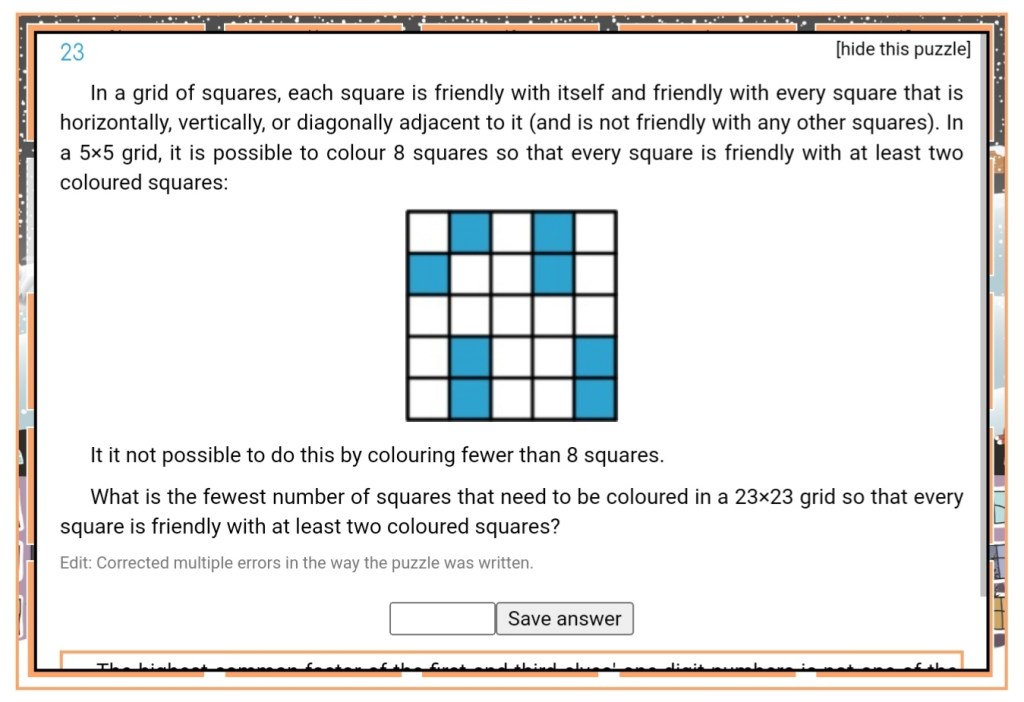
23The highest common factor of the first and third elves’ one-digit numbers is not 24, or 1.
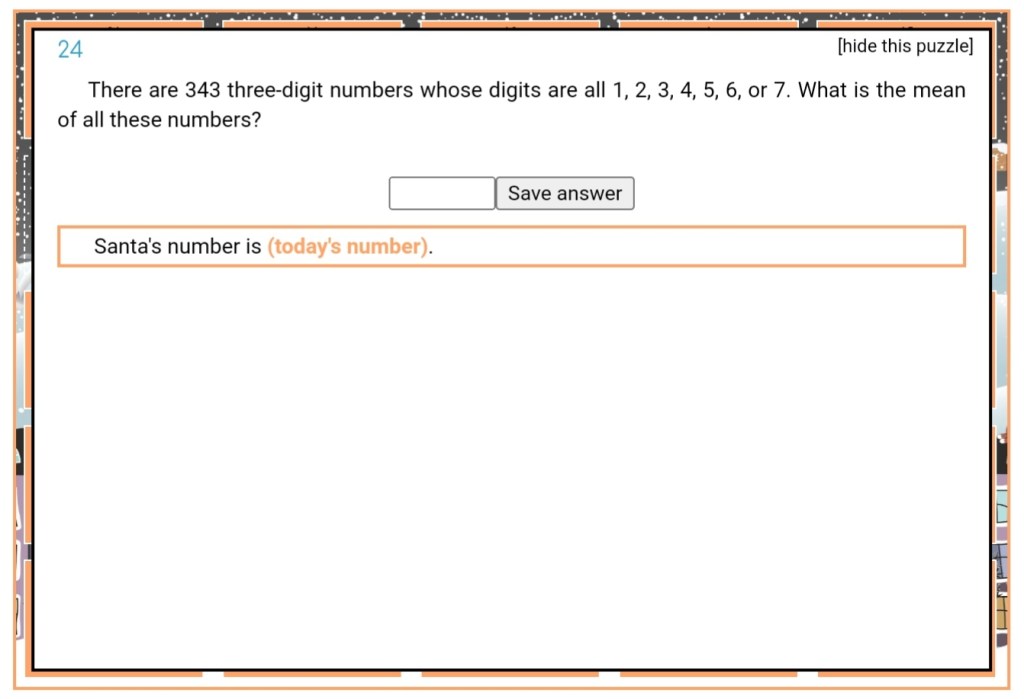
24Santa’s number is 444.

And I know no. 8 and 23 are wrong.

My first look at this problem:

  • (aaa – bbb)*c = x
  • (x – ddd)*e = y
  • (y – fff)*g = hhhhh

Let’s sort this a little bit.

DayClue
24Santa’s number is 444.

Very clear, and as I suspected, very late in the game. aaa = 444.

DayClue
1144 is an elf’s three-digit number.
6990 is a multiple of an elf’s three-digit number.
13One of the digits of the second elf’s three-digit number is 9.
19The highest common factor of 256 and the second elf’s three-digit number is 1.
21138 is an elf’s three-digit number.
22The highest common factor of 851 and the third elf’s three-digit number is 1.

Or to put it another way:

  • We’re looking for bbb, ddd and fff.
  • One of these is 144.
  • One of these is 138. (6 * 23)
  • One of these is a multiple of 990, therefore one of these: 110, 165, 198, 330, 495, 990. There’s no overlap with the 2 we already have, so this must be the third one.
  • One of the digits of ddd is 9. This must be the “multiple of 990” one.
  • As 256 is 28, ddd must be odd.
  • Combining these 3 facts, we get ddd = 495.
  • As 851 = 23 * 37, fff can’t be 138. fff = 144.
  • bbb = 138.
DayClue
2The first elf’s one-digit number is not a factor of 202.
3The first elf’s one-digit number is not 7.
9The first elf’s one-digit number is not 5.
16The first elf’s one-digit number is not 3.
17The first elf’s one-digit number is not 9.
18The first elf’s one-digit number is not 6.

c can’t be 2, 7, 5, 3, 9 or 6. This leaves 1, 4 and 8. (I assume for now, that none of the 1 digit numbers are 0.)

DayClue
5The second elf’s one-digit number is not 17, or 9.
10The second elf’s one-digit number is not 49, or 5.
12The second elf’s one-digit number is not 28, or 1.
14The second elf’s one-digit number is not 62, or 5.

e can’t be 1, 7, 9, 4, 5, 2, 8, 6. This leaves 3.

DayClue
4The third elf’s one-digit number is not 9.
7The third elf’s one-digit number is not 1.
11The third elf’s one-digit number is not 2.
15The third elf’s one-digit number is not 7.
20The third elf’s one-digit number is not 4.

g can’t be 9, 1, 2, 7 or 4. This leaves 3, 5, 6 and 8.

Let’s repeat that:

  • (aaa – bbb)*c = x
  • (x – ddd)*e = y
  • (y – fff)*g = hhhhh
  • aaa = 444
  • bbb = 138
  • c is 1, 4 or 8
  • ddd = 495
  • e = 3
  • fff = 144
  • g is 3, 5, 6 or 8

Now it’s just a question of going through all the options. Discarding the negative options for hhhhh first, and testing the true 5 digit options next.

444138149531443-2133
4441384495314436129
44413884953144317145no
444138149531445-3555
44413844953144510215no
44413884953144528575no
444138149531446-4266
44413844953144612258
44413884953144634290no
444138149531448-5688
44413844953144816344ja
44413884953144845720no

Hey! Turns out, (((444-138)*4-495)*3-144)*8 = 16344.

Advent of Code, day 24

This December I participated in Advent of Code.

One of those days, where I probably grumbled a lot. Part 1 was easy. I chose an algorithm, where I went through a list of all the expressions, checked whether the gate’s output could be calculated (and if yes, deleted the expression from the list), looped back and did it again, until the list was empty. Part 2… I tried several different approaches. Reading hints from others, I ultimately used a free online diagram tool, Mermaid, that accepts text input. Perfect. I wrote a small program to turn the input into something Mermaid could understand (every value, value, gate, value, turned into 2 x value, arrow, value). Then I tried to analyze this diagram. Printed a lot of full adders. And began copying the diagram on to these. Every time the diagram wouldn’t fit, I’d found a swap. Then it took some thinking to figure out how to swap back. But I got there!

Part 1:

<?php

///////////////////////////////////////

$input = file_get_contents('./d24input2.txt', true);

foreach(preg_split("/((\r?\n)|(\r\n?))/", $input) as $line) {
  if(strlen($line)>2) {
    // x00: 1
    if(preg_match("/^(\w+): (\d)$/", $line, $m)) {
      $values[$m[1]] = $m[2];
    }
    // ntg XOR fgs -> mjb
    if(preg_match("/->/", $line, $m)) {
      $m = explode(" ", $line);
      $expr[] = $m;
    }
  }
}

while(sizeof($expr) > 0) {
  foreach($expr as $key => $exp) {
    $val1 = $exp[0];
    $val2 = $exp[2];
    if(isset($values[$val1]) && isset($values[$val2])) {
      $gate = $exp[1];
      $val3 = $exp[4];
      switch($gate) {
        case "AND":
          $values[$val3] =
            $values[$val1] * $values[$val2];
          break;
        case "OR":
          $values[$val3] =
            $values[$val1] + $values[$val2] 
            - $values[$val1] * $values[$val2];
          break;
        case "XOR":
          $values[$val3] =
            ($values[$val1] + $values[$val2]) % 2;
          break;
      }
      unset($expr[$key]);
    }
  }
}

$allzs = $values;
foreach($allzs as $key => $posz) {
  if(!preg_match("/z/", $key, $m)) {
    unset($allzs[$key]);
  }
}

print_r($allzs);

$sum = 0;
foreach($allzs as $key => $z) {
  $pos = (int) str_replace("z", "", $key);
  $sum += $z * pow(2, $pos);
}

print("$sum\n");
?>

Part 2:

Big diagram. Small diagrams.

Advent of Code, day 23

This December I participated in Advent of Code.

For part 1, I optimized a little. Like only storing the representation of each 3 way computer group once. Also 3d arrays. For part 2… I flirted a little with BK (ehm, can’t remember what that stands for), but that program seemed to never stop. So I did it differently. Just like part 1 asked me to create all the 3 way groups, I now moved on to create all the 4 way groups, 5 way groups etc. As each computer had about 13 friends, this shouldn’t take forever to get through. I think it took 35 minutes. I stopped when I only had 1 group of the current size. Oh yeah, and I changed the data structure a little. (BK was sort of the other way around. Trying to grow 1 large set greedily.)

Part 1:

<?php

//////////////////////////////////

$input = file_get_contents('./d23input2.txt', true);

foreach(preg_split("/((\r?\n)|(\r\n?))/", $input) as $line) {
  if(strlen($line)>2) {
    $conn1[] = explode("-", $line);
  }
}

foreach($conn1 as $comp) {
  $comp1 = $comp[0];
  $comp2 = $comp[1];
  $conn2[$comp1][$comp2] = 1;
  $conn2[$comp2][$comp1] = 1;
}

foreach($conn2 as $comp1 => $c1con) {
  foreach($c1con as $comp2 => $cona) {
    foreach($c1con as $comp3 => $conb) {
      // make sure comp2 and comp3 are different
      if(isset($conn2[$comp2][$comp3])) {
        // only store the 3 way connection alphabetically, so as not to store it 6 times
        if(strcmp($comp1,$comp2) < 0 && strcmp($comp2,$comp3) < 0) {
          // only store this set, if one of the computers begin with t
          if(substr($comp1, 0, 1) == "t" || substr($comp2, 0, 1) == "t" || substr($comp3, 0, 1) == "t") {
            $conn3[$comp1][$comp2][$comp3] = 1;
          }
        }
      }
    }
  }
}

$sum = 0;
foreach($conn3 as $a) {
  foreach($a as $b) {
    foreach($b as $c) {
      $sum += $c;
    }
  }
}
print("$sum\n");

?>

Part 2:

<?php

//////////////////////////////////

$input = file_get_contents('./d23input1.txt', true);

foreach(preg_split("/((\r?\n)|(\r\n?))/", $input) as $line) {
  if(strlen($line)>2) {
    $conn1[] = explode("-", $line);
  }
}

foreach($conn1 as $comp) {
  $comp1 = $comp[0];
  $comp2 = $comp[1];
  $conn2[$comp1][$comp2] = 1;
  $conn2[$comp2][$comp1] = 1;
}

foreach($conn2 as $comp1 => $c1con) {
  foreach($c1con as $comp2 => $cona) {
    foreach($c1con as $comp3 => $conb) {
      // make sure comp2 and comp3 are different
      if(isset($conn2[$comp2][$comp3])) {
        // only store the 3 way connection alphabetically, so as not to store it 6 times
        if(strcmp($comp1,$comp2) < 0 && strcmp($comp2,$comp3) < 0) {
          //$conn3[$comp1][$comp2][$comp3] = 1;
          $conn3b[] = array($comp1, $comp2, $comp3);
        }
      }
    }
  }
}

$allcomp = array_keys($conn2);

$multiple = sizeof($conn3b);
$connx = $conn3b;
while($multiple > 1) {
  print("No. of sets in the iteration: $multiple\n");
  $conny = array();
  // build new arrays of length y from length x - y = x+1
  foreach($connx as $wayx) {
    foreach($allcomp as $key => $newcomp) {
      // test that computer is not already in array
      if(!in_array($newcomp, $wayx)) {
        $newgood = 1;
        // test that new is connected to all in wayx
        foreach($wayx as $oldcomp) {
          if(!isset($conn2[$oldcomp][$newcomp])) {
            $newgood = 0;
            break;
          }
        }
        if($newgood == 1) {
          // create new wayy
          $wayytmp = $wayx;
          array_push($wayytmp, $newcomp);
          sort($wayytmp);
          if(!in_array($wayytmp, $conny)) {
            $conny[] = $wayytmp;
          }
        }
      }
    }
  }
  
  $multiple = sizeof($conny);
  if($multiple == 1) {
    print("Max set found!\n");
    print_r($conny);
  }
  $connx = $conny;
}

?>

Advent of Code, day 22

This December I participated in Advent of Code.

For this one, it actually took me a long time to understand the instructions. Hence a big comment in the important function. Once that was established, part 1 was sort of easy. For part 2… Oh, wonderful 5d arrays! I had to calculate the price for each sequence, for each buyer. Then I had to sum for all sequences. A bit fiddly.

Part 1:

<?php

function newsecret($num1) {
  /*
  secret number s1
  multiply s1 by 64 - s2
  mix s2 into s1 - s3
  prune s3 - s4

  divide s4 by 32 - s5
  round s5 down to integer - s6
  mix s6 into into s4 - s7
  prune s7 - s8

  multiply s8 by 2048 - s9
  mix s9 into s8 - s10
  prune s10 - s11

  mix a into b: bitwise xor a and b
  prune a: a % 16777216
  */
  
  $num4 = (($num1 * 64) ^ $num1) % 16777216;
  $num8 = (floor($num4 / 32) ^ $num4) % 16777216;
  $num11 = (($num8 * 2048) ^ $num8) % 16777216;
  return $num11;
}

///////////////////////////////////////////

$input = file_get_contents('./d22input1.txt', true);
$rounds = 2000;

foreach(preg_split("/((\r?\n)|(\r\n?))/", $input) as $line) {
  if(strlen($line)>0) {
    $secrets[] = (int) $line;
  }
}

$sum = 0;
foreach($secrets as $num) {
  for($i=0;$i<$rounds;$i++) {
    $num = newsecret($num);
  }
  $sum += $num;
}
print("$sum\n");
?>

Part 2:

<?php

function newsecret($num1) {
  /*
  secret number s1
  multiply s1 by 64 - s2
  mix s2 into s1 - s3
  prune s3 - s4

  divide s4 by 32 - s5
  round s5 down to integer - s6
  mix s6 into into s4 - s7
  prune s7 - s8

  multiply s8 by 2048 - s9
  mix s9 into s8 - s10
  prune s10 - s11

  mix a into b: bitwise xor a and b
  prune a: a % 16777216
  */
  
  $num4 = (($num1 * 64) ^ $num1) % 16777216;
  $num8 = (floor($num4 / 32) ^ $num4) % 16777216;
  $num11 = (($num8 * 2048) ^ $num8) % 16777216;
  return $num11;
}

///////////////////////////////////////////

$input = file_get_contents('./d22input2.txt', true);
$rounds = 2000;

foreach(preg_split("/((\r?\n)|(\r\n?))/", $input) as $line) {
  if(strlen($line)>0) {
    $secrets[] = (int) $line;
  }
}

// for each buyer
foreach($secrets as $buyer => $numx) {
  // the last 4 changes in price, init
  $numa = 0;
  $numb = 0;
  $numc = 0;
  $numd = 0;
  $numm = 0;
  // for each new secret price
  for($i=0;$i<$rounds;$i++) {
    $numy = newsecret($numx);
    $numn = $numy % 10;
    $numa = $numb;
    $numb = $numc;
    $numc = $numd;
    $numd = $numn - $numm;
    // only if we have 4 changes / 5 prices / i >= 4
    if($i>=4) {
      if(!isset($changes[$numa][$numb][$numc][$numd][$buyer])) {
        $changes[$numa][$numb][$numc][$numd][$buyer] = $numn;
      }
    }
    $numx = $numy;
    $numm = $numn;
  }
}

$bestsum = 0;
// for each sequence, calculate sum
// remember best sum
for($a=-9;$a<=9;$a++) {
  for($b=-9;$b<=9;$b++) {
    for($c=-9;$c<=9;$c++) {
      for($d=-9;$d<=9;$d++) {
        if(isset($changes[$a][$b][$c][$d])) {
          $tmpsum = array_sum($changes[$a][$b][$c][$d]);
          if($tmpsum > $bestsum) {
            $bestsum = $tmpsum;
            $bestseq = "($a,$b,$c,$d)";
          }
        }
      }
    }
  }
}

print("$bestsum $bestseq\n");

?>