If you want to compare 2 large numbers, and remember to carry the one(s), this is how you do it.
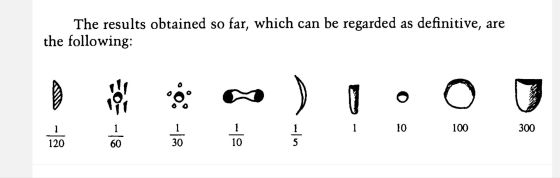
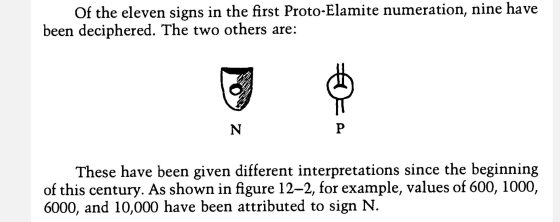
First row in the table below: Our units. In the middle, there’s a familiar system: 1, 10, 100. This is how our own numbers are constructed. There’s a position for 1s, a position for 10s, etc. To the left and to the right, the units are not the familiar ones, but hopefully we can understand this anyway.
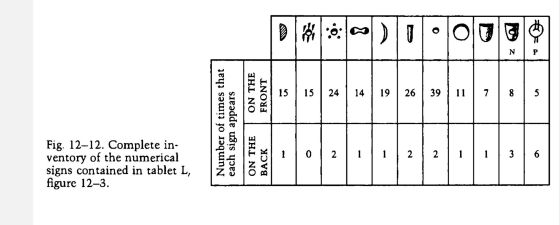
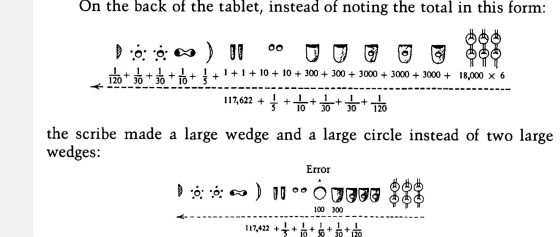
Second row: A sum of a lot of other numbers. The sum hasn’t been normalized to its shortest from yet. We want to normalize and then compare with the last row, another number from the same source.
Normalization example: In the second row, 15 and 15 are bolded. The jump from the first to the second column is to multiply by 2. (1/120 * 2 = 1/60.) So to normalize, we look at the first 15 and divide by 2.
- a = 1/120, b = 1/60
- 2a = b
- 15/2 = 7.5
- 15 = 1 + 7 * 2
- 15a + 15b
- = (1 + 7 * 2)a + 15b
- = a + 7 * 2a + 15b
- = a + 7b + 15b
- = a + 22b
So in the next row, instead of 15 and 15, we have 1 and 22.
Move to the next pair of columns and repeat.
| 1/120 | 1/60 | 1/30 | 1/10 | 1/5 | 1 | 10 | 100 | 300 | 3000 | 18000 |
| 15 | 15 | 24 | 14 | 19 | 26 | 39 | 11 | 7 | 8 | 5 |
| 1 | 22 | 24 | 14 | 19 | 26 | 39 | 11 | 7 | 8 | 5 |
| 1 | 0 | 35 | 14 | 19 | 26 | 39 | 11 | 7 | 8 | 5 |
| 1 | 0 | 2 | 25 | 19 | 26 | 39 | 11 | 7 | 8 | 5 |
| 1 | 0 | 2 | 1 | 31 | 26 | 39 | 11 | 7 | 8 | 5 |
| 1 | 0 | 2 | 1 | 1 | 32 | 39 | 11 | 7 | 8 | 5 |
| 1 | 0 | 2 | 1 | 1 | 2 | 42 | 11 | 7 | 8 | 5 |
| 1 | 0 | 2 | 1 | 1 | 2 | 2 | 15 | 7 | 8 | 5 |
| 1 | 0 | 2 | 1 | 1 | 2 | 2 | 0 | 12 | 8 | 5 |
| 1 | 0 | 2 | 1 | 1 | 2 | 2 | 0 | 2 | 9 | 5 |
| 1 | 0 | 2 | 1 | 1 | 2 | 2 | 0 | 2 | 3 | 6 |
| 1 | 0 | 2 | 1 | 1 | 2 | 2 | 1 | 1 | 3 | 6 |
And yes, the end result is, that the 2 numbers aren’t quite the same.
Background: Recently I read this, in From One to Zero, Georges Ifrah  :
:
 Stuff from ommadawn.dk (Lise Andreasen)