This week the #puzzle is: Can You Brighten Up the Room? #geometry #trigonometry #angles #reflection #animation
| While dining at a restaurant, I notice a lamp descending from the ceiling, as shown in the diagram below. The lamp consists of a point light source at the center of a spherical bulb with a radius of 1 foot. The top half of the sphere is opaque. The bottom half of the sphere is semi-transparent, allowing light out (and thus illuminating my table) but not back in. The light source itself is halfway up to the ceiling—5 feet off the ground and 5 feet from the ceiling. The ground reflects light. |
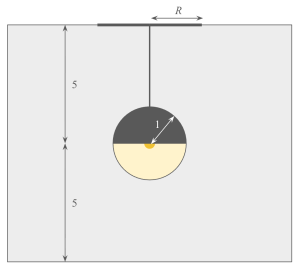 |
| Above the light, on the ceiling, I see a circular shadow. What is the radius R of this shadow? |
And for extra credit:
| Now suppose the lamp has a radius r and is suspended a height h off the ground in a room with height 2h. Again, the radius of the shadow on the ceiling is R. |
| For whatever reason, the restaurant’s architect insists that she wants r, h, and R, as measured in feet, to all be whole numbers. What is the smallest value of R for which this is possible? |
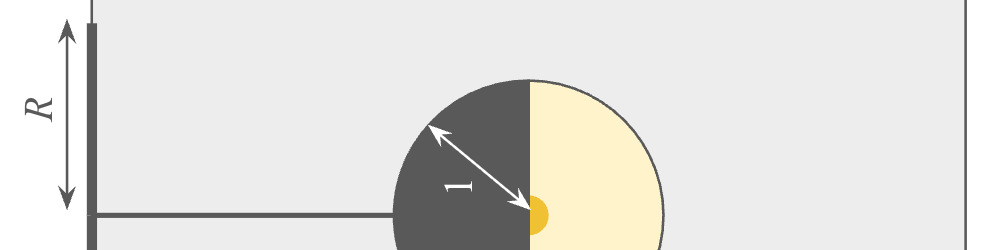

Highlight to reveal (possibly incorrect) solution:
Thoughts:
- Playing around with Desmos a little shows, that we want to find, where light hits the floor and reflects back and just nicks the lamp.
The light will travel 5 feet down and then 5 up. Meanwhile it will travel 1 foot horizontally.After nicking the lamp, it will travel a further 5 up and 0.5 horizontally.It will hit the light 1.5 feet away from the center. This is the radius of the shadow.- Playing with the angle of the light, I find a solution when the angle is 4.6122 rad and the radius is 1.507556 feet.
And for extra credit:
Thoughts:
Originally we had r = 1 and h = 5, resulting in R = 1.5.We want different values for r, h and R, so that they are all integers and R is minimized.I don’t think h actually matters.R = 1.5 * r.r should be an integer n, and so should 1.5 * n.1.5 * n= 3/2 * n= 3 * n/2
So n should be divisible by 2.We minimize R by minimizing r.The solution seems to be r = 2, R = 3. (And then h = 5 or whatever.)
Ahem.
- Originally we had r = 1 and h = 5, resulting in R = 1.507556. This happens at angle k = 4.6122216 rad.
- R = 3 * h / tan(k)
- Furthermore the distance between the line nicking the lamp and (0,0) has to be 1.
- The second part of the light beam is represented by y = tan(k) * x – 2 * h.
- x2 + y2 = 1 and y = tan(k) * x – 2 * h
- <=> x2 + (tan(k) * x – 2 * h)2 = 1
- <=> x2 + tan2(k) * x2 – 4 * h * tan(k) * x + 4h2 = 1
- <=> (tan2(k) + 1) * x2 – 4 * h * tan(k) * x + 4h2 – 1 = 0
- <=> x = (4 * h * tan(k) +- √((4 * h * tan(k))2 – 4 * (tan2(k) + 1) * (4h2 – 1))) / (2 * (tan2(k) + 1))
- <=> x = (4 * h * tan(k) +- √(42 * h2 * tan2(k) – 4 * (tan2(k) + 1) * (4h2 – 1))) / (2 * (tan2(k) + 1))
- <=> x = (2 * h * tan(k) +- √(4 * h2 * tan2(k) – (tan2(k) + 1) * (4h2 – 1))) / (tan2(k) + 1)
- <=> x = (2 * h * tan(k) +- √(4 * h2 * tan2(k) – tan2(k) (4h2 – 1) – 4h2 – 1)) / (tan2(k) + 1)
- <=> x = (2 * h * tan(k) +- √(tan2(k) – 4h2 + 1)) / (tan2(k) + 1)
- We want this to only have 1 solution.
- tan2(k) – 4h2 + 1 = 0
- <=> tan2(k) = 4h2 – 1
- <=> tan(k) = √(4h2 – 1)
- <=> k = arctan(√(4h2 – 1))
- Just to test: h = 5, k = 1.47063. k + π = 4.61222.
This actually assumes r = 1. Let’s try again.
- R = r * 3 * h / tan(k)
- The result for k becomes:
- k = arctan(√(4h2 – r2))
- Therefore:
- R = r * 3 * h / tan(arctan(√(4h2 – r2)))
- = r * 3 * h / √(4h2 – r2)
- So. We want h, r and R all to be integer.
- First we need 4h2 – r2 to be a square.
- Let r = 2m
- 4h2 – r2 = 4h2 – (2m)2
- 4h2 – 4m2
- 4(h2 – m2)
- This is a square when h2 – m2 is square.
- h > m, squares have to be positive. (Also, we don’t want to lamp to hit the floor, so h > 2m.)
- h2 – m2 = a2
- <=> h2 = a2 + m2
- h, m and a are all integer. (r is even.)
- Example: m = 5, a = 12, h = 13.
- h = 13, r = 2m = 10
- 4h2 – r2 = 4 * 132 – 102
- = 576
- R = r * 3 * h / √(4h2 – r2)
- 10 * 3 * 13 / √576
- 390 / 24
- 16.25
- So that wasn’t actually enough.
- a has to divide r * 3 * h
- R = r * 3 * h / √(4h2 – r2)
- = 2m * 3 * h / √(4h2 – (2m)2)
- = 2m * 3 * h / √(4 * (h2 – m2))
- = 2m * 3 * h / √(4 * a2)
- = 2m * 3 * h / 2√(a2)
- = 3mh / a
- I think it’s time to write a program.
My program finds several possible solutions.
| r: 40 | h: 52 | R: 65.0000 |
| r: 80 | h: 85 | R: 136.0000 |
| r: 80 | h: 104 | R: 130.0000 |
| r: 112 | h: 200 | R: 175.0000 |
| r: 120 | h: 156 | R: 195.0000 |
| r: 160 | h: 170 | R: 272.0000 |
| r: 160 | h: 208 | R: 260.0000 |
| r: 200 | h: 260 | R: 325.0000 |
| r: 224 | h: 400 | R: 350.0000 |
| r: 240 | h: 255 | R: 408.0000 |
| r: 240 | h: 312 | R: 390.0000 |
| r: 280 | h: 364 | R: 455.0000 |
| r: 320 | h: 340 | R: 544.0000 |
| r: 320 | h: 416 | R: 520.0000 |
| r: 360 | h: 468 | R: 585.0000 |
| r: 400 | h: 425 | R: 680.0000 |
Oh, and I did an animation of some of the solutions. Baby’s first animation.
From this I find, that R = 65 feet is the smallest solution.
 Stuff from ommadawn.dk (Lise Andreasen)