Let’s look at one of the actual problems in the Moscow Mathematical Papyrus.
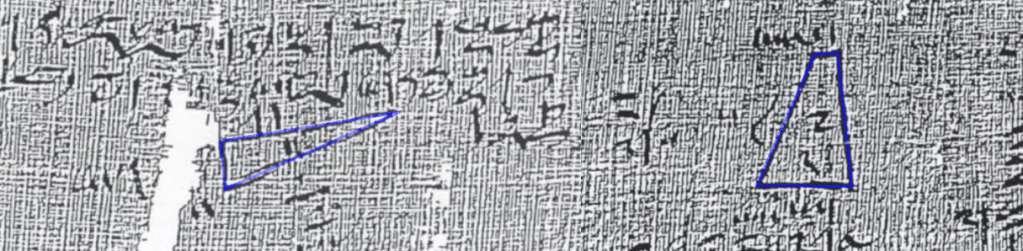
- Example of the calculation of a ship’s mast from a cedar log.
- If someone says to you: “[Make] a mast from a cedar log 30 cubits
- long [such that the mast] is 1/3 1/5 (?) [of the length of the log].” Calculate 1/3 1/5 of this 30.
- [If the result is 16, say to him:] “You have obtained
- [this mast. You have found it] correctly.”
Nowadays we would have a formula:
- ml = c * cl
- ml: mast length
- c: constant
- cl: cedar length
And of course we would have drilled school children in this formula, because everybody needs to know these things. Next we would have defined, for this particular problem, some values:
- c = 1/3 + 1/5
- cl = 30 cubits
We’re not used to writing values with fractions like that in our time, so we need to convert that.
- c = 1/3 + 1/5
- = 5/15 + 3/15
- = 8/15
Now we can plug these values in.
- ml = c * cl
- = 8/15 * 30
And calculate.
- ml = 16
You have found it correctly!
 Stuff from ommadawn.dk (Lise Andreasen)