This week the #puzzle is: How Much Free Money Can You Win? #probabilities #bets #minimum #maximum
| A casino offers you $55 worth of “free play vouchers.” You specifically receive three $10 vouchers and one $25 voucher. |
| You can play any or all vouchers on either side of an even-money game (think red vs. black in roulette, without those pesky green pockets) as many times as you want (or can). You keep the vouchers wagered on any winning bet and get a corresponding cash amount equal to the vouchers for the win. But you lose the vouchers wagered on any losing bet, with no cash award. Vouchers cannot be split into smaller amounts, and you can only wager vouchers (not cash). |
| What is the guaranteed minimum amount of money you can surely win, no matter how bad your luck? And what betting strategy always gets you at least that amount? |
| Hint: You can play vouchers on both sides of the even money game at the same time! |
And for extra credit:
| You have the same $55 worth of vouchers from the casino in the same denominations. But this time, you’re not interested in guaranteed winnings. Instead, you set your betting strategy so that you will have at least a 50 percent chance of winning W dollars or more. As before, you cannot split vouchers and cannot wager cash. |
| What is the maximum possible value of W? In other words, what is the greatest amount of money you can have at least a 50 percent chance of winning from the outset, with an appropriate strategy? And what is that betting strategy? |

How Much Free Money Can You Win? 
Highlight to reveal (possibly incorrect) solution:
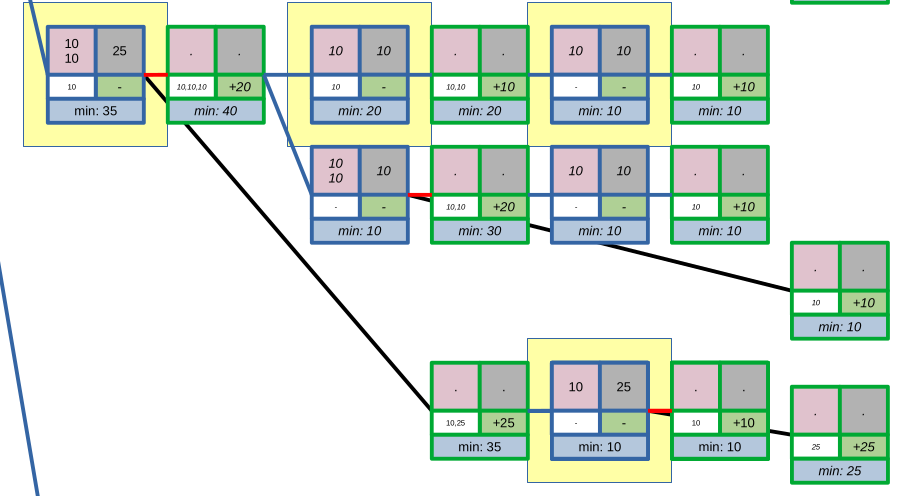
This time I chose to write out all the possibilities. Big PDF file resulted. The important bit is the part shown in the image. This shows this strategy:
- I first bet 2 x 10 against 25.
- Either I win $20 and have 3 x 10 left. Bet 10 against 10 twice, resulting in a further $20. $40 in all.
- Or I win $25 and have 1 x 10 and 1 x 25 left. Bet them against each other and win at least $10. $35 in all.
- Win at least $35.
And for extra credit:
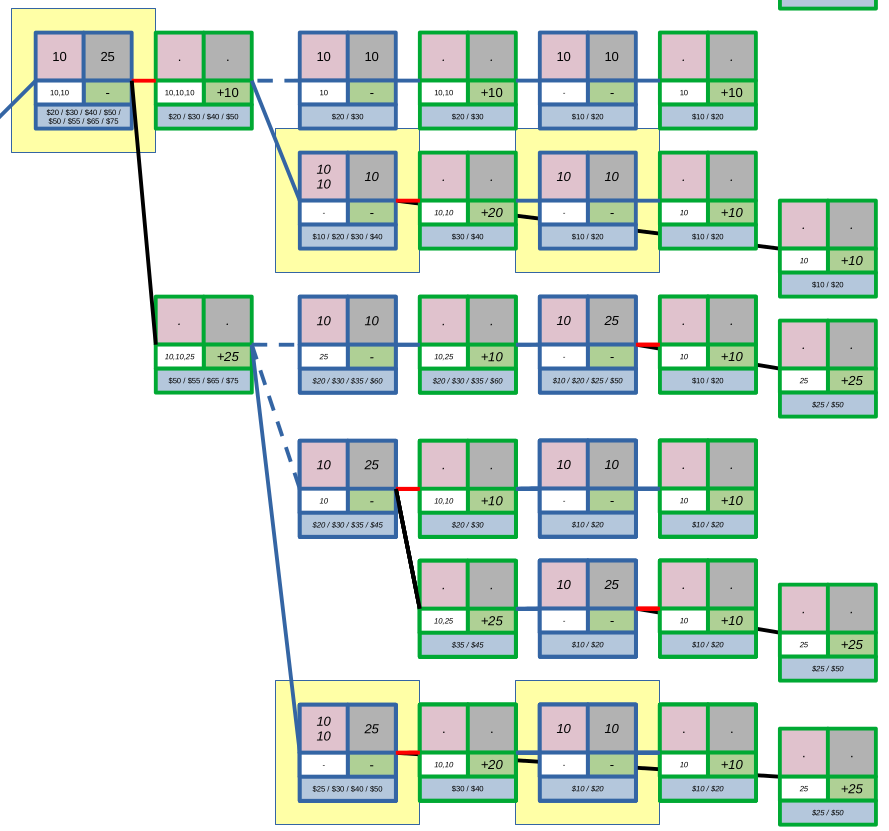
I adjust my PDF to look at probabilities instead of minimum. This gives me the strategy:
1 first bet 10 against 25.Either I win $10 and have 3 x 10 left. Now bet 2 x 10 against 10.Either I win $20 and have 2 x 10 left. Now bet 10 against 10, win $10, have 10 left, bet that 10 alone, 50% of getting $10. That is in total 50% for $40, 50% for $50.Or I win $10 and have 10 left. Bet that 10 alone, 50% of getting $10. That is in total 50% for $20, 50% for $30.Combined this is 25% for $20, 25% for $30, 25% for $40, 25% for $50.
Or I win $25 and have 2 x 10 and 25 left. Now bet 2 x 10 against 25.Either I win $20 and have 2 x 10 left. Now bet 10 against 10, win $10, have 10 left, bet that 10 alone, 50% of getting $10. That is in total 50% for $55, 50% for $65.Or I win $25 and have 25 left. Bet that 25 alone, 50% of getting $25. That is in total 50% for $50, 50% for $75.Combined this is 25% for $50, 25% for $55, 25% for $65, 25% for $75.
Combined this is 12.5% for each of $20, $30, $40, $50, $50, $55, $65, $75.The median here is $50. That is therefore my 50% chance result.
I am little surprised at this result. I doodled with adding more bets (if I win my final bet above, I can bet again), but that didn’t change the result. It is close to a theoretical $55, the value of all the vouchers.
Ahem.
There’s a strategy where I begin by betting everything on red. Either I lose, 50% chance, or I win $55 and keep all my vouchers, 50% chance. If I win, I can bet again. This way I get at least $55 with 50% chance. A more complicated strategy has to beat that.
After many thoughts I tried writing a program. This approach uses a little monte carlo. It also uses going through all the options for strategies. A typical output looks like this:
Median:       70.
Array
(
    [10101025] => 7c
    [101025] => 6b
    [101010] => 1
    [1025] => 1
    [1010] => 3b
    [25] => 2
    [10] => 1
    [0] => end
)
The numbers (7c, 6b etc.) refer to the program and to the PDF. Translated this strategy is:
- Bet 10 on red and 3 other vouchers on the rest. (7c)
- Either win on red, get $10 and keep a 10 voucher. By all means keep playing (1), but it probably won’t get much better. At least $10 in all.
- Or win on black. Get $45 and keep vouchers for 10, 10 and 25. Bet 2 x 10 on red and 25 on black. (6b)
- Either win on red and get $20 more and keep 2 x 10 vouchers. Bet 10 on red and 10 on black. (3b) Get $10 more and keep a 10 voucher. Feel free to keep playing (1). At least $75 in all.
- Or win on black and get $25 more and keep the 25 voucher. Feel free to keep playing (2). At least $70 in all.
Winning on the 1st black guarantees winning at least $70, with 50% chance. And that’s what we were looking for! W = 70!
It’s a rather special feeling, writing a program just to make sure everything is right, and then finding a better solution.
Addendum.
Just for fun I converted the program back to solve the fiddler. And found another solution. And an error in my math in the prodigious, pretty PDF. Hm. This strategy also works:
- Play 10 against 10 (3b). Lose 1 x 10, gain $10. Play 2 x 10 against 25 (6b).
- Either lose 25 and gain $20. Play 10 against 10 (3b). Lose 1 x 10, gain $10. $40 in total.
- Or lose 2 x 10 and gain $25. $35 in total.
Minimum:       35.
Array
(
    [10101025] => 3b
    [101025] => 6b
    [101010] => 1
    [1025] => 1
    [1010] => 3b
    [25] => 2
    [10] => 1
    [0] => end
)
 Stuff from ommadawn.dk (Lise Andreasen)