This week the #puzzle is: Can You Sweep the Series?  #probability
| Let p represent the probability the Celtics win any given game in the [best-of-seven] series. You should assume that p is constant (which means there’s no home-court advantage) and that games are independent. |
| For certain values of p, the likeliest outcome is indeed that the Celtics will win the series in exactly five games. While this probability is always less than 50 percent, this outcome is more likely than the Celtics winning or losing in some other specific number of games. In particular, this range can be specified as a < p < b. |
| Determine the values of a and b. |
And for extra credit:
| Let p4 represent the probability that the Celtics sweep the Knicks in four games. And let p7 represent the probability that the series goes to seven games (with either team winning). |
| Suppose p is randomly and uniformly selected from the interval (a, b), meaning we take it as a given that the most likely outcome is that the Knicks will lose the series in five games. How likely is it that p4 is greater than p7? In other words, how often will it be the case that probably losing in five games means a sweep is more likely than a seven-game series? |

Highlight to reveal (possibly incorrect) solution:
It’s easy to calculate p(4) (that Celtics wins in 4 games). It’s [ p4 ].
For p(5), we need 3 wins and 1 loss, and then 1 final win. The loss can be anywhere in the 4 first games. So this is p3 * (1-p)1 * c(4, 1) * p = [ p4 * (1-p)1 * 4 ].
For p(6), we need 3 wins and 2 losses, and then 1 final win. The losses can be anywhere in the 5 first games. So this is p3 * (1-p)2 * c(5, 2) * p = [ p4 * (1-p)2 * 10 ].
For p(7): p3 * (1-p)3 * c(6, 3) * p = [ p4 * (1-p)3 * 20 ].
We need [ p4 * (1-p)1 * 4 ] > [ p4 ], [ p4 * (1-p)1 * 4 ] > [ p4 * (1-p)2 * 10 ] and [ p4 * (1-p)1 * 4 ] > [ p4 * (1-p)3 * 20 ].
For p(4):
- [ p4 * (1-p)1 * 4 ] > [ p4 ]
- 1-p * 4 > 1
- 1-p > 1/4
- 1 – 1/4 > p
- 3/4 > p
For p(6):
- [ p4 * (1-p)1 * 4 ] > [ p4 * (1-p)2 * 10 ]
- 4 > (1-p) * 10
- 4/10 > 1-p
- p > 1 – 4/10
- p > 3/5
For p(7):
- [ p4 * (1-p)1 * 4 ] > [ p4 * (1-p)3 * 20 ]
- 4 > (1-p)2 * 20
- 4/20 > (1-p)2
- 1/5 > (1-p)2
- 1/√5 > 1-p
- p > 1 – 1/√5 ≈ 0.5528
0.5528 < 3/5
Therefore 3/5 < p < 3/4 or 0.6 < p < 0.75 should work. My program confirms this.
And for extra credit:
In my terms, p4 = p(4) and p7 = p(7) + p(-7), the latter being the probability that the Celtics loses in 7 games.
I didn’t specify p(-7) before. It’s p3 * (1-p)3 * c(6, 3) * (1-p) = [ p3 * (1-p)4 * 20 ].
We have 0.6 < p < 0.75. We’re looking for the probability that p4 > p7. First let’s find the p’s, where this inequality holds.
- [ p4 ] > [ p4 * (1-p)3 * 20 ] + [ p3 * (1-p)4 * 20 ]
- p4 > p3 * (1-p)3 * (p + 1-p) * 20
- p4 > p3 * (1-p)3 * 20
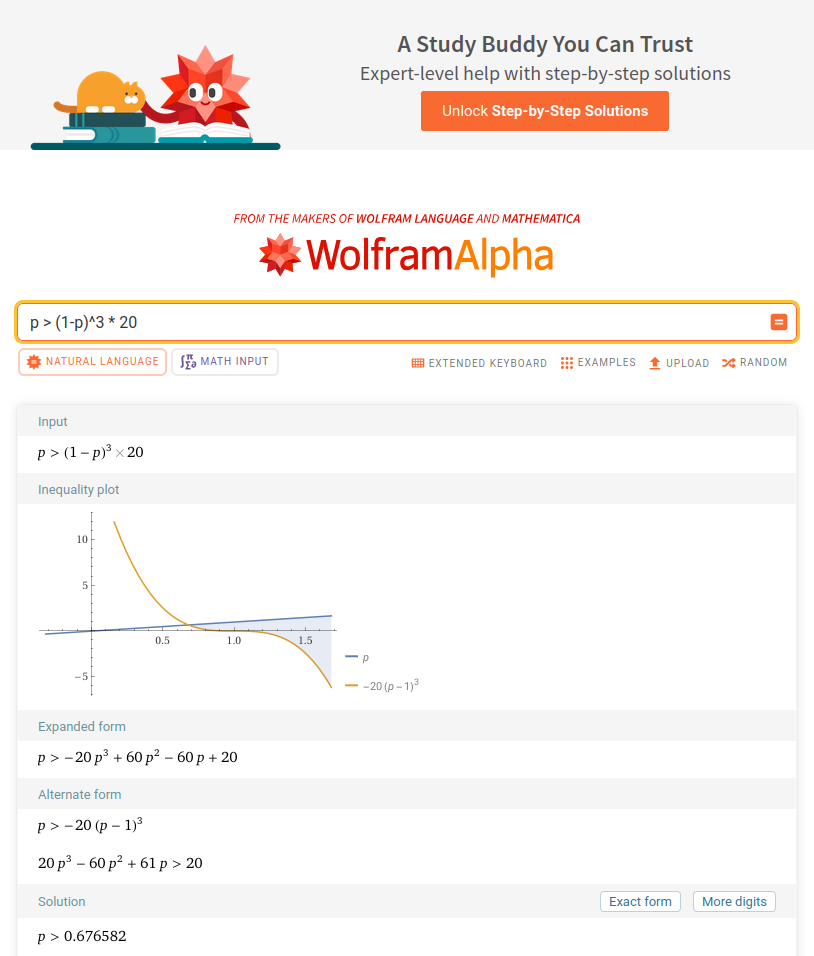
- p > (1-p)3 * 20
A quick visit to WolframAlpha reveals, that p > 0.6766.
As p is chosen randomly, 0.6 < p < 0.75, and the inequality holds when 0.6766 < p, the number we’re looking for is (0.75 – 0.6766) / (0.75 – 0.6) = 0.4893. My 1st program somewhat confirms this. Program 2 also lands in this general vicinity.
 Stuff from ommadawn.dk (Lise Andreasen)