This week the question is: Can You Grow a Hibiscus Hedge?  #permutation #sequence
| Dean has three colors of the hibiscus: red, orange, and yellow. He wants to plant them in a straight hedge of shrubs (each of which is one color) so that the order appears somewhat random, but not truly random. More specifically, he wants the following to be true: |
| – No two adjacent shrubs have the same color. – No ordering of three consecutive shrubs appears more than once in the hedge. (But a prior ordering can appear in reverse. For example, ROYOR is an acceptable hedge, but ROYROY is not.) |
| What is the greatest number of shrubs Dean’s hedge can contain? |
And for extra credit:
| In addition to red, orange, and yellow hibiscus flowers, Dean now includes a fourth color: pink. Again, he wants to plant a straight hedge of shrubs that appears somewhat random. Here are the rules for ordering the shrubs this time: |
| – No two adjacent shrubs have the same color. – No ordering of four consecutive shrubs appears more than once in the hedge. (Again, a prior ordering can appear in reverse.) – Among any group of four consecutive shrubs, at least three distinct colors are represented. |
| What is the greatest number of shrubs Dean’s hedge can contain? |

Intermission.
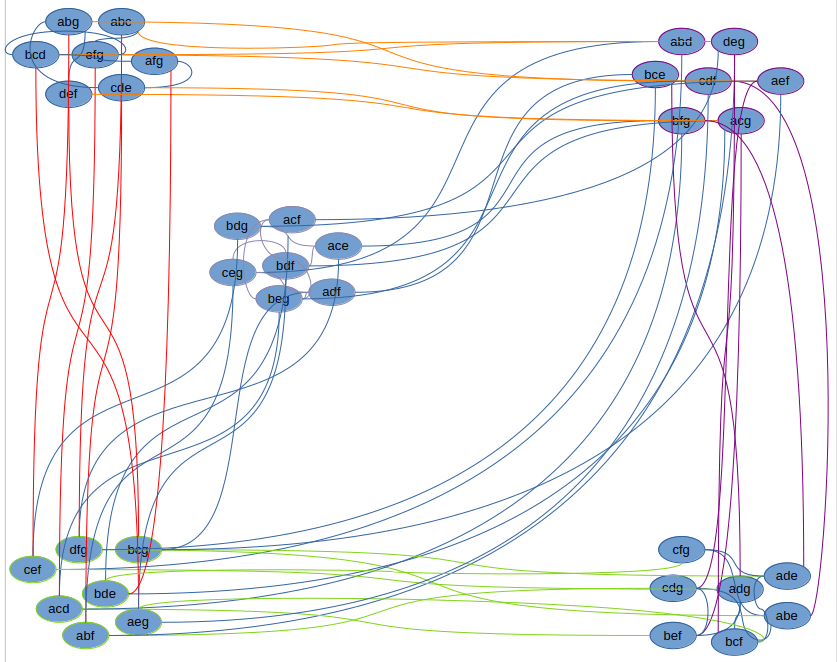
I am sort of obsessed with the candy puzzle from last week. Handled correctly, it’s possible to see, that the important graph has a structure, and that this structure can be used to find the required path. (This picture has a few connections missing, but hopefully it still demonstrates the principle.)
Oh! And I’ve just discovered that years ago a similar puzzle was featured on the riddler.
Scroll down to the classic solution.
Last week I had to guess at the solution to the extra credit question. As it happens, I had the right idea: 21 students. But that wasn’t what the question actually asked for. Sigh. Read the question carefully, next time, me! Anyway. I got 21 points out of 26 possible in Q1. Actually not bad.
Highlight to reveal (possibly incorrect) solution:
What are we actually looking for here?
We are interested in the permutations of the 3 colors with 3 elements. However, a permutation cannot have 2 neighbors with the same color. And in the final sequence, a permutation can appear at most once.
My program (brute forcing all possible sequences) tells me, 1) there are 12 of these permutations, 2) it is possible to build a sequence with all of them, and this sequence therefore has length 14.
One possible sequence: ROROYRYOYORYRO.
And for extra credit:
Now there are 4 colors and the permutations have 4 elements. As an extra requirement, each permutation has at least 3 colors. (Having a similar requirement doesn’t change anything in the fiddler case.)
My program tells me, 1) there are 96 of these permutations, 2) it is possible to build a sequence with all of them, and this sequence therefore has length 99.
One possible sequence (split up in smaller chunks for readability):
RORYRORPRO
YROYOROYPR
OPRYRPRYOR
YOYRYOPRPO
ROPORYPRYP
ORPOYRPOPY
ROPYORPYRY
PYRPYOYPOY
OPOYPYOPYP
RPYPOPROR
 Stuff from ommadawn.dk (Lise Andreasen)