This week the question is: Can You Spin the Graph?
You’re taking a math exam, and you’ve been asked to draw the graph of a function. That is, your graph must pass the vertical line test, so that no vertical line intersects your function’s graph more than once.
You decide you’re going to graph the absolute value function, y = |x|, and ace the test.
There’s just one problem. You are dealing with a bout of dizziness, and can’t quite make out the x– and y-axes on the exam in front of you. As a result, your function will be rotated about the origin by a random angle that’s uniformly chosen between 0 and 360 degrees.
What is the probability that the resulting graph you produce is in fact a function (i.e., y is a function of x)?
And for extra credit:
In a more advanced course, you’ve been asked to draw a 3D sketch of the function z = |x| + |y|. As you’re about to do this, you are struck by another bout of dizziness, and your resulting graph is randomly rotated in 3D space.
More specifically, your graph has the correct origin. But the true z-axis is equally likely to point from the origin to any point on the surface of the unit sphere. (Meanwhile, the x-axis is equally likely to point in any direction perpendicular to the z-axis. From there, the y-axis is uniquely determined.)
What is the probability that the resulting graph you produce is in fact a function (i.e., z is a function of x and y)?

Highlight to reveal (possibly incorrect) solution:
Basically we’re looking at a triangle (2 of the sides are y=x and y=-x), and we’re rotating the triangle around the origin. If the triangle rotates enough for 1 side to be below the x axis and 1 side above, we’re out. If we rotate enough, so that both sides are now below the x axis, we’re back in business. The good rotations are in degrees 0-45 , 135-225 and 315-360. This represents 45, 90 and 45 degree slices of the 360 degrees a rotation can be, or in other words, 180/360 = 0.5. This is also our probability of not breaking the function. The answer is 0.5.
And for extra credit:
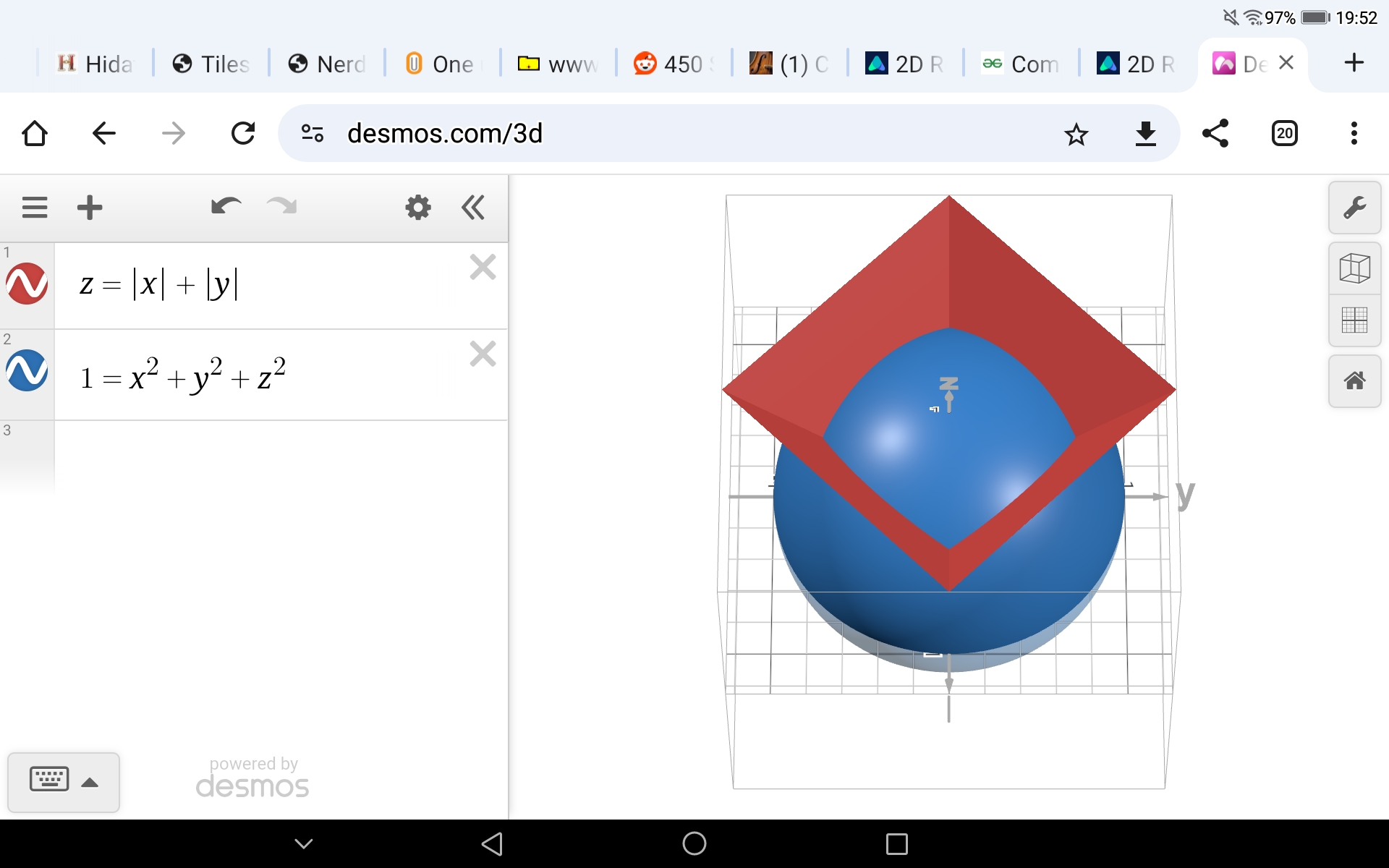
Desmos. Figure 1, 2, 3, 4, 5, 6, 7.
This time it’s a pyramid shape, that has to stay all above (or all below) the x y plane. The figures show, how I modeled this pyramid in Desmos, letting it intersect with a unit circle. The tip of the z axis can roam, but once it moves outside the 4 sided figure with curvy edges (let’s call it Curvy), the function breaks. So the question is: How big is that figure?
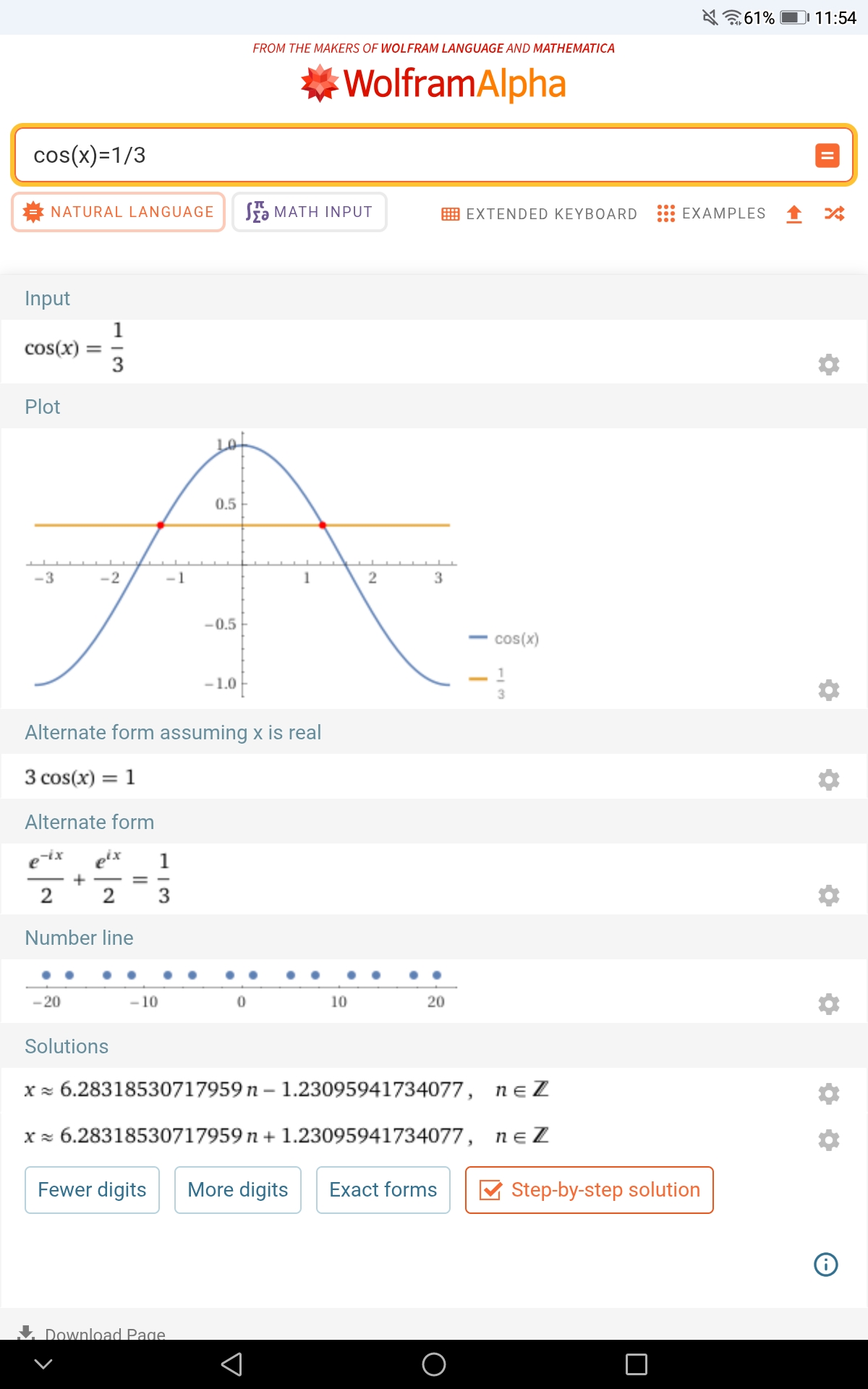
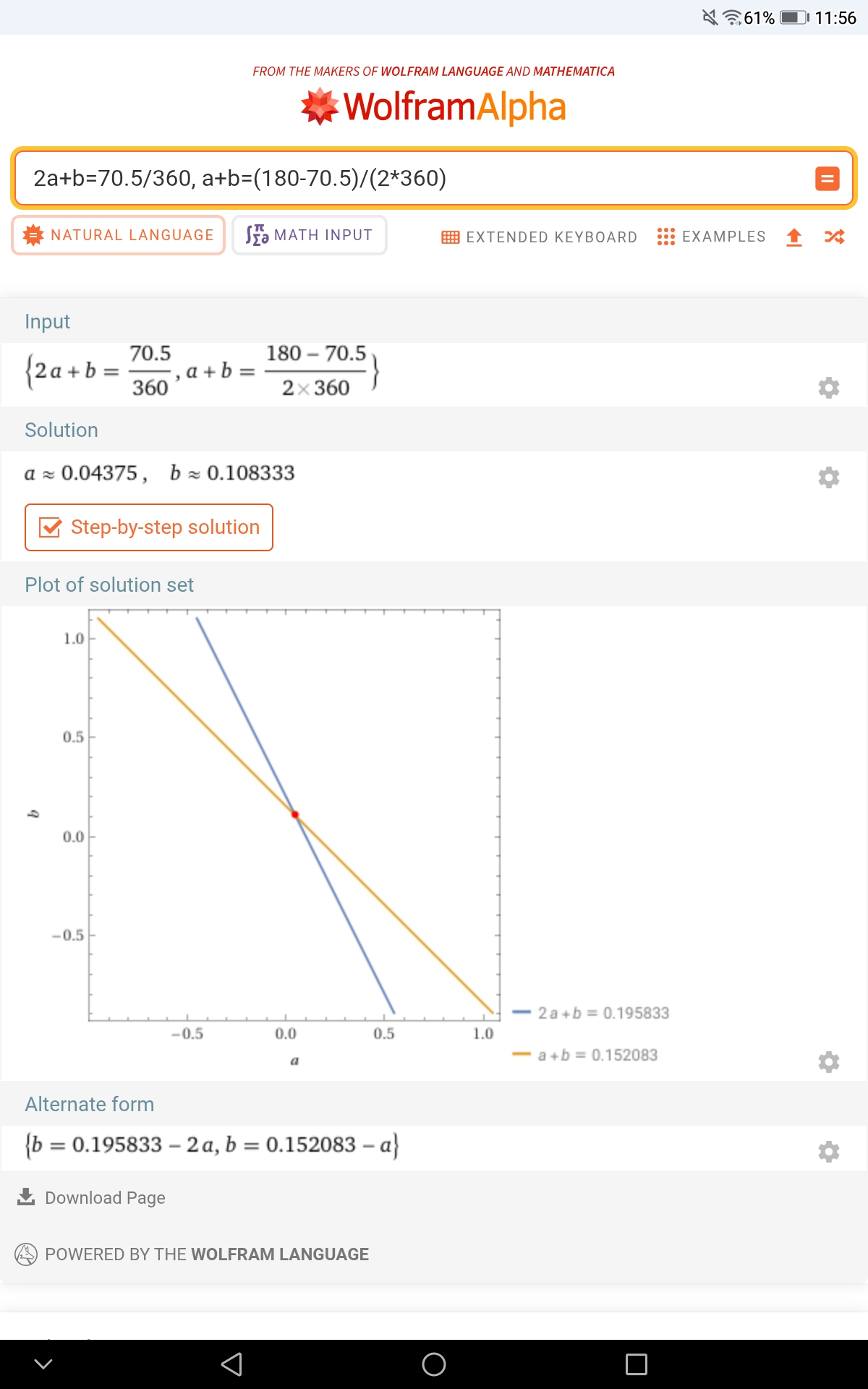
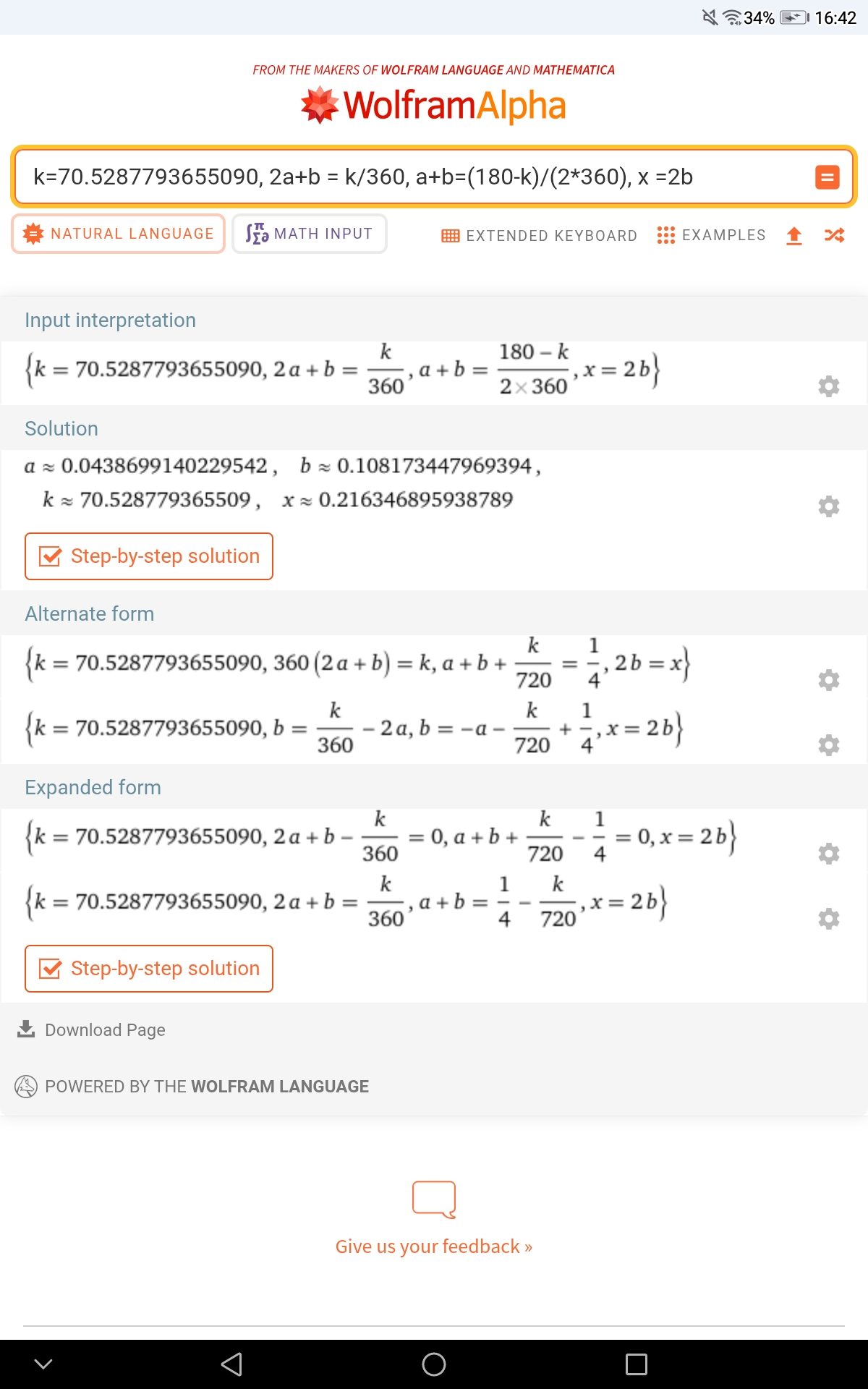
In figure 3 I see a Curvy, bounded by 4 great circles. Letting the area of the triangle be a and the area of Curvy be b, we see that 4a + 3b = 1/2 sphere area. (On the other side of the sphere, we have the same picture and the same equation.) Further, the middle band, bounded by 2 great circles, consists of 2a + b = m part of sphere area, and the upper band consists of a + b = n part of sphere, where m + 2n = 1/2. m depends on the angle between the 2 great circles. Their planes are defined by z = x + y and z = – x – y. This can be computed via the angle k, cos(k) = 1/3. As seen in figure 4, this means k is about 70.5 degrees. So our 2 equations become approximately 2a + b = 70/360 and a + b = 55/360. This again means b is about 0.108 part of sphere.
There are 2 Curvys, just like there were 2 good areas in the first puzzle. So our answer ends up being 2 x 0.108 = 0.216. Well, doing it with more digits, closer to 0.216347.
I am not at all sure about this one. It was hard for me.
 Stuff from ommadawn.dk (Lise Andreasen)