Days 1-6 happened without a lot of drama (only 1 question on the forum). This phase also mostly saw me coding in a sandbox (exception: day 3, part 2). Day 7 I permanently changed to my PC. The tasks were rather easy for me. I didn’t really try to come up with a fast answer, in part because the sandbox + my tablet was a slow way to code. My examples below manipulate the test data, but ran on the actual data as well.
So now we just have to count the 9s and 7s and the 2.
The 1 lives in position 1. The 3 above it has a 3 in position 56. The next 3 is in position 111. Finally the 1 above it is in position 166.
The result of adding and subtracting is 9s from position 1 to 55, a 2 at position 56, then some 0s, a 7 at position 111 and finally 9s from position 112 to 165. 55*9+2+7+54*9 = 990. Which happens to be 55*18.
Just to test my logic here: if n had been 9999 (4 digits), n3 would be 999,700,029,999. 4*9+2+7+3*9 = 72 = 4*18. Checks out.
A new December and a new bunch of puzzles from mscroggs.co.uk.
I think the example is also a hint.
A number with 1 factor would be 1. And that’s not 13.
A number with 2 factors would be a prime. Number p, factors 1 and p. The geometric mean would be (1*p)1/2. We can’t get 13 to fit there.
A number with 3 factors has a special property. There’s a square here somewhere. The number, p2, has factors 1, p and p2. This accounts for p2 = 1 * p2 = p * p, the 2 different ways to write p2. Like, 9 = 1*9 = 3*3. The geometric mean works out to be p, isn’t that neat? So my guess is that we’re looking for 132 = 169.
A new December and a new bunch of puzzles from mscroggs.co.uk.
My first attempt is further down. But I thought of a better way.
These are equivalent:
Writing n as a sum of m odd, positive integers (5 = 1+3+1).
Writing n+m as a sum of m even, positive integers (8 = 2+4+2).
Writing (n+m)/2 as a sum of m positive integers (4 = 1+2+1).
And how many ways can I write the last sum? Stars and bars. Imagine writing 4 as 1 1 1 1. We want to convert this to 3 positive integers. We do this by adding 2 bars in between, like 1 | 1 1 | 1. (3-1 = 2.) The bars could be added in 3 different positions, between 2 1s. (4-1 = 3.) Only 1 bar in each position. We can do this in (3 c 2) different ways. This is 3*2/2*1 = 3. Anyway, 1 | 1 1 | 1 corresponds to 1 | 1+1 | 1 = 1 | 2 | 1, corresponds to the 4 = 1+2+1.
Going back, writing (n+m)/2 as a sum of m positive integers can be done in ((n+m)/2-1 c m-1) different ways.
Anyway.
Write 14 as m odd, positive integers.
Write 14+m as m even, positive integers.
Write (14+m)/2 as m positive integers.
To write 14 as a sum of m odd, positive integers, m must be at least 2 and at most 14. Also m is even, because the sum of an odd number of odd integers would be odd. Let’s look at these.
m
((14+m)/2-1 c m-1)
2
7
4
56
6
126
8
120
10
55
12
12
14
1
And when we add up the right column, we get 377.
First attempt:
There’s probably a smarter way to do this. But I needed an intermediary step, before I could answer the primary question. First: How many ways can I write a sum of odd, positive integers, if I don’t care about the order?
(1) I find this result for 2 by adding a 1 to the result for 1. 1 = 1*1. 2 = 1*1+1 = 2*1.
(2) I find this result for 3 by first adding a 1 to the result for 2 (getting the first new result), and then adding a 3 to the result for 0 (getting the second new result).
I only actually need the last cell. Let’s look a little closer at it. E.g. 3*1+1*11 is 1+1+1+11 (4 elements), when we don’t care about the order. Let’s look at how many different ways each sum can be written (how many permutations, like 1+1+1+11 = 1+1+11+1 = 1+11+1+1 = 11+1+1+1, 4 different ways).
Sum
#Elements
#Perms
14*1
14
1
11*1+1*3
12
12 (1)
9*1+1*5
10
10
8*1+2*3
10
(10 c 2) = 45 (2)
7*1+1*7
8
8
6*1+1*3+1*5
8
8*7 = 56 (3)
5*1+3*3
8
(8 c 3) = 56
4*1+1*3+1*7
6
6*5 = 30
4*1+2*5
6
(6 c 2) = 15
5*1+1*9
6
6
3*1+2*3+1*5
6
6 * (5 c 2) = 6*10 = 60 (4)
2*1+1*5+1*7
4
4*3 = 12
2*1+1*3+1*9
4
4*3 = 12
3*1+1*11
4
4
2*1+4*3
6
(6 c 2) = 15
1*1+2*3+1*7
4
4*3 = 12
1*1+1*3+2*5
4
4*3 = 12
1*1+1*13
2
2
1*3+1*11
2
2
1*5+1*9
2
2
2*7
2
1
(1) Among the 12 positions, I choose 1 for the 3.
(2) Among the 10 positions, I choose 2 for a 3. I can do this in “10 choose 2” ways.
(3) Among the 8 positions, I choose 1 for the 3. I can do this in 8 different ways. Among the remaining 7 positions, I choose 1 for the 5. I can do this in 7 different ways.
(4) Combining methods 2 and 3.
Finally we have to add up the right column. The result is 373. I did some of this manually, I must have missed a step somewhere. Oh yeah, I think I missed 3*3+5, good for 4 further permutations.
A new December and a new bunch of puzzles from mscroggs.co.uk.
14 is even, so 2 is a factor. The other factor is 7, a prime, so it can’t be constructed by multiplying lower numbers.
100 d100: One factor is 2, to get an even product the lowest possible way. Then the other factor of the product is a prime p, in this case 101, to make the product impossible. (Anything lower could be reached with 198 * 2 * p.) The product is 202.
A new December and a new bunch of puzzles from mscroggs.co.uk.
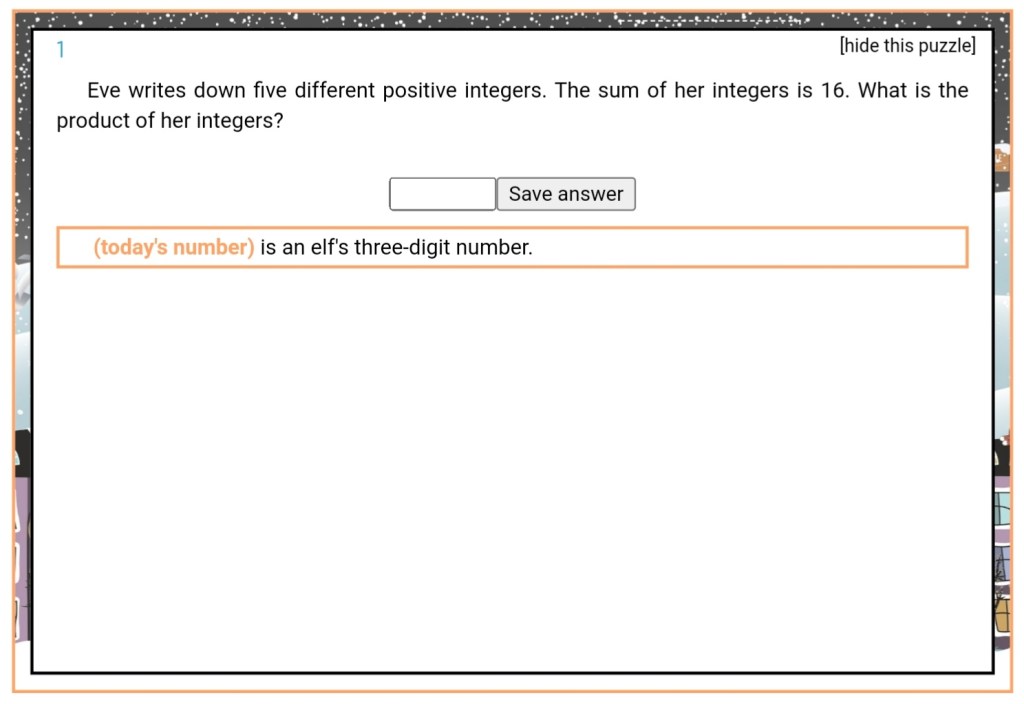
The only way to reach the sum 16 with 5 different positive integers is 1+2+3+4+6.
The lowest possible sum with 5 different positive integers is 1+2+3+4+5 = 15. In order to reach 16, one of these integers has to be 1 higher. If the integers are still different after this operation, the only candidate is 5.




 Stuff from ommadawn.dk (Lise Andreasen)