This week the question is: Can You Break the Bell Curve?
Bean machines can famously produce bell-shaped curves. But today, we’re going to change all that!
Suppose you have a board like the one shown below. The board’s topmost row has three pins (and two slots for a ball to pass through), while the bottommost row has two pins (and three slots for a ball to pass through). The remaining rows alternate between having three pins and two pins.
But instead of the 12 rows of pins in the illustrative diagram, suppose the board has many, many rows. And at the very bottom of the board, just below the two bottommost pins, are three buckets, labeled A, B, and C from left to right. [Picture rotated counter clockwise.]
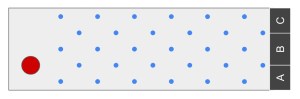
Whenever a ball encounters one of the leftmost pins, it travels down the right side of it to the next row. And whenever a ball encounters one of the rightmost pins, it travels down the left side of it to the next row.
But this isn’t your garden variety bean machine. Whenever a ball encounters any of the other pins, it has a 75 percent chance of traveling down the right side of that pin, and a 25 percent chance of traveling down the left side of that pin.
A single ball is about to be dropped into the left slot at the top of the board. What is the probability that the ball ultimately lands in bucket A, the leftmost slot at the bottom?
And for extra credit:
Suppose you have the board below, which starts with a row with six pins (and five slots), followed by a row with five pins (and six slots), and then back to six pins in an alternating pattern. Balls are only allowed to enter through the middle three slots on top. This time around, the pins that aren’t on the far left or far right behave normally, meaning each ball is equally likely to go around it via the left side or the right side.

Your goal is to create a trapezoidal distribution along one of the rows with six slots, which have been highlighted with dotted lines in the diagram above. More precisely, the frequency of balls passing through the six slots from left to right should be x−y, x, x+y, x+y, x, x−y, for some values of x and y with x ≥ y.
Suppose the ratio by which you drop balls into the top three middle slots, from left to right, is a : b : c, with a + b + c = 1. Find all ordered triples (a, b, c) that result in a trapezoidal distribution in at least one row with six slots.

Highlight to reveal (possibly incorrect) solution:
Assumptions:
- After many rows, the state of the bean machine will reach an equilibrium. The values for the row just above the A, B and C bins will be the same as for the 2 pin row just above that.
- This equilibrium is independent of the beginning state.
First let’s name some things. (Figure 1.)
Before reaching the last row, a ball travels through the state A’, B’ or C’. Then it goes through one of the states of the next row, let’s call them X and Y. And finally it reaches A, B or C. p(S) is the probability, that the ball reached this state, S.
p(A) = p(X) * 1/4
p(B) = p(X) * 3/4 + p(Y) * 1/4
p(C) = p(Y) * 3/4
p(X) = p(A’) + p(B’) * 1/4
p(Y) = p(B’) * 3/4 + p(C’)
Using the assumptions:
p(A) = p(A’) etc.
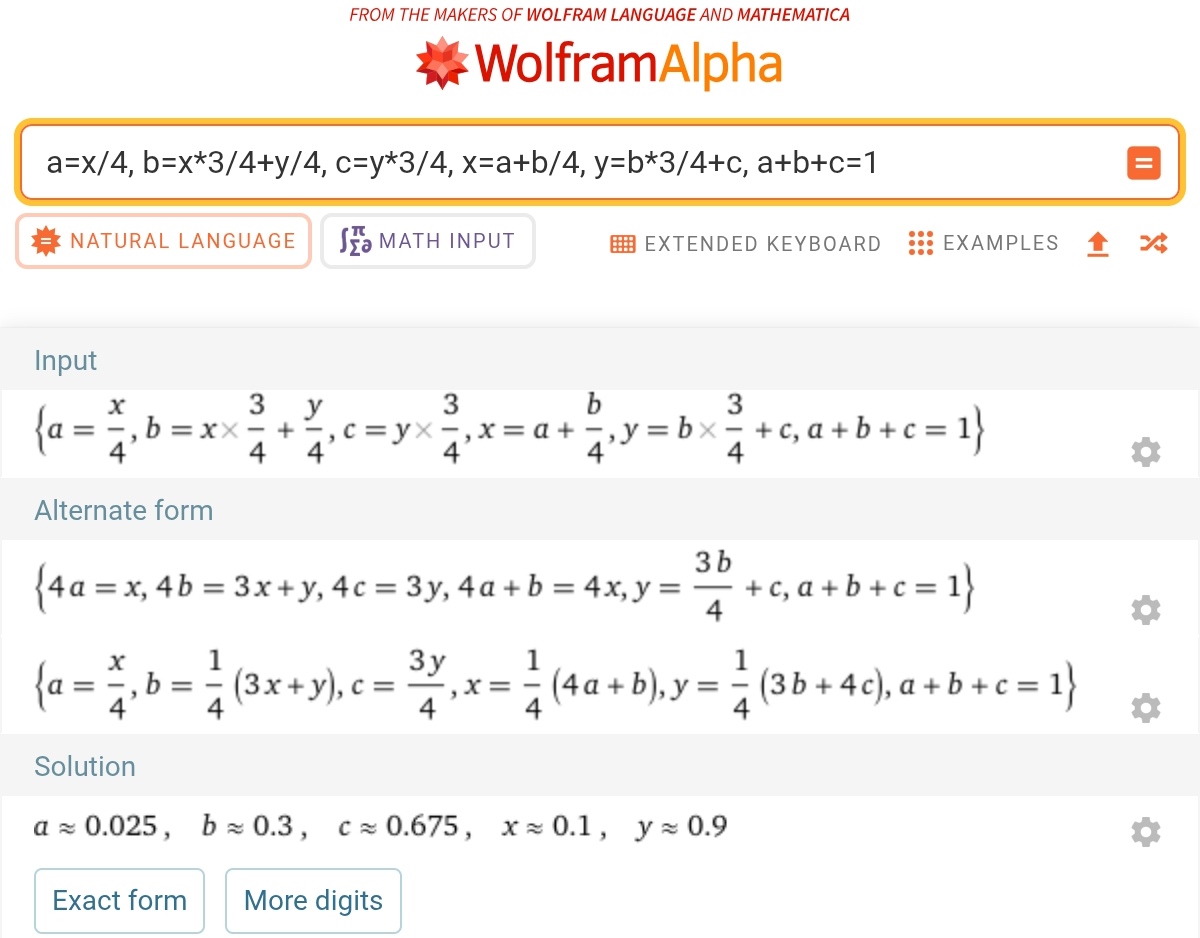
Further: p(A) + p(B) + p(C) = 1. WolframAlpha is happy to solve this system of equations for me. (Figure 2.)
The answer we’re looking for is p(A) = 0.025 = 1/40. A small program confirms this.
And for extra credit:
Assumptions:
- The 5 pin states converge rather quickly into (0.1, 0.2, 0.2, 0.2, 0.2, 0.1). If we want something radically different (and we do), it has to be found within the first maybe 10 pairs of rows. So let’s just look at these early, non-equilibrium states.
- We’re looking for a symmetric state (x−y, x, x+y, x+y, x, x−y). Therefore the beginning state must also be symmetric. Not (a, b, c), but (a, b, a). Therefore b = 1 – 2a, 0 <= a <= 0.5, 0 <= b, <= 1. We’re just looking for a.
- Adding up the sixth sought after probabilities, we get 6x. 6x = 1, so x = 1/6.
- A symmetric state, where the 2nd and 5th probabilities were 1/6, would represent a solution.
Let’s look at some probabilities. Each filled out cell is a position between 2 pins in a row. I only show the left part of the table, as the right part is simply a mirror of the left part. Our potential x = 1/6 will show up in the 3rd column.
| 0 | a | b | |||
| 0 | a/2 | a/2+b/2 | |||
| a/4 | a/2+b/4 | a/2+b/2 | |||
| a/8 | 3a/8+b/8 | a/2+3b/8 | |||
| 5a/16+b/16 | 7a/16+b/4 | a/2+3b/8 | |||
| 5a/32+b/32 | 3a/8+5b/32 | 15a/32+3b/8 | |||
| 11a/32+7b/64 | 27a/64+17b/64 | 15a/32+3b/8 | |||
| 11a/64+7b/128 | 49a/128+3b/16 | 57a/128+41b/128 | |||
| 93a/256+19b/128 | 53a/128+65b/256 | 57a/128+41b/128 | |||
| 93a/512+19b/256 | 199a/512+103b/512 | 55a/128+147b/512 |
It is possible to have a/2 = 1/6? Yes it is, a = 1/3.
Is it possible to have 3a/8+b/8 = 1/6?
- 3a/8 + b/8 = 1/6
- 3a + b = 8/6 = 4/3
- 9a + 3b = 4
- 9a + 3(1-2a) = 4
- 9a + 3 – 6a = 4
- 3a = 1
- a = 1/3
The same solution, a = 1/3.
Is it possible to have 3a/8+5b/32 = 1/6?
- 3a/8 + 5b/32 = 1/6
- 12a + 5b = 32/6
- 72a + 30b = 32
- 72a + 30(1-2a) = 32
- 72a + 30 – 60a = 32
- 12a = 2
- a = 1/6
A new solution, a = 1/6.
Is it possible to have 49a/128+3b/16 = 1/6?
- 49a/128 + 3b/16 = 1/6
- 49a + 24b = 128/6 = 64/3
- 147a + 72b = 64
- 147a + 72(1-2a) = 64
- 147a + 72 – 144a = 64
- 3a = -8
- a = -8/3
This won’t do, a has to be positive.
Is it possible to have 199a/512+103b/512 = 1/6?
- 199a/512 + 103b/512 = 1/6
- 199a + 103b = 512/6 = 256/3
- 597a + 309b = 256
- 597a + 309(1-2a) = 256
- 597a + 309 – 618a = 256
- 53 = 21a
- a = 53/21
As we go along, we will keep getting weird solutions. Therefore the whole set of solutions is:
(1/3, 1/3, 1/3), (1/6, 2/3, 1/6).
Phew!
 Stuff from ommadawn.dk (Lise Andreasen)