This week the question is: Can You Squeeze the Sheets?
Two large planar sheets have parallel semicircular cylindrical ridges with radius 1. Neighboring ridges are separated by a distance L ≥ 2. The sheets are placed so that the ridges extrude toward each other, and so that the sheets cannot shift relative to each other in the horizontal direction, as shown in the cross-section below:

Which value of L (again, that’s the spacing between ridges) maximizes the empty space between the sheets?
To be clear, you are maximizing the volume of empty space per unit area of one flat sheet. In the cross-section shown above, that’s equivalent to maximizing the area of empty space per unit length of one flat sheet.
And for extra credit:
Instead of cylindrical ridges, now suppose the sheets have any number (greater than zero) of hemispherical deformations with radius 1 that extrude toward each other. This time, the sheets need not be the same as each other.
As before, the distance between the centers of any two deformations on the same sheet must be at least 2. What is the minimum empty space, again expressed as volume per unit area of one flat sheet?

Highlight to reveal (possibly incorrect) solution:
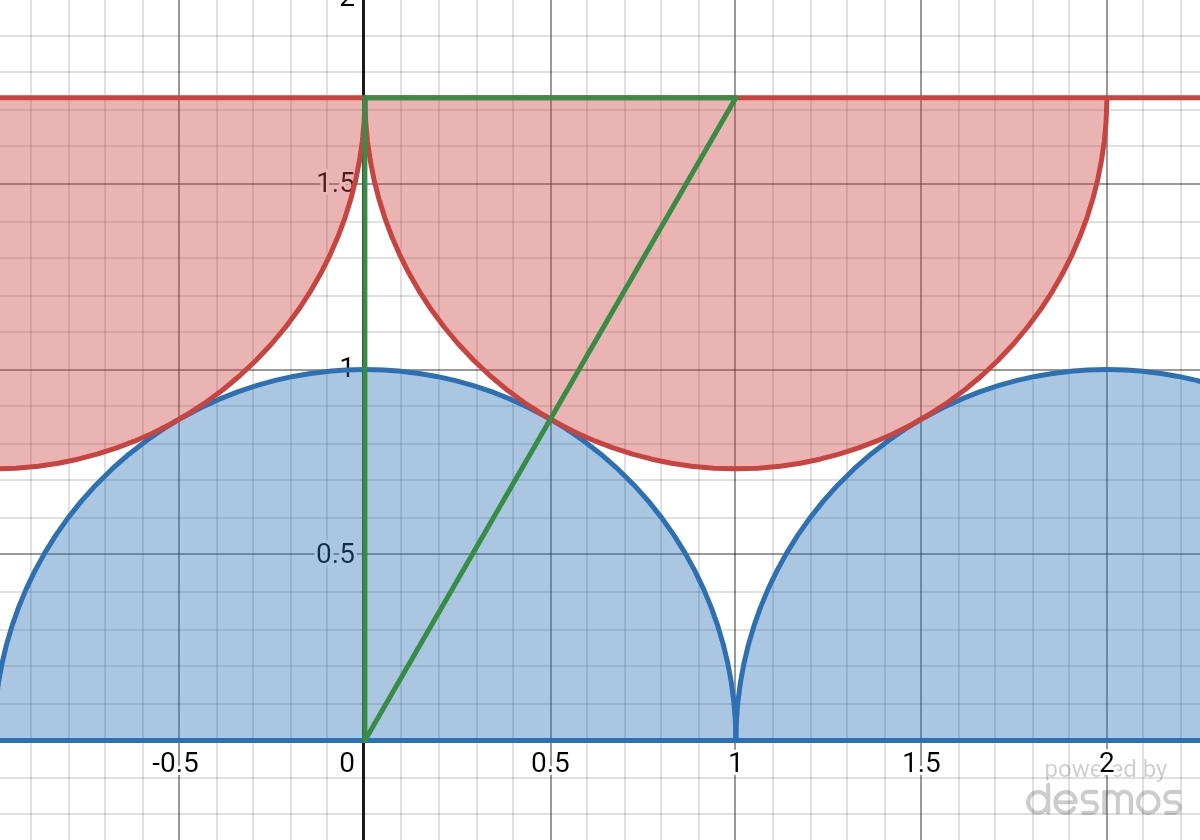
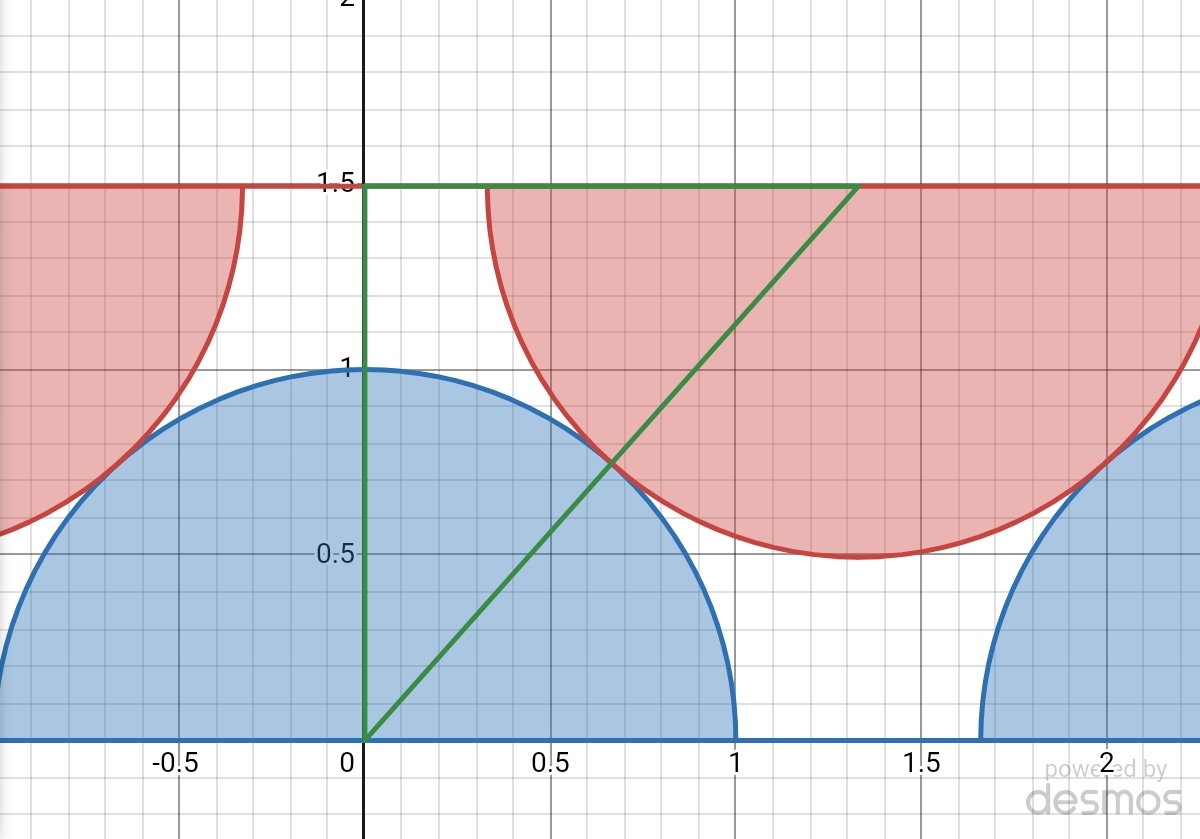
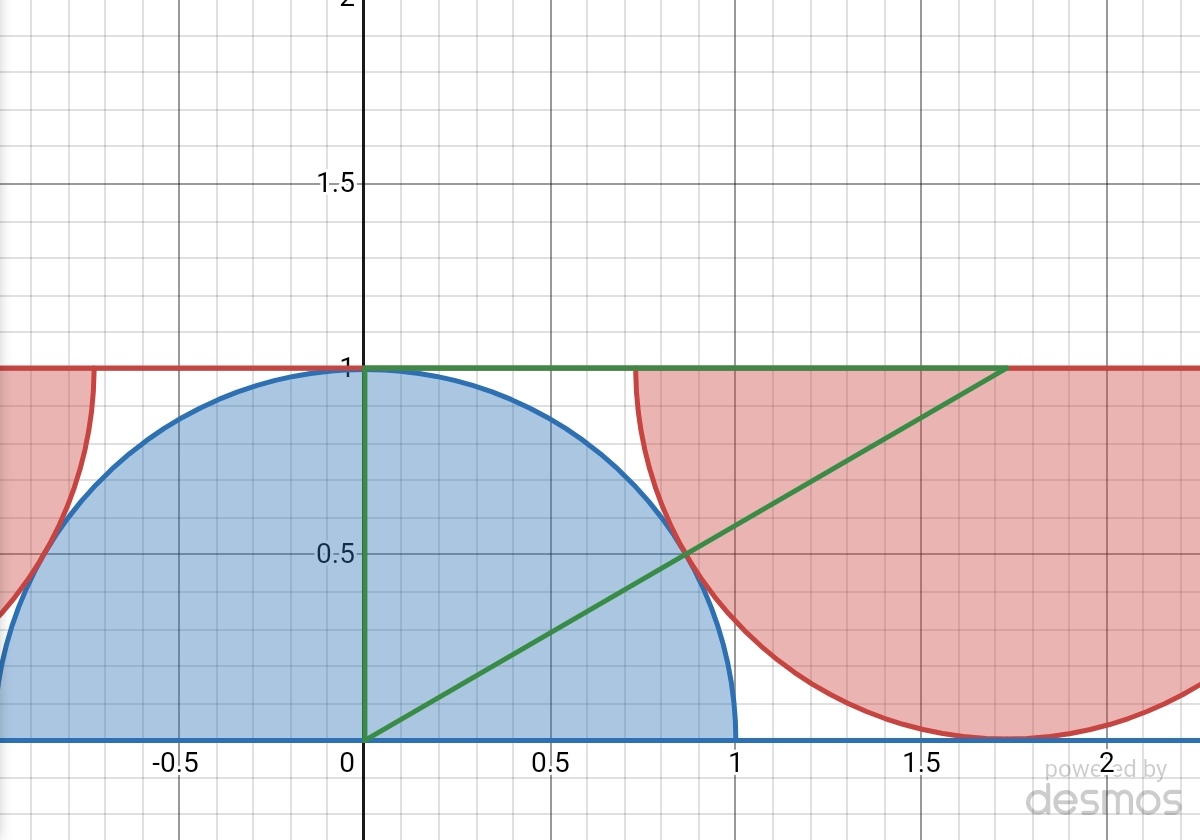
Construct (in the cross section of the 2 sheets) a triangle. 1 side is horizontal, 1 side vertical, and 1 side connects the centres of 2 neighboring ridges-semicircles.
The horizontal side is L/2. The hypotenuse is exactly 2. Therefore the vertical side is √(4 – L2/4). Let’s call that h for height.
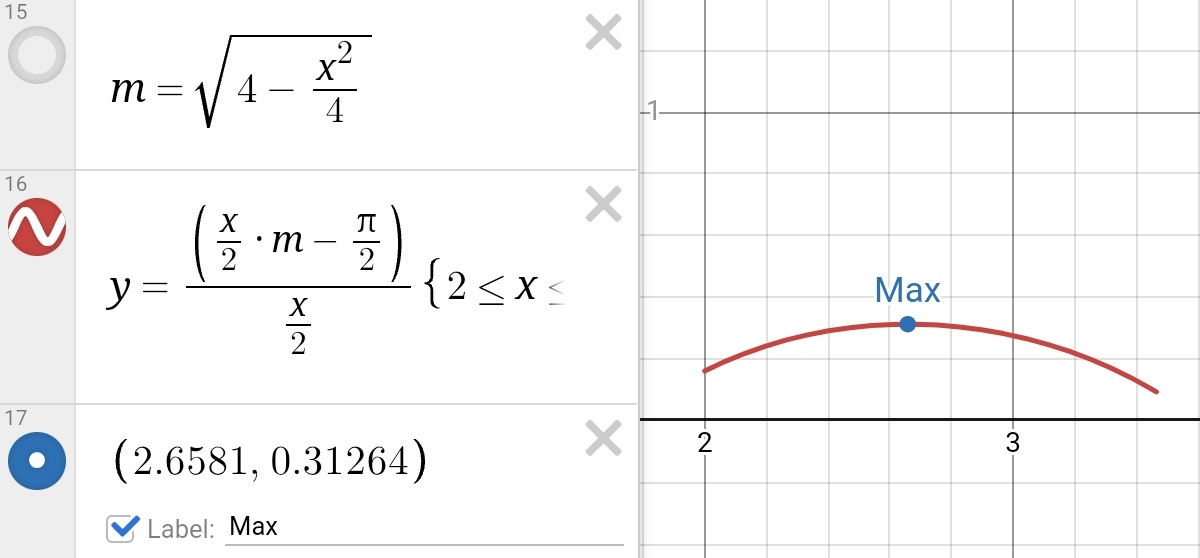
Looking at a rectangle containing 2 of these triangles, its area (again, a cross section of the real 3d situation) is hL/2. Some of this area is taken up by circle parts; exactly π/2. The rest is empty: hL/2 – π/2. We want to normalize this, to correspond to a unit step in the horizontal direction. This gives (hL/2 – π/2)/(L/2). This function has a maximum for about L = 2.6581.
And for extra credit:
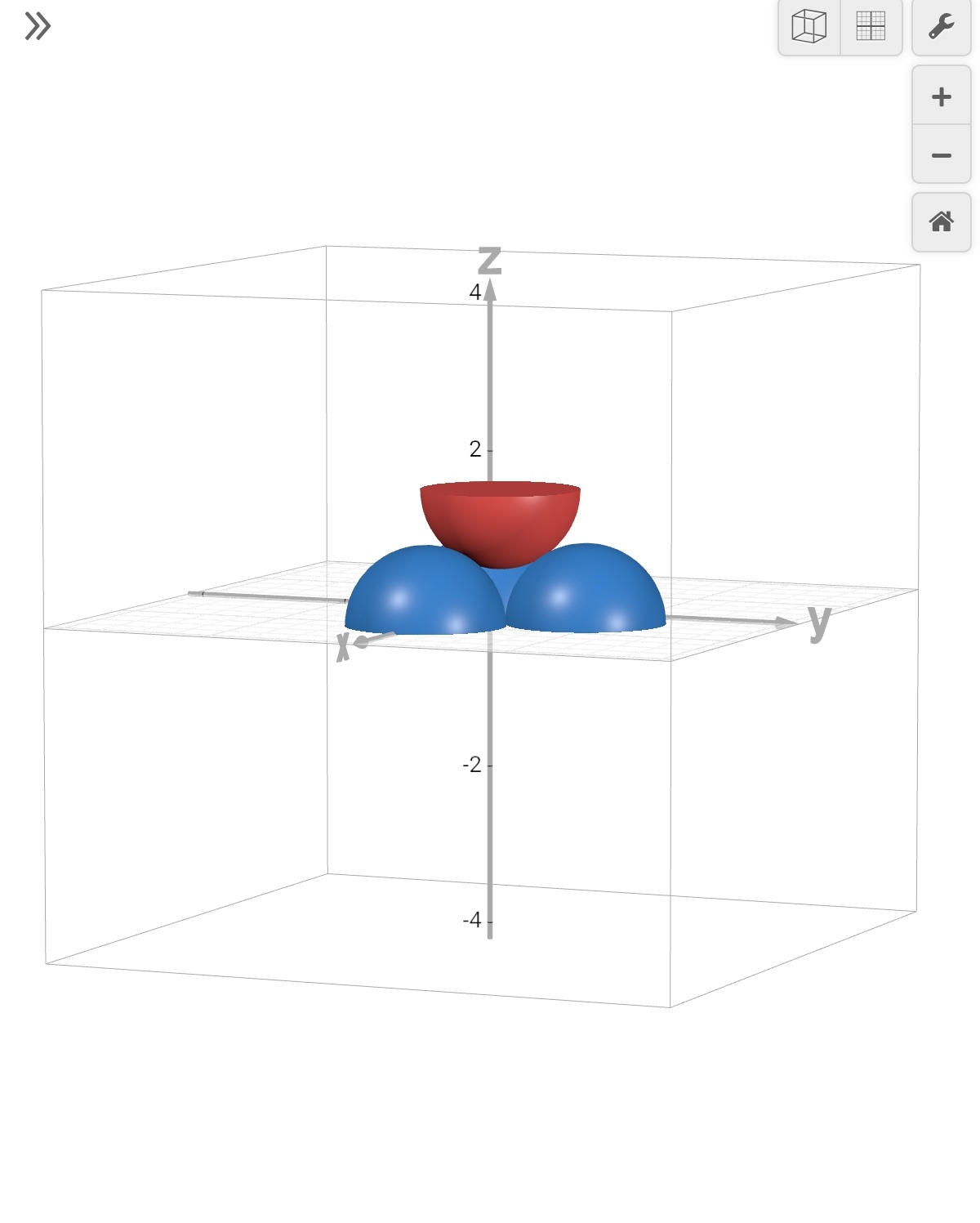
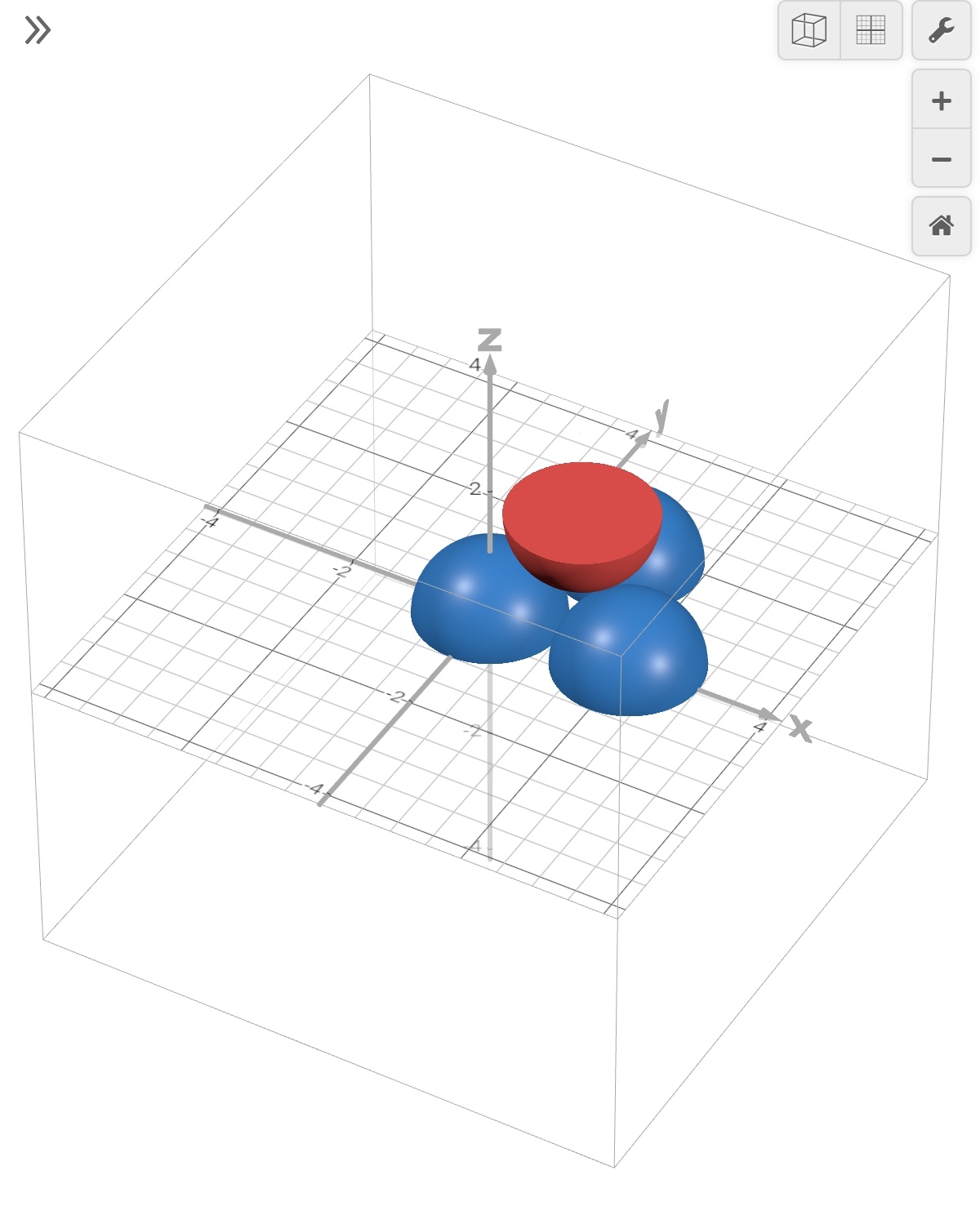
Option a: This is the same solution as the optimal stacking of balls. In my figures there’s a triangle between the centres of the 3 blue hemispheres. The base of the triangle is 2, and the height is √3. Adding the centre of the red hemisphere, we get a tetrahedron. This has height 2√2/√3.
Looking at the volume with the 2 green triangles as the base, we have a complete red hemisphere (the bits chopped off have friends included elsewhere) and a complete blue hemisphere (2 x 1/3 and 2 x 1/6). The space taken up is π4/3, appr. 4.19. The complete space is 2*√3*2*√2/√3 = 4*√2, appr. 5.66. The empty space is appr. 1.45. The base of the volume is 2*√3, appr. 3.46. The empty volume pr. unit area is 1.45/3.46, appr. 0.42.
Option b: Let L be the distance between 2 centres of hemispheres on a sheet. Vary L and find a minimum. Oh! That minimum occurs when L = 2, so we get the same solution, appr. 0.42.
Option c: Defies the my imagination.
 Stuff from ommadawn.dk (Lise Andreasen)