This week the question is: Can You Squeeze the Particles Into the Box?
You have three particles inside a unit square that all repel one another. The energy between each pair of particles is 1/r, where r is the distance between them. To be clear, the particles can be anywhere inside the square or on its perimeter. The total energy of the system is the sum of the three pairwise energies among the particles.
What is the minimum energy of this system, and what arrangement of the particles produces it?
And for extra credit:
Instead of three particles, now you have nine. Again, the energy between each pair of particles is 1/r, where r is the distance between them. The total energy is the sum of the 36 pairwise energies among the particles.
What is the minimum energy of this system, and what arrangement of the particles produces it?
Highlight to reveal (possibly incorrect) solution:
This week I felt like combining some Monte Carlo programming with some guessing.
With 3 particles, the program suggests a solution where each particle is in a different corner. The energy of this configuration is about 2.71.
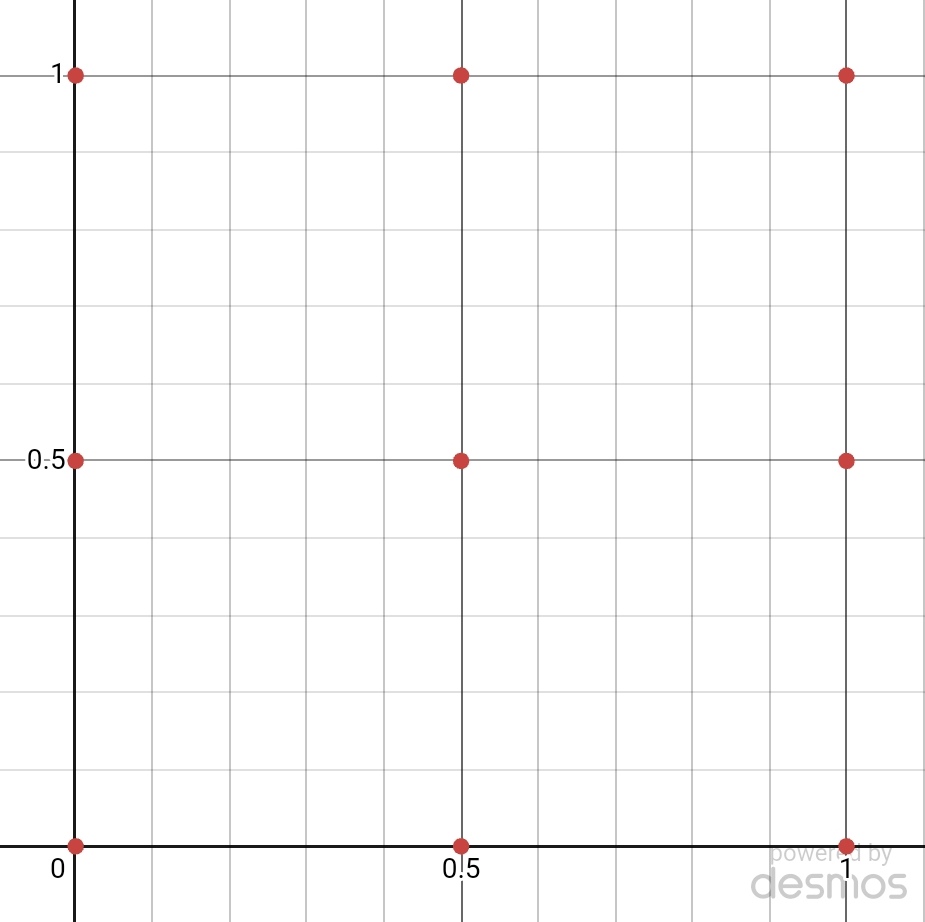
With 9 particles it’s a bit harder to be sure, but I’m going for a solution where there’s a particle for every x, y in {0, 0.5, 1}. The energy of this solution is about 50.
 Stuff from ommadawn.dk (Lise Andreasen)