This week the question is: What’s the Area of a “Pseudo-Square”?
Here’s an image:

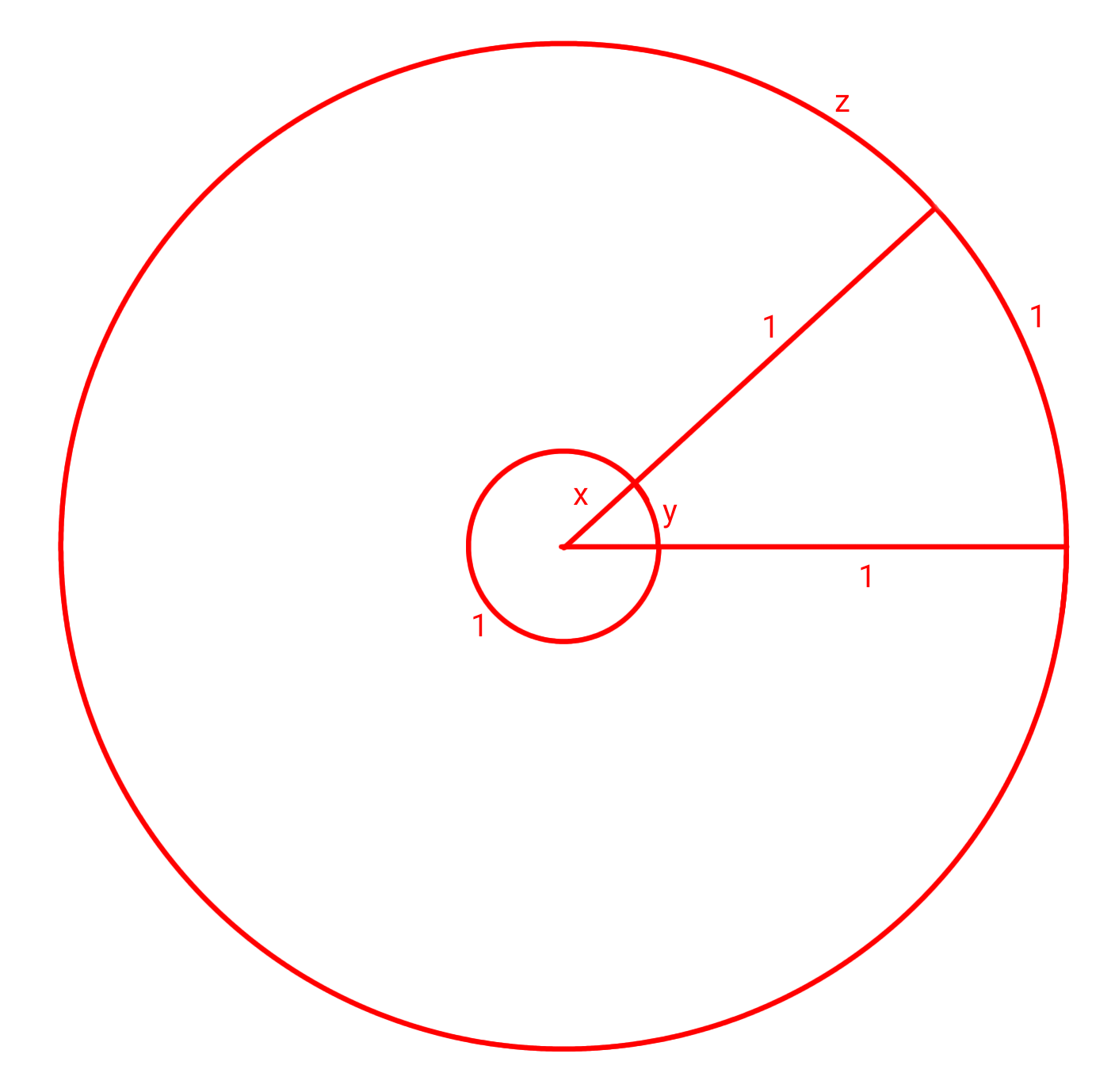
Sure enough, the shape (or one very much like it) has four “sides” of equal length, with four right angles. However, two of these sides are curved (in particular, they are arcs of circles), and two of the right angles are exterior, meaning the interior angles measure 270 degrees (rather than the usual 90 degrees).
Let’s call shapes like this one “pseudo-squares.” A pseudo-square has the following properties:
- It is a simple, closed curve.
- It has four sides, all the same length.
- Each side is either a straight line segment or the arc of a circle.
- The four sides are joined at four corners, with each corner having an internal angle of 90 degrees or 270 degrees.
The pseudo-square pictured above has two straight sides, which run radially between arcs of two concentric circles.
Assuming this is a unit pseudo-square (i.e., each side has length 1), what is its area?

Highlight to reveal (possibly incorrect) solution:
I’ve built a larger diagram with 2 circles and 3 variables.
- The radius of the small circle is x.
- The circumference of the small circle is 1 + y.
- The radius of the large circle is 1 + x.
- The circumference of the large circle is 1 + z.
- The 2 straight lines in the original drawing lie on top of radii of the large circle.
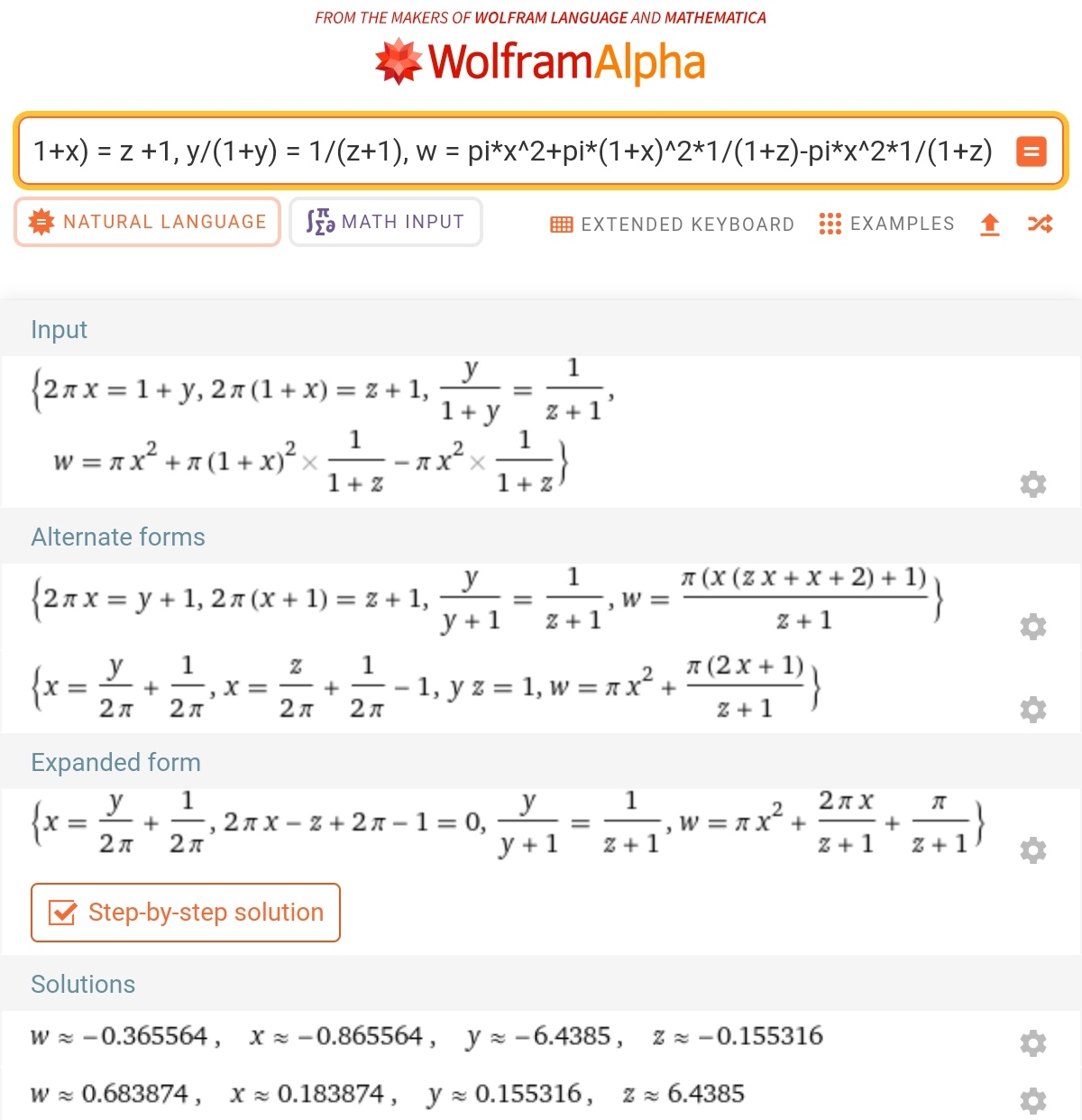
- Circumference of small circle: 2πx = 1 + y.
- Circumference of large circle: 2π(1+x) = 1 + z.
- Ratio between circumference and smaller arc: y / (1+y) = 1 / (1+z).
- This is a system of 3 equations with 3 unknowns. Calculations tell me, that x = (1-π+√(1+π2))/2π (about 0.184), y = √(1+π2) – π (about 0.155), z = π + √(1+π2) (about 6.439).
- The requested area is small circle + large circle sector – small circle sector. (Avoiding double counting.)
- Small circle area: πx2.
- Large circle sector: π(1+x)2 * 1/(1+z).
- Small circle sector: πx2 * 1/(1+z).
- Further calculations find this area is about 0.684.
 Stuff from ommadawn.dk (Lise Andreasen)