This week the question is: Will You Top the Leaderboard?
You’re doing a 30-minute workout on your stationary bike. There’s a live leaderboard that tracks your progress, along with the progress of everyone else who is currently riding, measured in units of energy called kilojoules. (For reference, one kilojoule is 1000 Watt-seconds.) Once someone completes their ride, they are removed from the leaderboard.
Suppose many riders are doing the 30-minute workout right now, and that they all begin at random times, with many starting before you and many starting after. Further suppose that they are burning kilojoules at different constant rates (i.e., everyone is riding at constant power) that are uniformly distributed between 0 and 200 Watts.
Halfway through (i.e., 15 minutes into) your workout, you notice that you’re exactly halfway up the leaderboard. How far up the leaderboard can you expect to be as you’re finishing your workout?
As an added bonus problem (though not quite Extra Credit), what’s the highest up the leaderboard you could expect to be 15 minutes into your workout?
And for extra credit:
Again, suppose there are many riders starting their 30-minute workouts at random times, and that their powers are uniformly distributed between 0 and 200 Watts. Now, suppose you decide that you too will be pedaling with a random (but constant) power between 0 and 200 Watts.
If you look down at the leaderboard at a random time during this random workout, how far up the leaderboard can you expect to be, on average?

Highlight to reveal (possibly incorrect) solution:
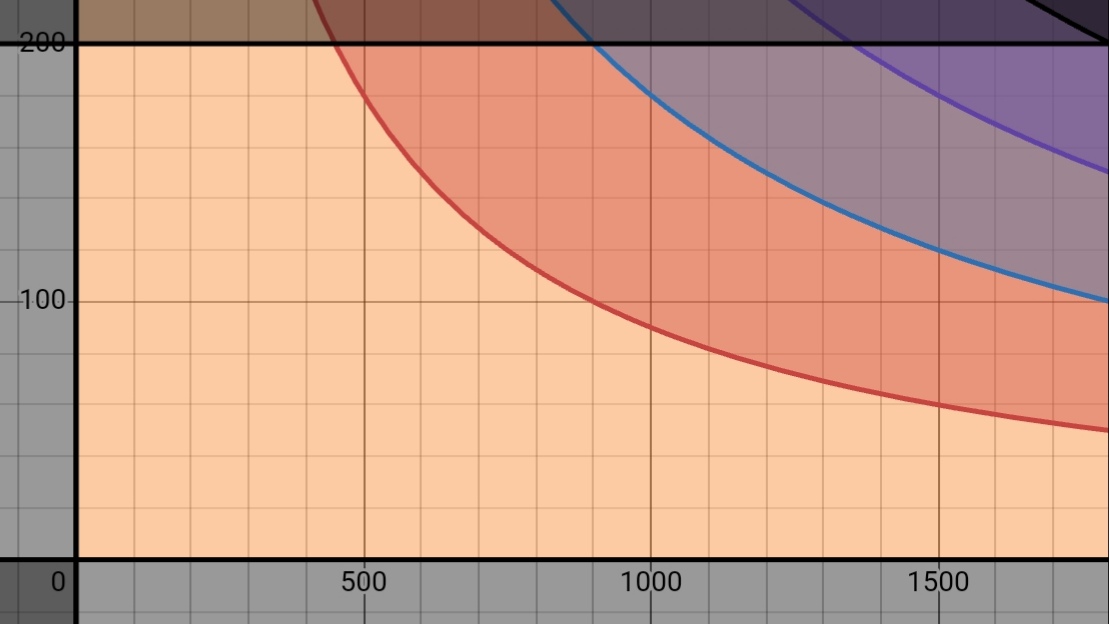
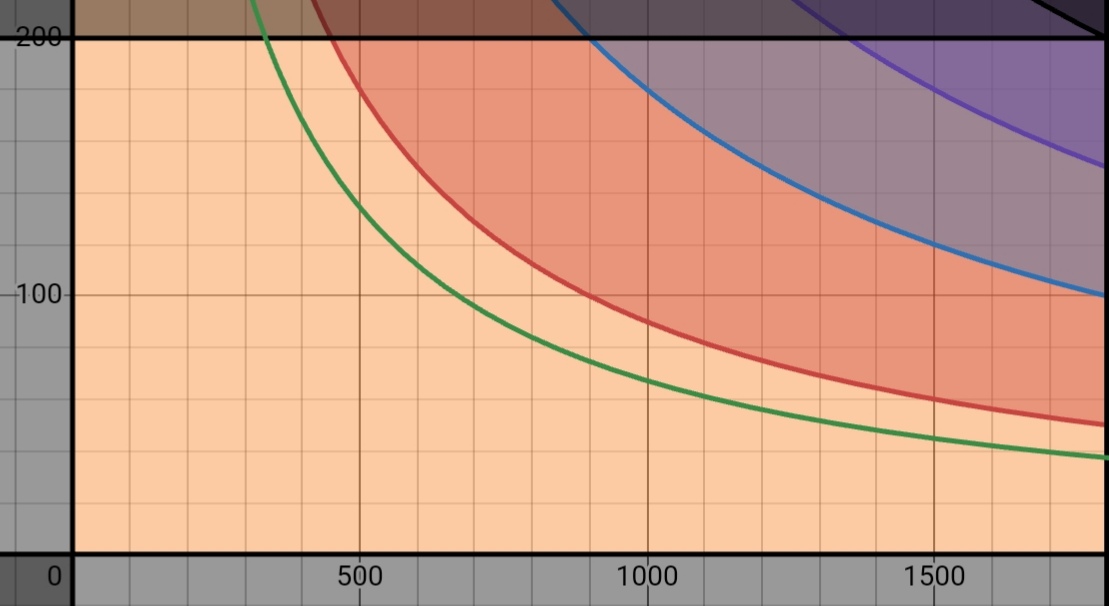
Plot 1 and 2. Calculations. Program.
How high up you are on the leaderboard is determined by how many kJ you spent, which is in turn determined by how much time you spent and how hard you’re pedaling (power). Time: somewhere between 0 and 30 minutes. Power: somewhere between 0 and 200 W. Furthermore you look at the leaderboard at your personal time of 15 minutes.
Let’s simplify to Energy = Time * Power. E = T * P. Both T and P are evenly distributed. E can be somewhere between 0 kJ and 30 minutes * 200 W = 30 * 60 seconds * 200 W = 360000 Ws = 360 kWs = 360 kJ.
Trying to plot some sections of values for E, we see that a lot of space is taken up by the less than 100 kJ points. (The sections have borders corresponding to 90, 180 and 270 kJ.) While T and P are evenly distributed, E isn’t.
So, what we’re looking for here is some curve, f(x,y) = T * P = C, a constant, so that the area below the curve is half of the available rectangle. All those points below (or to the left of) this curve are the many, many people below you on the leaderboard. Because of the time or power they’ve spent, or maybe both, they’re behind you. The guy with 1 Watt is probably behind you the whole time. The gal beginning 1 minute ago is probably behind you too. They’re both in the lower left corner of the plot.
Some calculations reveal, that C = 67.2 kJ. A new plot sort of confirms this. A program also hits in this neighborhood. ETA: This uses the equation for the area C * (1 + log(360k/C) = E. In this case, C * (1 + log(360k/C) = 180 kJ, half the available area.
In other words, your energy use at 15 minutes is 67.2 kJ. This corresponds to 74.7 W. At the end of the 30 minutes, you will hit double this energy use, 134.4 kJ. Now we do the calculation the other way, T * P = 134.4 kJ. What is the area below this curve? ETA: 134.4k * (1 + log(360k/134.4k) = E = 266.8 kJ. Out of an area of 360 kJ in all, that’s 74.1%. So you can expect to rise above 74% of your competitors, just before you drop out of the leaderboard.
So, I’m not doing any more of this fiddler. I’m not in love with probabilities.
Bonus question:
The highest you can be on the leaderboard implies, that you are going full power, 200 W, ending up with 360 kJ. At 15 minutes you would be at 180 kJ. Again using the equation 180k * (1 + log(360k/180k) = E = 304.8 kJ. Out of the available area of 360 kJ, that means you are above 84.7% of the board.
And for extra credit:
We want the average value of E, because that’s the E you have at a random time. This requires calculating the “volume” of the figure in the coordinate system with axis T, P and E, and then dividing by the area, 360 kJ. A quick integral gives the volume as (1/2 * 360k)2. This gives an average E of (1/2)2 * 360k. = 90k. What is the area below E = 90 kJ? 90k * (1 + log(360k/90k) = 214.8 kJ. Out of an area of 360 kJ, that’s 59.7%. You will be above 59.7% of the competition.
And I am not too sure about those extra bits. ETA: My program says something else. Sigh.
 Stuff from ommadawn.dk (Lise Andreasen)