(Related to #ThisWeeksFiddler.) 9 years ago the question was: How Long Before You Can Use Your 2015 Calendar Again?
Calendars are as predictable as the march of time itself — the major thing that changes is the day of the week a date is on. Jan. 1 was a Thursday in 2015, for example, but in 2016 it will be a Friday, requiring a one-day shift and making 2015’s calendar pretty useless.
Calendars’ predictability makes them ripe for mathy questions. Here are six to chew on:
- How many different calendars would you need to represent all possible years — accounting for all day and date combinations? (Don’t forget about leap years!)
- Now that we have all the calendars we could possibly need, it’d be nice to know how often we’re using them. When is the next time we’ll use the 2015 calendar?
- What is the smallest total number of years that will pass between using the same non-leap-year calendar twice?
- What is the largest?
- What is the smallest total number of years that will pass between using a leap year calendar twice?
- What is the largest?

Highlight to reveal solution, that I swear I didn’t look up, before writing my own: [Argh! Got 3-6 wrong.]
- The first day of the year has 7 different options. Also, the year can be a leap year or not. 7*2 = 14 different calendars.
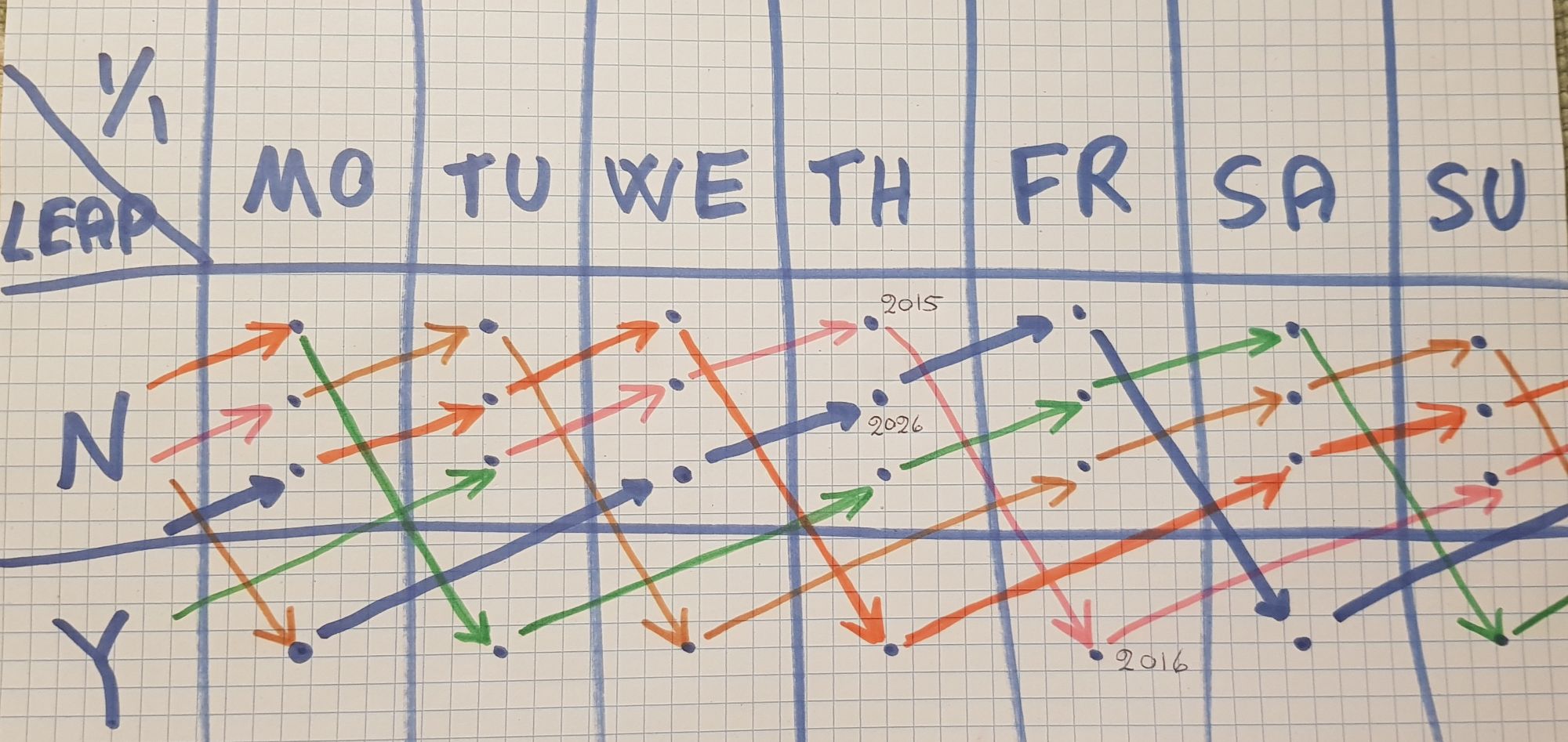
- Referring to my sheet, 2026.
- Every time I jump 1 year ahead (from 2015 to 2016, say), the first day of the year also jumps 1 ahead (from Thursday to Friday, say). The exception is a leap year, when the day jumps 2 ahead (from Friday to Sunday, say). Could a calendar be recycled 6 years later? Yes. (NL = non leap. LE = leap.) That could be a sequence of NL NL LE NL NL NL. 6 years, but the day jumps 7 ahead, and we’re back to the same day of the week. Could we do it with 5 years? Yes, that’s a sequence of LE NL NL NL LE. Could we do it with 4 years? No. It’s not possible to cram 3 leap years into a total of 4 years. So, 5 years.
- Is it possible to go around the sheet 2 or 3 times, sort of missing the critical calendar at least once? Actually it’s easy to find an example. Going from 2015 to 2026 is 1 miss and 11 years. NL LE NL NL NL LE NL NL NL LE NL. Any longer? No. There are only 4 options for the beginning of this sequence (whether the first LE is the 1st, 2nd, 3rd or 4th year in the sequence), and we’ve found the only one with a miss. So, 11 years.
- In order to come back to a leap year, we have to travel a whole cycle through the sheet. This takes 28 years.
- Same, 28 years.
 Stuff from ommadawn.dk (Lise Andreasen)