This week the question is: Round, Round, Get a Round, I Get a Round
Suppose you have two real numbers, like 3.14 and 2.718. If you round these two numbers and add these rounded values together, you get 3 + 3, or 6. Alternatively, if you add the original two numbers and then round the sum, you still get 6.
But rounding then adding doesn’t always give you the same result as adding then rounding. For example, if the two numbers are 2.4 and 3.4, rounding then adding gives you 5 (i.e., 2 + 3), whereas adding then rounding gives you 6 (i.e., 2.4 + 3.4 = 5.8, which rounds to 6).
How likely is it that rounding then adding gives you the same result as adding then rounding?
To be more precise, suppose you randomly, uniformly, and independently pick two real numbers between 0 and 1. What is the probability that rounding the two numbers and then adding gives you the same result as adding the two numbers and then rounding?
And for extra credit:
Instead of picking two numbers from the interval between 0 and 1, suppose you randomly and independently pick N numbers.
What is the probability that rounding each of the N numbers and then adding gives you the same result as rounding the sum of the N numbers?

Highlight to reveal solution:
WolframAlpha sheet. Integration sheet.
My first stab at this was to ask WolframAlpha. After a bit of fiddling (!) (the rounding function didn’t work as I expected), I got some nice areas.
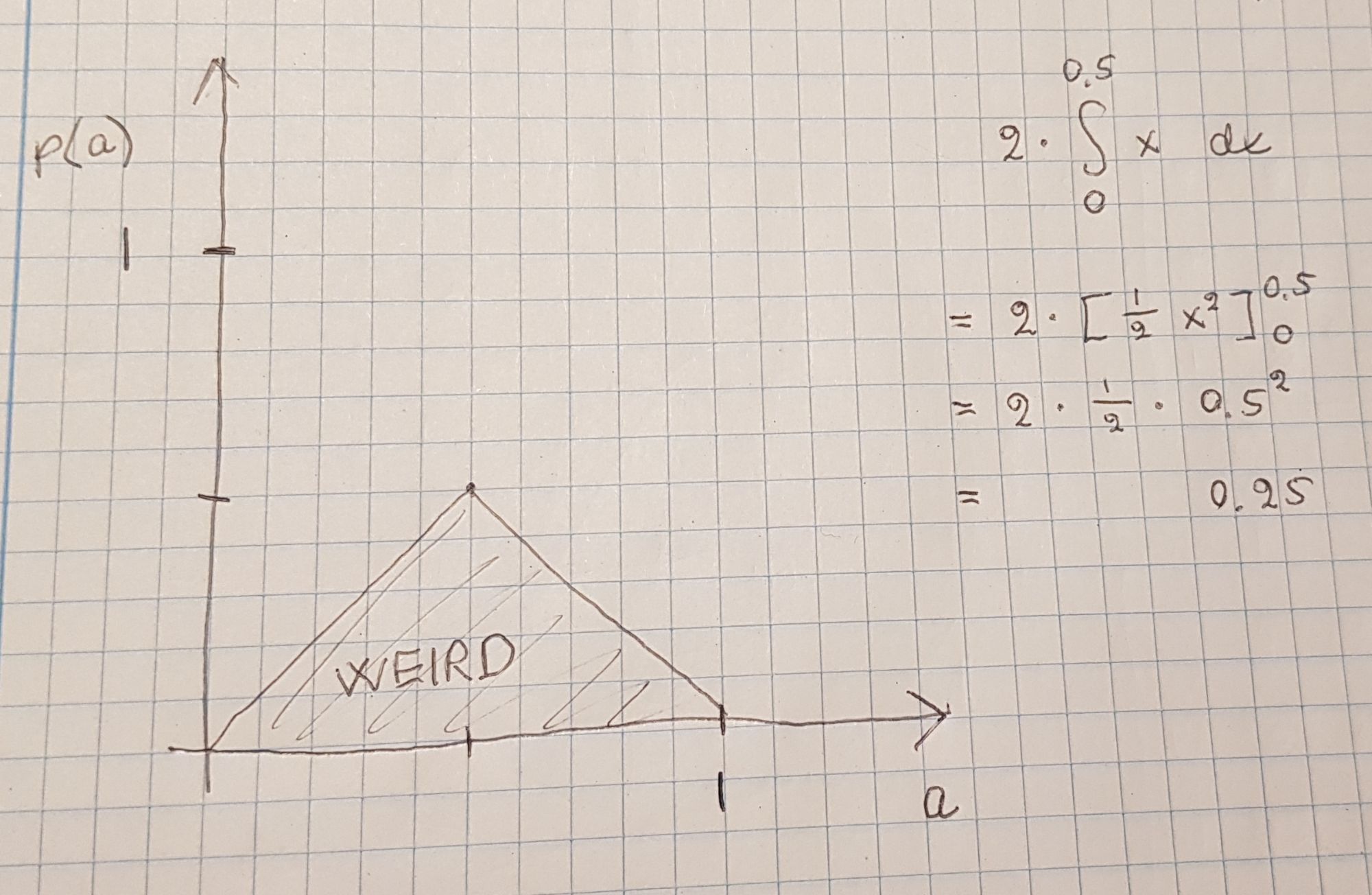
Then I tried looking at it differently. Let’s say I already picked the first number, a. WLOG, let’s say a < 0.5. In order to get the weird situation, we need a < 0.5 (r), b < 0.5 (s), a+b > 0.5 (t). Because then a and b will both be rounded down to 0, but a+b will be rounded up to 1. So, for b we already have b < 0.5 (s). If b < 0.5 – a (not t), then we’re out. So 0.5 – a < b. So 0.5 – a < b < 0.5. This interval is a wide. So, for any a, the probability to pick a weird b is a.
I’m not quite sure about the next step. But I think I need to calculate the integral ∫00.5 x dx. And then multiply by 2, because I only looked at the left half of the system. This yields the same result as the first method, 0.25. So the non-weird situation has probability 0.75.
And for extra credit:
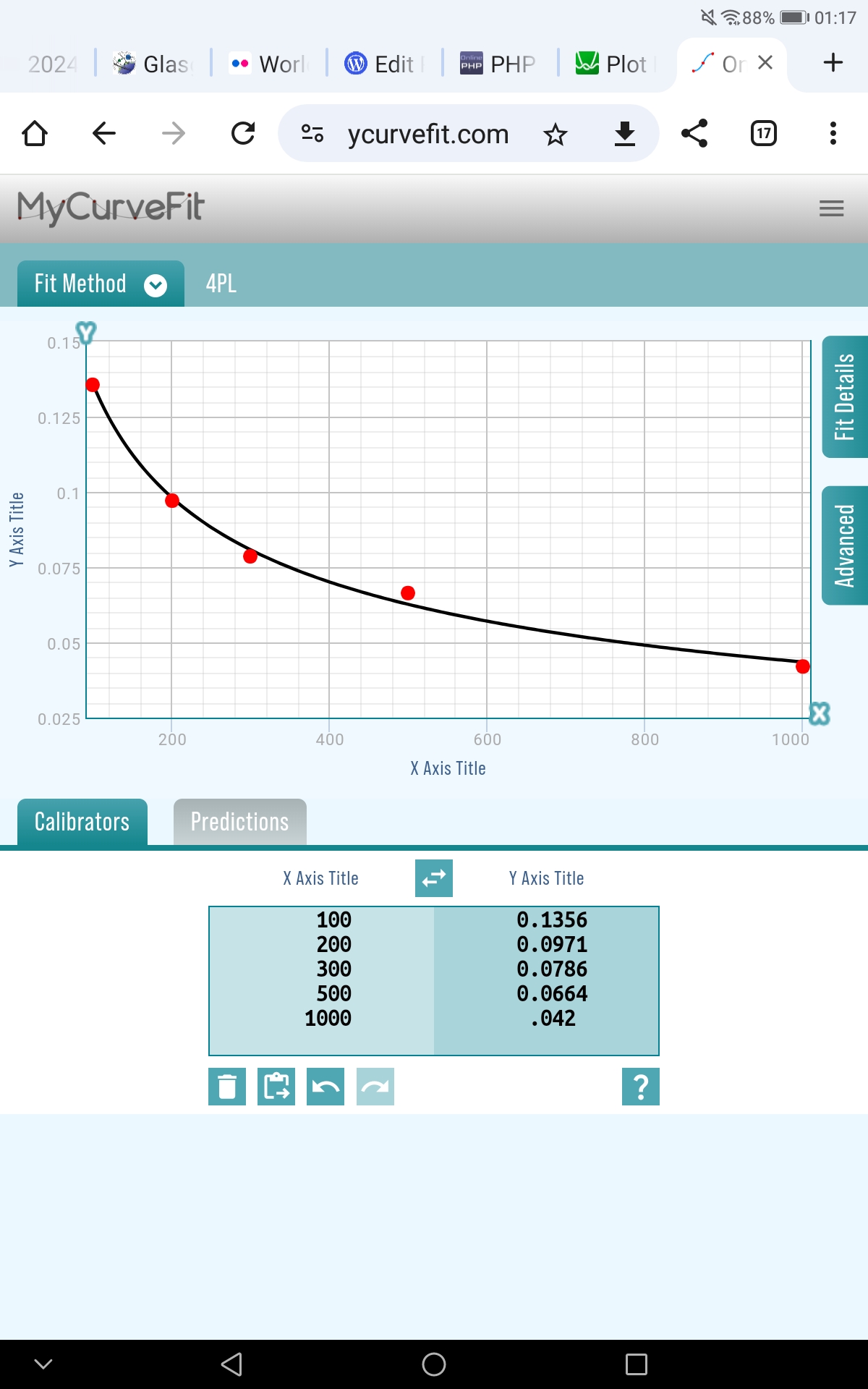
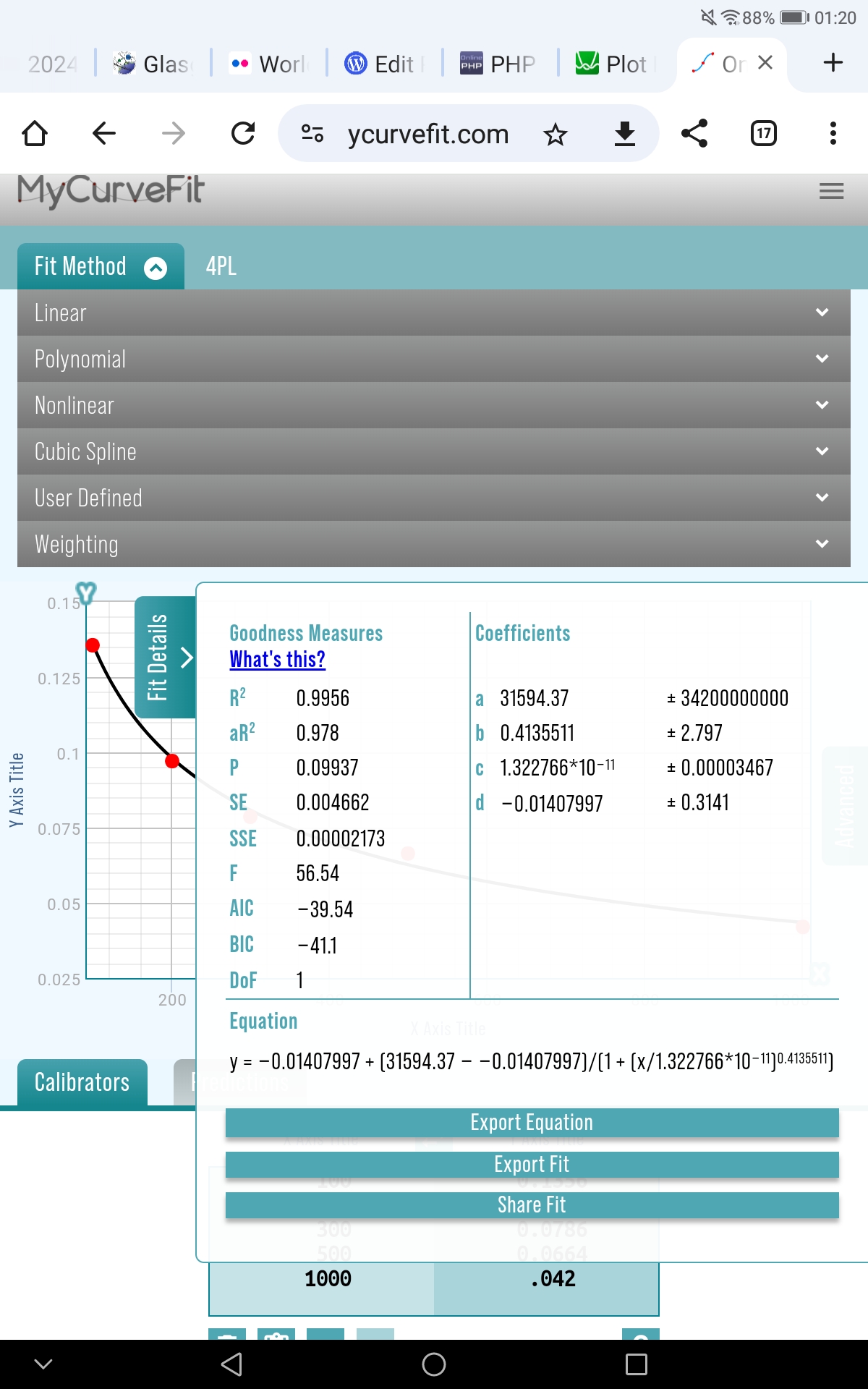
My program says: Add extra numbers, and the probability goes down. I reached 0.01, and it was still going down. So. Time to find some points and try to plot a curve. The bewildering result is something like a/(b+(N/c)^0.41). Anyway. N goes up, p goes down.
 Stuff from ommadawn.dk (Lise Andreasen)