This week the question is: Can You Even the Odds?
Suppose you (player A) and a friend (player B) are playing a game in which you alternate rolling a die. So the order of play is AB|AB|AB, and so on. (The vertical bars here are just for organizational purposes, and do not signify anything special that happens.) The first player to roll a five wins the game. As it turns out, whoever goes first has a distinct advantage!
Kayla wondered about other ways you and your friend could take turns, ways that might result in a fairer game. For example, consider the “snake” method, in which the order is reversed after each time you both roll: AB|BA|AB|BA, and so on.
Assuming you are the first to roll, what is the probability you will win the game?
And for extra credit:
Another way to take turns is to use the Thue-Morse sequence, where the entire history of the order is reversed after each round. As an illustration, consider the first few rounds:
- Round 1: Player A goes first.
- Round 2: Only A went in the first round. So now player B goes.
- Round 3: Up to this point, the order has been AB. Reversing this, round 3’s order is BA.
- Round 4: Up to this point, the order has been ABBA. Reversing this, round 4’s order is BAAB.
- Round 5: Up to this point, the order has been ABBABAAB. Reversing this, round 5’s order is BAABABBA.
Writing this out as a single sequence of turns, the order is A|B|BA|BAAB|BAABABBA, and so on.Assuming you are the first to roll, what is the probability you will win the game?

Solution:
This type of problem has been studied before.
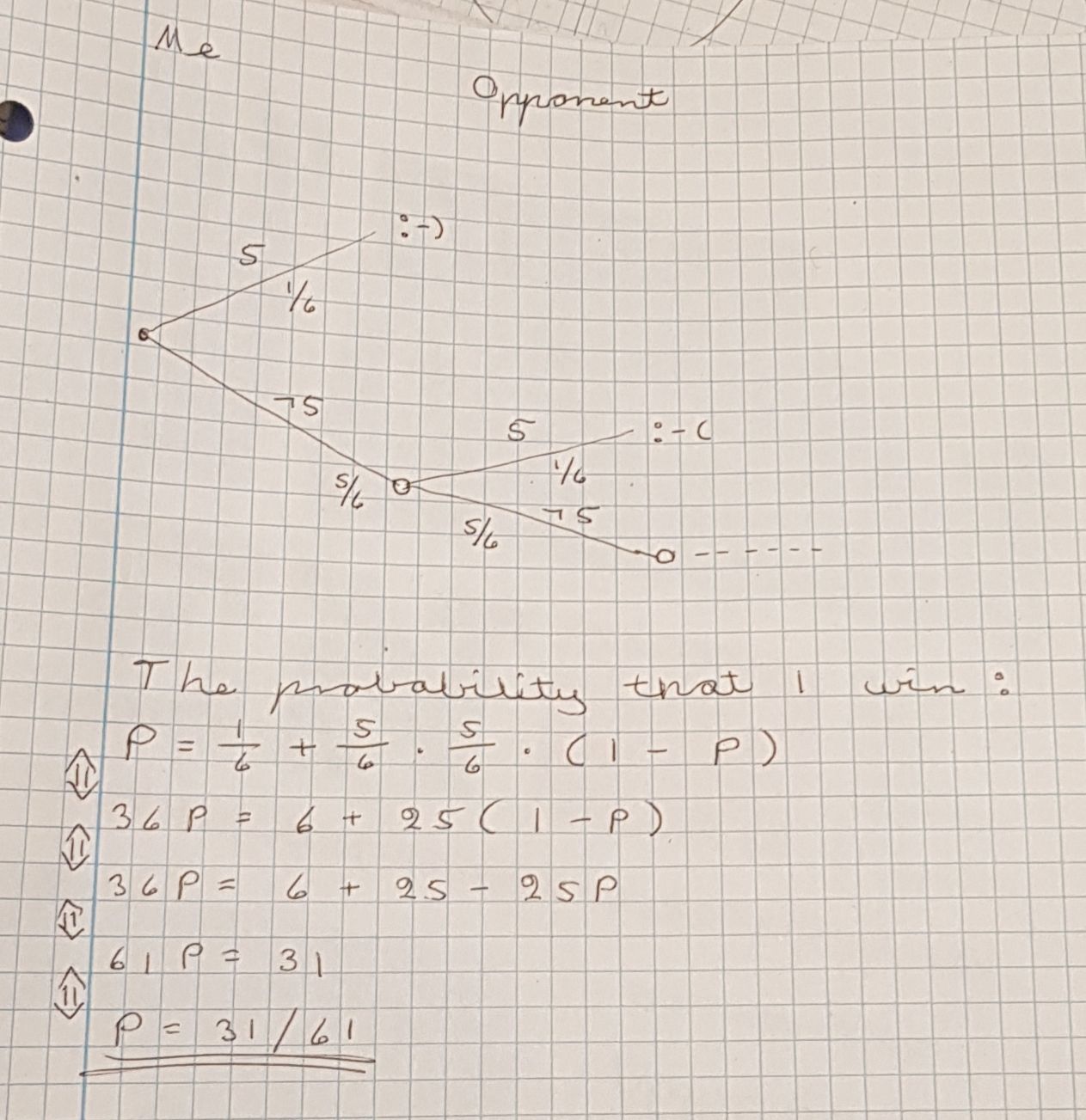
I think my calculation sheet says it all.
And for extra credit:
I tried to program my way out of this.
 Stuff from ommadawn.dk (Lise Andreasen)