This week the question is: Can You Find a Matching Pair of Socks (Again)?
I have five distinct pairs of socks in my drawer, none of which is actually paired up. The room is pitch black, so I can’t see the color of any sock I’m pulling out. I reach into my drawer and randomly pull out one of the 10 socks. Then I reach in again and pull out one of the remaining nine. I can keep pulling out one sock at a time, at random, until I decide to stop at some point.
My goal is to stop removing socks as soon as I have a matching pair among those I have drawn. How many socks should I draw to maximize the chances that the last sock I draw results in the first such pair?
And for extra credit:
Instead of five pairs of socks, I now have N pairs of socks, where N is a very large number. In terms of N, how many socks should I draw to maximize the chances that the last sock I draw results in the first pair?

Highlight to reveal solution:
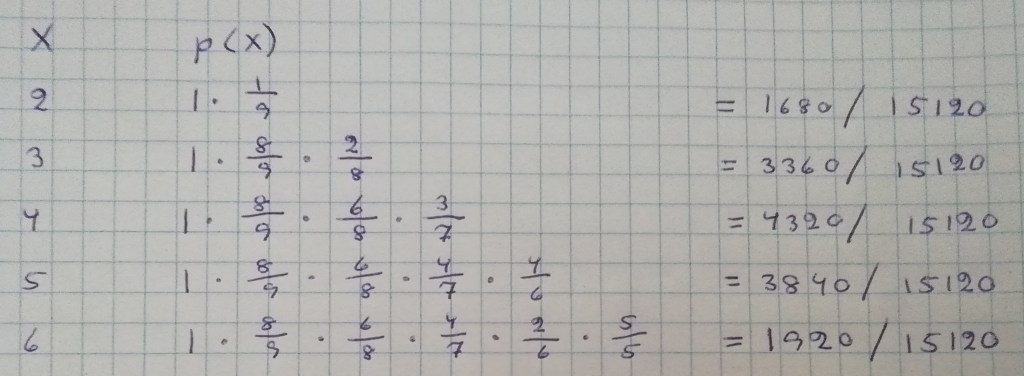
It’s a little hard for me to read this question. But I think it means: At which value x do I get the highest probability overall, that x-1 socks produced no pairs, but x did? Or: What is the maximum probability that sock x produced a pair, and at which x? It’s hard for me to turn my calculations back into words.
Anyway. I calculate the probability for each case. E.g., what is the probability I hit a pair at the 3rd sock? The 1st sock is just given. The 2nd sock does not produce a pair, so of the 9 possible socks, I picked one of the 8 with that property. The 3rd sock did produce a pair, so of the 8 socks left, I picked one of the (at this point) 2 lonely socks. The probability of this is 1 * 8/9 * 2/8. For all these calculations, check my sheet. Then I just have to look for the highest probability.
Anyway, the answer seems to be 4.
And for extra credit:
After a bit of trial and error, the pattern seems to be, that you should draw √N + 1 socks. There has to be some extra rule for rounding up or down.
 Stuff from ommadawn.dk (Lise Andreasen)