ETA: Mine eyes have been opened by Tom Keith.
This week the question is: Can You Win at Non-Traditional Blackjack?
You’re playing a modified version of blackjack, where the deck consists of exactly 10 cards numbered 1 through 10. Unlike traditional blackjack, in which the ace can count as 1 or 11, the 1 here always has a value of 1.
You shuffle the deck so the order of the cards is completely random, after which you draw one card at a time. You keep drawing until the sum of your drawn cards is at least 21. If the sum is exactly 21, you win! But if the sum is greater than 21, you “bust,” or lose.
What are your chances of winning, that is, of drawing a sum that is exactly 21?
And for extra credit:
You’re playing the same modified version of blackjack again, but this time, whenever there’s even the slightest chance you could bust on the next card, you quit the round and start over. On average, how many rounds should you expect to start until you finally win?
Highlight to reveal solution:
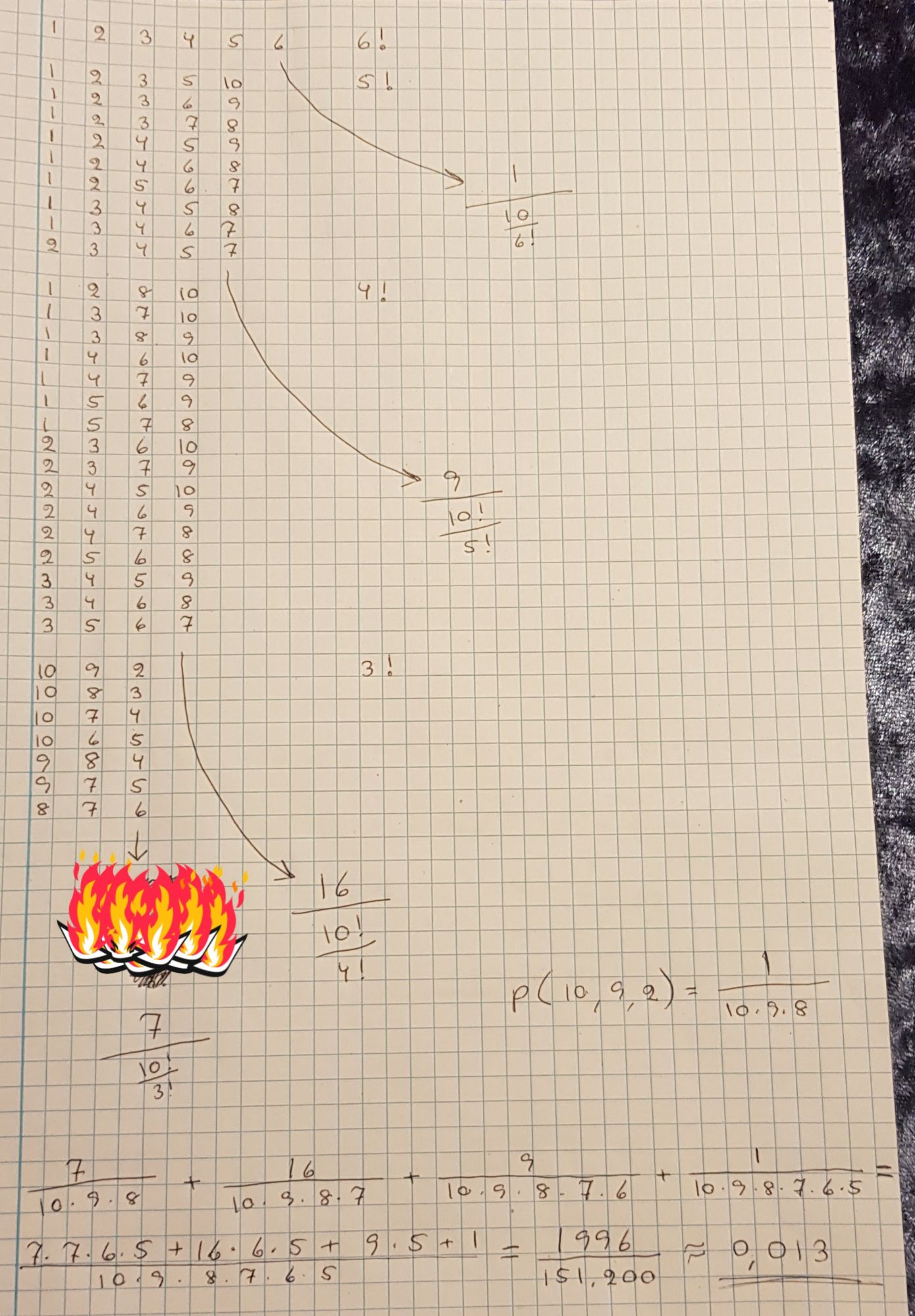
In short: I find all the possible card combinations, and add together their probabilities. One possible combination is 1+2+3+4+5+6. It’s the only possible one with 6 cards. So its probability is 1/(10*9*8*7*6*5). (I can draw these 6 cards in 10*9*8*7*6*5 different ways, depending on their order.) Another possible combination is 1+2+3+5+10. It turns out, there are 9 different combinations with 5 cards. Their combined probability is 9/(10*9*8*7*6*5). Notice that these 2 cases (5 cards and 6 cards) aren’t overlapping. Like, one of the 5 card combinations can’t be combined with 1 more card into a 6 card combination, because we already hit the right sum with 5 cards. So we can safely add these probabilities together. If I keep going in this way, the resulting probability is 1996/151200 or approximately 0.013. Assumption: that I listed all the possible combinations.
My program solution gets a wildly different result. Sigh.
And for extra credit:
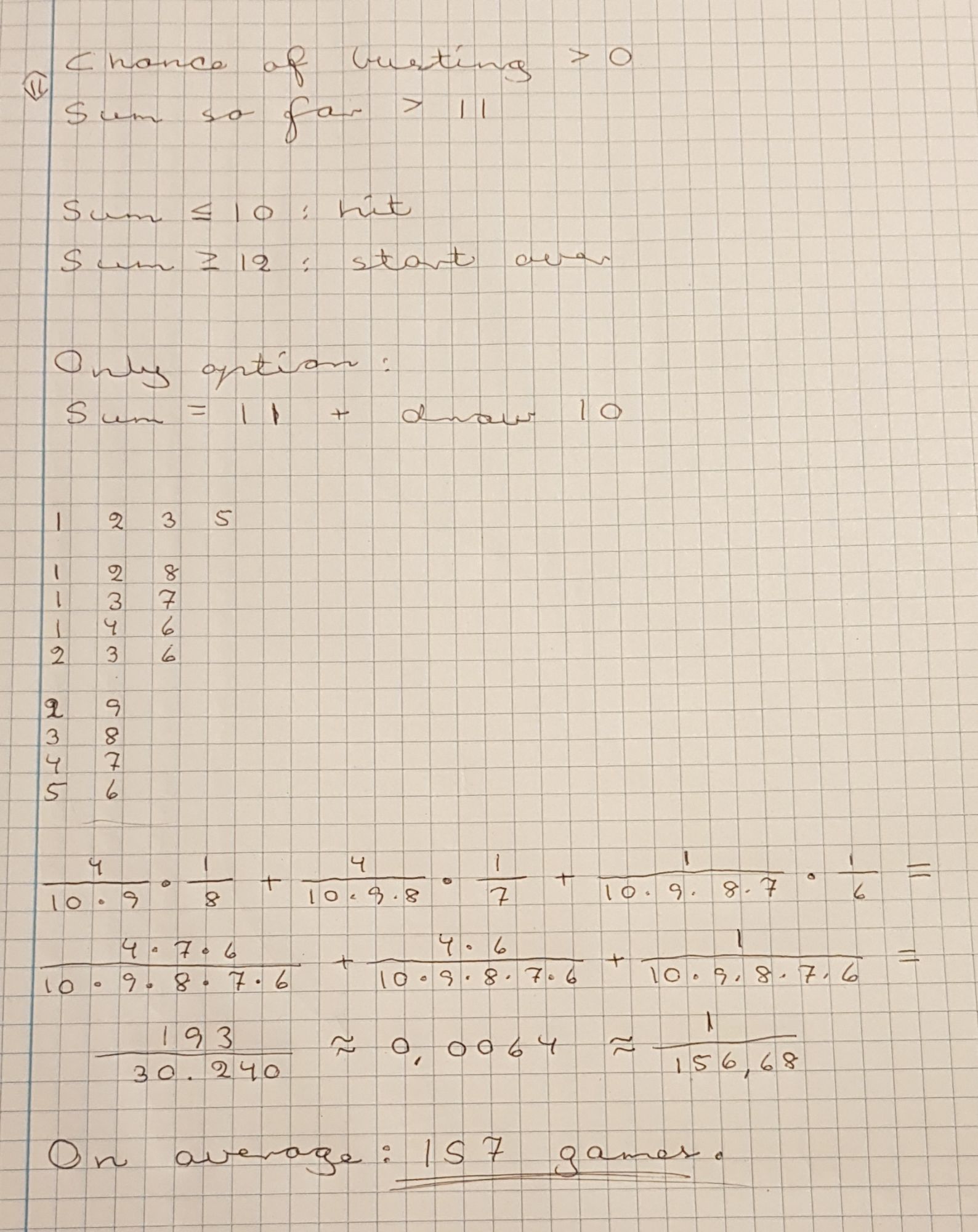
If there’s the slightest chance of busting, I start over. This translates to:
- The sum is 10 or less, and I can’t reach 21 with 1 more card, but I keep going.
- The sum is 11, and I can reach 21, if I draw a 10.
- The sum is 12 or more, and I stop.
Case 1 turns into either case 2 or 3, depending on the next card. My only chance of winning is case 2, drawing a 10. This case reduces to: What is my chance of getting the sum 11, and then drawing a 10? After some calculations, the result is 193/30240, or approximately 1/157. On average, I have to play 157 games to win.
And again, my program says otherwise. Hmf.
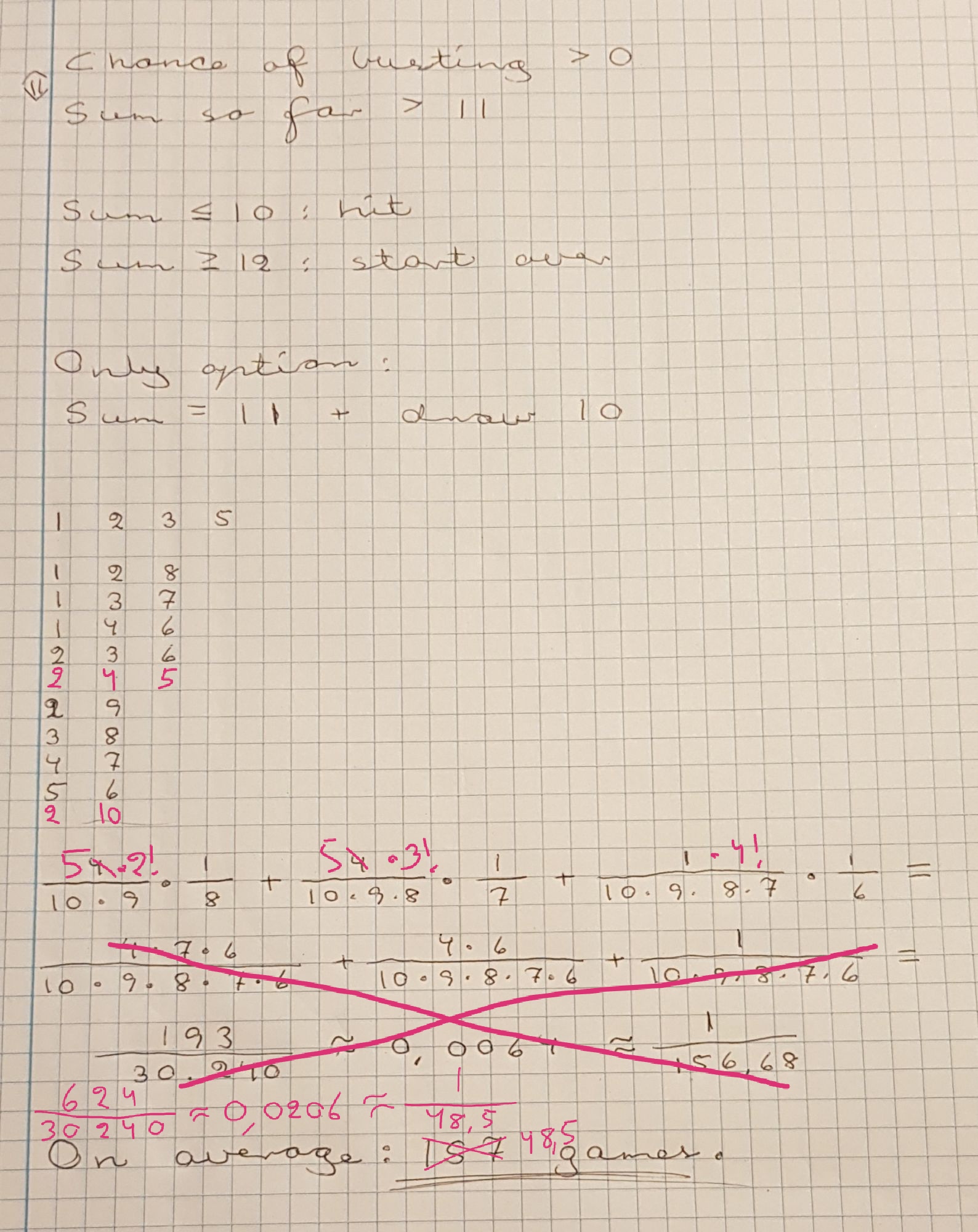
Addendum: In both puzzles I forgot that, e.g., the card combination (2,9) can also be (9,2), so I need to multiply by 2! in this case. Also in extra credit I forgot the valid combinations (before drawing the final card) (2,4,5) and (2,10), the latter followed by a 9. Sigh. Updated calculations for puzzle and extra credit .


 Stuff from ommadawn.dk (Lise Andreasen)