Solution below.
Reveal solution by highlighting:
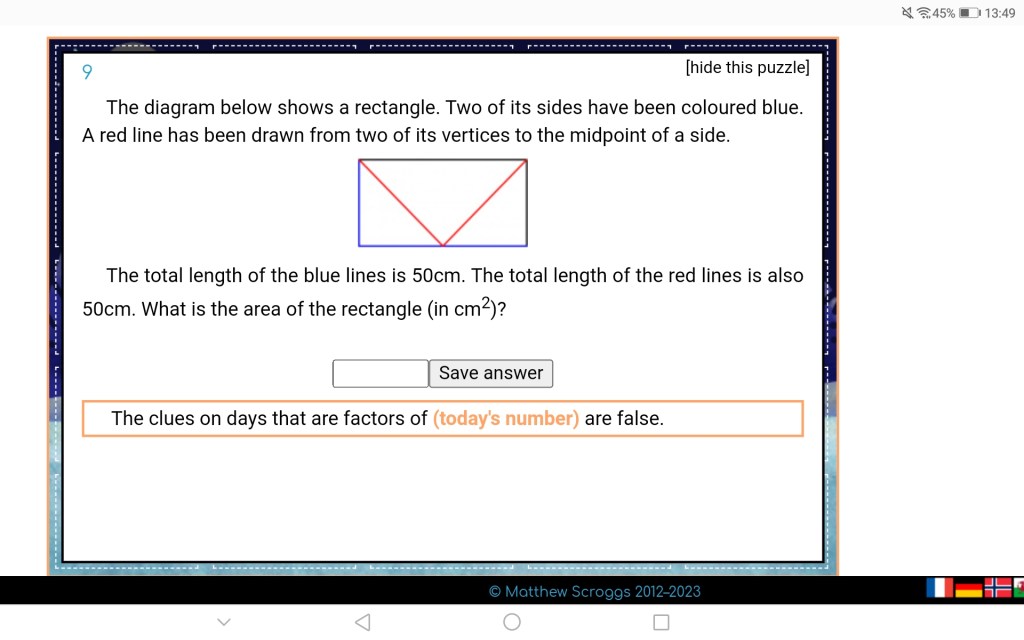
As the 2 red sides have been constructed in the same way, they are the same length: a. 2a = 50. Let the vertical blue line be b. The horizontal blue line will be 50-b, and half of that is 25-b/2.
Pythagoras (among others) tells us, b2+(25-b/2)2 = 252
<=> b2+252-25*b+b2/4 = 252
<=> (1+1/4)b2-25*b = 0
<=> b2-20*b = 0
<=> b(b-20) = 0
<=> b = 0 or b = 20. 0 won’t work, then we wouldn’t have a true rectangle with a positive area. So b = 20, a = 25. 50-b = 30. The area of the rectangle is b*(50-b) = 20*30 = 600.
 Stuff from ommadawn.dk (Lise Andreasen)